
In the 1840s, the Duchess of Bedford had a problem. Dinner in aristocratic households was served at eight in the evening. The gap since lunch left her, as she famously put it, with a “sinking feeling” — and she decided to fix it with a pot of tea, some bread and butter, and a few small cakes.
What began as a private solution to afternoon hunger became one of Britain’s most enduring social rituals. Within years, the practice had spread across London’s drawing rooms and hotel lounges. By the late Victorian era, it was no longer a private pleasure. It was a public institution — and it has never stopped being one.
How a Hungry Duchess Changed Britain Forever
Anna Russell, the seventh Duchess of Bedford, started inviting friends to join her for afternoon refreshment at Woburn Abbey in the early 1840s. Word spread. London society adopted the custom. Tearooms began to appear across the capital, catering first to women (who were otherwise excluded from many public spaces) and then to anyone with time to spare and a taste for something sweet.
The ritual grew particularly popular after Queen Victoria embraced it. By the 1880s, elaborate afternoon teas were social events: an opportunity to see and be seen, exchange news, and spend an agreeable hour away from the colder demands of the day.
London’s grand hotels formalised the tradition in the Edwardian era. The Ritz, which opened in 1906, introduced afternoon tea in the Palm Court and set the template that dozens of hotels would follow over the next century. The dress codes, the tiered stands, the specific order of eating — all of this crystallised into something close to ceremony.
What Actually Arrives at the Table
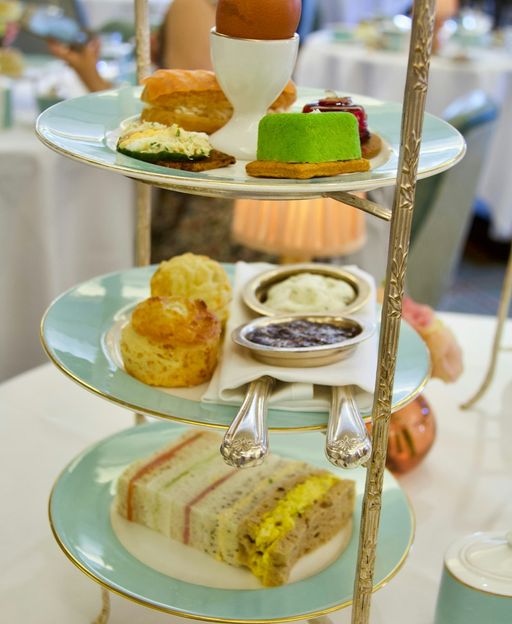
A proper afternoon tea comes on a three-tiered cake stand. Each tier has a role, and you work from the bottom upward.
The bottom tier holds finger sandwiches — usually four to six varieties. Expect cucumber with cream cheese, smoked salmon with cream cheese, egg mayonnaise, and roast beef with horseradish. These are sliced thin and crustless, eaten in two bites. They are the savoury opening act.
The middle tier belongs to the scones — warm, golden, slightly crumbly. They come with a pot of clotted cream and a pot of jam. The top tier carries the sweet pastries: miniature éclairs, fruit tarts, macarons, and whatever the kitchen is proud of that season. The tea arrives in its own pot, alongside a separate pot of hot water for refreshing it. You choose from a menu that may list a dozen varieties.
Build at least 90 minutes into your afternoon. A proper sitting is never rushed. If you are planning the rest of your day around it, our 3-day London itinerary shows you how to fit afternoon tea into a packed visit without losing any of the great sights.
The Great Scone Debate
Few questions provoke more polite disagreement in Britain than whether to put the cream or jam on first. The Cornish tradition says cream first, then jam. Devon insists on the reverse — jam first, then a generous spoonful of cream. Neither side has conceded, and neither is likely to.
What actually matters is this: the scones should be freshly baked, the cream genuinely clotted — thick, rich, and golden-crusted on top — and the jam high quality. Strawberry or raspberry are standard. A hotel that serves supermarket-quality jam is not to be trusted with your scone.
Enjoying this? 3,000+ London lovers get stories like this every week. Subscribe free →
Where to Have Afternoon Tea in London
London offers afternoon tea at every price point, from full ceremony at five-star hotels to relaxed versions at neighbourhood restaurants. These are the venues that matter.
Fortnum & Mason
The Piccadilly institution is the traditional gold standard. Pale blue china, the famous pale green livery, and a century of quiet ceremony. The Diamond Jubilee Tea Salon — named in honour of Queen Elizabeth II — is the principal setting. The sandwiches are impeccable, the scones arrive warm, and the atmosphere is one of London’s most particular pleasures. Book well in advance, especially for weekends.
The Ritz London
The Palm Court is probably the most photographed afternoon tea setting in the world. Chandeliers, elaborate floral arrangements, and the sound of a string quartet drifting through the room. Formal dress is required: jacket and tie for gentlemen, smart dress for ladies. Prices are at the top of the market. Worth experiencing at least once.
Claridge’s
The Foyer and Reading Room at Claridge’s offers afternoon tea inside one of London’s finest art deco interiors. The service is faultless, the food is excellent, and the atmosphere is precisely formal enough to feel like an occasion without being stifling. Popular with visitors and longtime London regulars alike.
Sketch
A contemporary choice in Mayfair. The Gallery dining room is all hot pink velvet chairs, white tablecloths, and David Shrigley artworks covering every wall. The afternoon tea is excellent; the setting makes it an event in itself. More relaxed in feeling than the grand hotels, and beloved by those who like a little edge with their Earl Grey.
The Unwritten Rules
Afternoon tea has informal customs that nobody explains until you get them wrong.
Eat from the bottom of the stand upward: sandwiches first, scones second, pastries last. Skipping straight to the sweet tier is acceptable only if you genuinely cannot manage the full spread. The proper order exists for good reasons — it builds from savoury to sweet, and finishes on the pastries, which are the kitchen’s showpiece.
Stir your tea gently, not vigorously. The spoon rests in the saucer between sips, not inside the cup. If you take milk, it follows the tea when using fine hotel china. And treat the occasion as a slow one: afternoon tea at The Ritz is not the place for a phone call at full volume or a rushed exit after forty minutes.
The grandest venues have dress codes. The Ritz is the strictest, but Fortnum’s and Claridge’s also reward guests who make an effort. Check each venue’s specific requirements before you visit. For everything else you need to know before landing in London, our London travel tips for US visitors covers the essentials.
What is the difference between afternoon tea and high tea?
Afternoon tea is a light, elegant meal served between 2pm and 5pm — sandwiches, scones, and pastries. High tea is a working-class tradition: a hot, substantial early evening meal served at the kitchen table. When London hotels advertise “high tea,” they almost always mean afternoon tea. The two terms are frequently confused.
How much does afternoon tea cost in London?
Budget around £30–£55 per person at a well-regarded mid-range venue. The grand hotels — The Ritz, Claridge’s, Fortnum & Mason — charge between £65 and £115 per person. Champagne upgrades add more still. Many visitors find it worth the splurge precisely once: it is less about the food and more about the full experience of somewhere exceptional.
Do I need to book afternoon tea in London in advance?
Yes, at any reputable venue. The Ritz requires booking weeks or months ahead, particularly at weekends. Fortnum & Mason and Claridge’s fill up quickly throughout the year. Book as early as you can — walk-ins are rarely accepted at the serious venues. Online booking is available at all four venues listed above.
When is the best time to have afternoon tea during my London trip?
Mid-afternoon on a day without a heavy evening schedule. It works well on rainy days, after a morning at one of London’s free museums, or as a treat before an evening at the theatre. The sitting lasts 90 minutes to two hours, so plan accordingly.
The Duchess of Bedford found the solution to a small problem, and in doing so gave Britain something it never quite let go of. A pot of good tea, a tiered stand of beautiful things to eat, and the unhurried company of someone whose company you enjoy: it turns out this is still a very good way to spend an afternoon in London.
🇬🇧 25 London Places Most Visitors Miss
From secret riverside walks to hidden Victorian tunnels, centuries-old pubs to rooftop gardens with skyline views — our free guide reveals the London most visitors never discover. Join 3,000+ London lovers who get it free.
Get Your Free 25-Places Guide →📲 Know someone who’d love this? Share on WhatsApp →
Free forever · · Unsubscribe anytime
Subscribe Free