
Charles Dickens did not simply live in London. He devoured it. He walked its streets for hours each night, sometimes covering twenty or thirty miles in a single restless ramble. He memorised its alleys, its taverns, its courtrooms and counting houses. Then he poured all of it onto the page.
The result was something extraordinary: a London that outlasted its own demolition. Whole neighbourhoods Dickens described have been swept away, yet his words preserve them. When you walk through the city today with his novels in mind, you are walking through two Londons at once — the modern city and the one he captured for ever.
This guide takes you to the real places behind his most beloved stories.
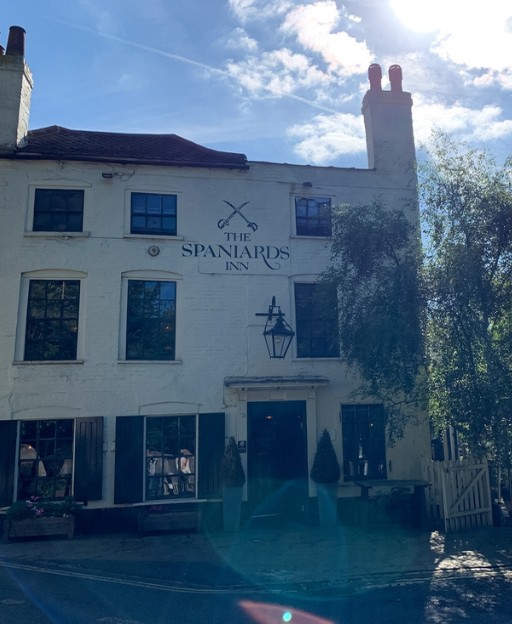
The Spaniards Inn, Hampstead: Where Pickwick’s Story Breathes
On the edge of Hampstead Heath, shaded by old trees and set back from the road, the Spaniards Inn has stood since around 1585. It is one of London’s oldest pubs, and Dickens knew it well.
In The Pickwick Papers, Mrs Bardell — the landlady pursuing Mr Pickwick for breach of promise — is captured by the tipstaffs at a tea party held at this very inn. It is a comic scene, warm and ridiculous, and it feels at home here. The Spaniards Inn has always been a place where Londoners go to exhale. Keats wrote poetry nearby. Byron drank here. Dick Turpin, the highwayman, is said to have stabled his horse Black Bess in the old toll house next door.
The pub has barely changed in outline since Dickens’ day. Order a pint, find a table in the garden, and you will understand why he kept coming back to Hampstead when the city felt too loud.
Getting there: Take the London Overground to Gospel Oak, then walk up Parliament Hill and across the Heath. The walk itself is part of the experience — it is how Dickens arrived, on foot, thinking.
The Charles Dickens Museum, Doughty Street: Where the Novels Were Born
Of all the houses Dickens lived in — and there were many — only one survives intact. Number 48 Doughty Street in Bloomsbury is now the Charles Dickens Museum, and it is the most important literary address in London.
Dickens moved here in 1837, newly married and newly famous. He was twenty-five years old. In this house, working at a desk by the window, he completed The Pickwick Papers, wrote all of Oliver Twist, and began Nicholas Nickleby. The pace was almost inhuman. He worked through the night when deadlines pressed, fuelled by strong tea and sheer will.
His sister-in-law Mary Hogarth died suddenly in the house in 1837. The grief shattered him. He wore her ring for the rest of his life. She became the model for Rose Maylie in Oliver Twist and, some scholars argue, for Little Nell in The Old Curiosity Shop.
The museum has restored the rooms to their 1839 appearance. You can stand in the study where Oliver Twist was written and look out at the quiet street below. It requires very little imagination to hear the scratch of his pen.
🏙️ Enjoying this? 3,000 London lovers get stories like this every week. Subscribe free →
The Marshalsea Prison, Borough: The Shadow Over Little Dorrit
In February 1824, when Dickens was twelve years old, his father John was arrested for debt and taken to the Marshalsea debtors’ prison in Southwark. The family — mother, younger siblings — moved into the prison to be near him. Charles was sent to work in a blacking factory, pasting labels onto pots of shoe polish for ten hours a day.
He never fully recovered from those months. He rarely spoke of them, even to his closest friends. But they surface repeatedly in his writing — the shame of poverty, the cruelty of the workhouse, the grinding indifference of institutions towards ordinary people.
Little Dorrit is set almost entirely within and around the Marshalsea. Amy Dorrit is born in the prison and grows up there. The novel is Dickens at his most personal — and his most angry.
The Marshalsea was demolished in 1879, but a section of its south wall survives in Borough. You will find it on Angel Place, off Borough High Street. A small plaque marks it. Stand there and read the opening chapters of Little Dorrit, and the wall will mean something to you that no guidebook can give.
Smithfield Market and the Old Bailey: Oliver Twist’s Dark London
When Oliver Twist arrives in London, he is taken to Smithfield Market — a scene of overwhelming chaos, noise and filth that leaves the boy stunned. Dickens describes it with visceral precision: the mud, the blood, the roar of cattle, the stench. He had visited many times as a journalist and as a compulsive night walker.
Smithfield still operates today as a meat market, though it is far cleaner and quieter than in Dickens’ era. The Victorian market building, opened in 1868, is a spectacular piece of architecture — iron and glass and Gothic ornament. It is being converted into a new Museum of London, which makes a visit now particularly worthwhile. You are seeing it in its final form before the transformation begins.
Nearby, the Old Bailey — the Central Criminal Court — stands on the site of Newgate Prison, where Fagin spent his last night before his execution at the end of Oliver Twist. Dickens attended public executions at Newgate as a young journalist. He found them brutal and degrading, and campaigned against public hangings for years. His writing on the subject helped shift public opinion.
The Old Bailey is open to the public gallery during trials — check their website for sitting days. Watching a real trial in this courtroom is an experience unlike any museum visit.
Westminster Abbey: Poets’ Corner and Dickens’ Grave
Dickens died on 9 June 1870. He had wanted a private, simple funeral — no public ceremony, no elaborate monument. His wishes were largely respected. He was buried quietly in Poets’ Corner at Westminster Abbey, in a grave that remained open for two days so that ordinary Londoners could pay their respects.
Thousands came. Working people, mostly — the readers he had written for all his life. They left flowers and wept openly. The Times reported that no other death in living memory had produced such genuine, widespread grief.
His grave is modest, as he requested: a simple stone bearing only his name, birth date and death date. Around him lie Chaucer, Tennyson, Thomas Hardy and Rudyard Kipling. The company is formidable. Stand there quietly for a moment, away from the tour groups, and think about what this man accomplished in fifty-eight years.
He wrote fifteen major novels, hundreds of short stories, and campaigned tirelessly for child labour reform, better sanitation, free education and prison reform. He changed the way the English-speaking world thought about poverty. Not many writers can claim that.
The Old Curiosity Shop, Portsmouth Street: Fact Meets Fiction
On Portsmouth Street near Lincoln’s Inn Fields, there is a small, crooked timber-framed building that calls itself The Old Curiosity Shop. Whether it is truly the inspiration for Dickens’ novel is disputed — the dates do not quite align, and Dickens scholars are careful about the claim. But the building is genuinely old, dating to around 1567, and it has the right feeling: cramped, leaning slightly, surviving against the odds in a street of modern offices.
It is now a shoe shop, which adds a pleasing absurdity to the visit. Go anyway. Stand outside and look up at the painted sign. Whether or not Dickens ever described this exact building, it is the kind of place he would have noticed on his night walks — the kind of ancient, stubborn thing that London keeps throwing up in unexpected corners.
Planning Your Dickens Walk
The best way to follow Dickens through London is on foot, which is exactly how he would have wanted it. The key sites cluster into two walkable routes:
Central Route (half a day): Start at the Charles Dickens Museum on Doughty Street. Walk south through Bloomsbury to Holborn, past the Inns of Court (Bleak House territory), down to the Old Curiosity Shop on Portsmouth Street. Continue to Smithfield Market and the Old Bailey. End at the Marshalsea wall in Borough — cross Waterloo Bridge for the best view of the city Dickens loved.
North London Extension: Take the Overground to Gospel Oak and walk to the Spaniards Inn on Hampstead Heath. The views across London from Parliament Hill are extraordinary — Dickens walked up here regularly to clear his head. Add Westminster Abbey at the end of the central route to complete the circuit.
Allow a full day if you want to do both routes properly. Pack comfortable shoes and carry a paperback — reading a passage in the place it describes is one of the quiet pleasures of literary travel.
Frequently Asked Questions
Where is the best place to start a Dickens tour of London?
The Charles Dickens Museum on Doughty Street in Bloomsbury is the ideal starting point. It is the only surviving house Dickens lived in, fully restored to its 1839 appearance, and it gives you the grounding to understand everything else you will see. Allow at least 90 minutes there before heading out onto the streets.
Is Poets’ Corner at Westminster Abbey worth visiting for Dickens fans?
Yes, without question. Dickens’ grave is modest and moving, and the company he keeps in Poets’ Corner — Chaucer, Hardy, Tennyson, Kipling — is remarkable. Westminster Abbey charges an entry fee, but the building is extraordinary in its own right. A combined visit to Poets’ Corner and the nave takes about two hours at a comfortable pace.
Which Dickens novel is most closely tied to real London locations?
Little Dorrit is the most geographically specific, centred on the Marshalsea Prison in Southwark where Dickens’ own father was imprisoned. Oliver Twist covers the greatest range — from Smithfield Market to the streets of Clerkenwell. Bleak House captures the legal world of Lincoln’s Inn Fields with particularly sharp accuracy. All three reward reading alongside a modern London map.
🇬🇧 25 London Places Most Visitors Miss
From secret riverside walks to hidden Victorian tunnels, centuries-old pubs to rooftop gardens with skyline views — our free guide reveals the London most visitors never discover. Join 3,000+ London lovers who get it free.
Get Your Free 25-Places Guide →Already subscribed? Download your free London guide (PDF)
Love more? Join 64,000 Ireland lovers → · Join 43,000 Scotland lovers → · Join 30,000 Italy lovers →
Free forever · Unsubscribe anytime
Subscribe Free