
Four hundred years after his death, William Shakespeare still draws people to London. Americans in particular make the journey — not just to see a play, but to stand where he stood, walk where he walked, and understand how one man from a market town in Warwickshire became the most performed playwright in history. London is where that story unfolded. And more of it survives than most people expect.
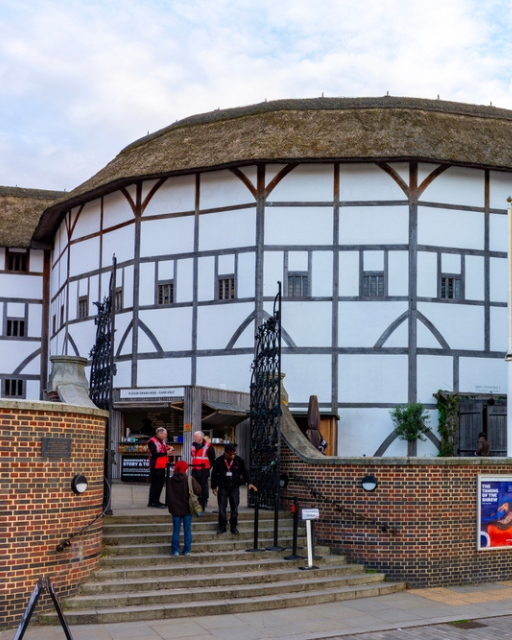
This guide covers the key Shakespeare sites in London — what they are, why they matter, and how to make the most of a heritage visit. Whether you have half a day or a full weekend, London rewards the Shakespeare traveller.
🏙️ Enjoying this? 3,000 London lovers get stories like this every week. Subscribe free →
The Globe Theatre on Bankside
The most famous Shakespeare site in London is not a museum. It is a working theatre. Shakespeare’s Globe on Bankside is a faithful reconstruction of the original 1599 playhouse, built roughly 200 metres from where the first Globe once stood.
The original Globe burned down in 1613 when a stage cannon misfired during a performance of Henry VIII. A second Globe was built on the same site the following year, but was demolished in 1644 during the Puritan closure of London’s theatres. For three centuries, nothing marked the spot.
The modern reconstruction came from an unlikely source: American actor Sam Wanamaker. He arrived in London in 1949 and was astonished to find a small plaque as the only marker for one of history’s most important stages. He spent the next four decades campaigning and fundraising to rebuild the Globe. He died in 1993, four years before the theatre opened. The Sam Wanamaker Playhouse — a candlelit indoor Jacobean theatre built alongside the Globe — now bears his name.
Visiting the Globe today, you have two main options. You can book a guided exhibition tour, which covers the history of both the original theatre and the reconstruction. Or you can attend a performance. Standing tickets in the open-air yard — where the groundlings stood in Shakespeare’s time — cost around £5. It is one of the best-value cultural experiences in London.
Performances run from April to October. The indoor Sam Wanamaker Playhouse runs year-round. Book ahead — popular productions sell out weeks in advance.
Southwark: The Borough That Built the Bard
Southwark, on the south bank of the Thames, was London’s entertainment district in Shakespeare’s day. The City of London — the medieval walled centre to the north — banned theatres, bear-baiting, and other public entertainments. So the theatres moved south, outside the city walls, to Southwark.
Shakespeare was not just a writer. He was a shareholder and actor in the Lord Chamberlain’s Men, the company that built and ran the Globe. He lived in Southwark for much of his London life and worshipped at Southwark Cathedral, which stands a short walk from the Globe.
Southwark Cathedral contains a Shakespeare Memorial — a reclining alabaster figure of the playwright, installed in 1912. Above him, a stained-glass window depicts characters from his plays. His younger brother Edmund, also an actor, is buried in the cathedral. The exact location of his grave was lost, but a modern stone marks the site.
From the cathedral, it is a five-minute walk to Borough Market, one of London’s oldest food markets. The market has stood here in various forms since the 13th century. Shakespeare would have known this area well. Stop for lunch before or after the Globe — the market is excellent and feels historic in a way that many tourist attractions do not.
🏙️ Enjoying this? 3,000 London lovers get stories like this every week. Subscribe free →
The National Portrait Gallery
Here is something many Shakespeare visitors do not know. We have no certain portrait of Shakespeare painted from life. Every image you have seen may be inaccurate.
The two images considered most likely to be authentic are the Chandos portrait and the Cobbe portrait. The Chandos portrait — a dark painting showing a man with an earring and a trimmed beard — is believed by many scholars to be Shakespeare, though it cannot be proven. It hangs in the National Portrait Gallery near Trafalgar Square.
The gallery reopened in 2023 after a major renovation. The Tudor and Jacobean galleries have been redesigned and are worth the visit on their own. Admission is free. Shakespeare’s section places him alongside his contemporaries — Christopher Marlowe, Ben Jonson, Francis Bacon — and gives a strong sense of the world he inhabited.
The gallery is a ten-minute walk from the Globe, across Waterloo Bridge. Combining the two in a single day makes for a full and satisfying Shakespeare itinerary.
The British Library and the First Folio
Shakespeare died in 1616. He did not publish his plays. It was two of his fellow actors — John Heminges and Henry Condell — who gathered his works together and published them in 1623. They called it a folio, because of the size of the paper. It contained 36 plays. Eighteen of them, including Macbeth, Twelfth Night, and The Tempest, had never been published before. Without Heminges and Condell, those plays might have been lost entirely.
The British Library holds copies of the First Folio. The library’s Treasures Gallery — which is free to enter — displays a rotating selection of its most important documents. The Folio is one of the most requested exhibits. Call ahead or check the library website to confirm it is currently on display before you visit.
The library is at St Pancras, next to King’s Cross station. It also holds the Magna Carta, Lewis Carroll’s handwritten draft of Alice in Wonderland, and original manuscripts by Jane Austen, the Beatles, and Leonardo da Vinci. Even if the Folio is temporarily off display, the Treasures Gallery is worth a visit.
Poet’s Corner, Westminster Abbey
Shakespeare is not buried in London. He died in Stratford-upon-Avon and is buried at Holy Trinity Church there. But London has claimed him in another way.
Westminster Abbey’s Poet’s Corner, in the south transept, holds memorials to Britain’s greatest writers. Shakespeare’s monument was installed in 1740 — more than a century after his death. It shows him leaning on a plinth, pointing to a scroll with a quotation from The Tempest. Surrounding him are memorials to Chaucer (who is actually buried here), Charles Dickens, Thomas Hardy, Rudyard Kipling, and many others.
Entry to Westminster Abbey requires a ticket, which is not cheap. However, if you attend a choral evensong service, entry is free. Services take place most weekdays and on Sundays. Check the abbey website for current times. Experiencing Poet’s Corner during evensong — with the choir singing in the candlelit chancel — is one of London’s quieter and more powerful experiences.
The Rose Theatre Excavation
Few visitors know about this site, but it is one of the most remarkable Shakespeare connections in London. The Rose Theatre on Bankside opened in 1587 — twelve years before the Globe. Shakespeare’s early plays were performed here before the Globe was built. The theatre was used by Christopher Marlowe and other leading playwrights of the period.
In 1989, demolition work for an office building uncovered the foundations of the Rose. A public campaign — supported by actors including Laurence Olivier and Judi Dench — halted the demolition. The foundations were preserved beneath the building. Today you can visit them.
The Rose is open to visitors several days a week. The excavated foundations are kept damp to preserve them. Walking into the space, you look down at the timber and earth where the first audiences for early Elizabethan drama stood. It is a genuinely moving site and significantly less visited than the Globe. Admission is modest.
Planning Your Shakespeare Heritage Day
A one-day Shakespeare heritage trail in London is entirely manageable. Here is a suggested order.
Start at the British Library in the morning, when it is quietest. Take the Tube to King’s Cross, visit the Treasures Gallery, then head south by bus or Tube to Bankside. Have lunch at Borough Market, then visit the Globe exhibition. Walk the few minutes to Southwark Cathedral for the Shakespeare memorial. If you are interested in the early theatres, the Rose is a five-minute walk from the Globe.
In the afternoon, cross the river via Millennium Bridge (there is a satisfying view of St Paul’s Cathedral from the bridge) and walk to the National Portrait Gallery via Tate Modern and the Embankment. End the day at Westminster Abbey for choral evensong if the timing works.
If you want to extend the trip, Stratford-upon-Avon is a 90-minute train journey from Marylebone station. Shakespeare’s Birthplace, Anne Hathaway’s Cottage, and the Royal Shakespeare Company’s theatres are all there. Many visitors combine a London Shakespeare day with an overnight in Stratford.
Frequently Asked Questions
Is the Shakespeare’s Globe Theatre the original building?
No. The original Globe Theatre was built in 1599 and burned down in 1613. The current Globe is a modern reconstruction, opened in 1997, built close to — but not exactly on — the original site. It was built using traditional Elizabethan methods and materials where possible, making it the closest thing in the world to what Shakespeare’s audiences experienced.
Do I need to book in advance for the Globe Theatre?
For performances, yes — especially for popular productions during the summer season. Standing tickets in the yard are £5 and are sometimes available on the day, but booking ahead is wise. Exhibition tours can usually be booked on the day during quieter periods, but advance booking is recommended at weekends and school holidays.
How long should I allow for the Bankside Shakespeare sites?
Allow at least half a day for the Bankside area. The Globe exhibition tour takes about 45 minutes to an hour. Southwark Cathedral deserves at least 30 minutes. The Rose Theatre visit runs about 45 minutes. Add Borough Market for lunch and you have a full morning or afternoon.
Is there anything Shakespeare-related in London that is completely free?
Yes. The National Portrait Gallery admission is free — including the galleries with the Chandos portrait. The British Library Treasures Gallery is free. Southwark Cathedral is free to enter (donations are welcome). Westminster Abbey choral evensong is free. You can have a meaningful Shakespeare day in London spending very little money.
🇬🇧 25 Hidden Gems of London Most Tourists Never Find
From secret riverside walks to hidden Victorian tunnels, centuries-old pubs to rooftop gardens with skyline views — our free guide reveals the London most visitors never discover. Join 3,000+ London lovers who get it free.
Get Your Free London Hidden Gems Guide →Already subscribed? Download your free London guide (PDF)
Love more? Join 64,000 Ireland lovers → · Join 43,000 Scotland lovers → · Join 30,000 Italy lovers →
Free forever · One email per week · Unsubscribe anytime
