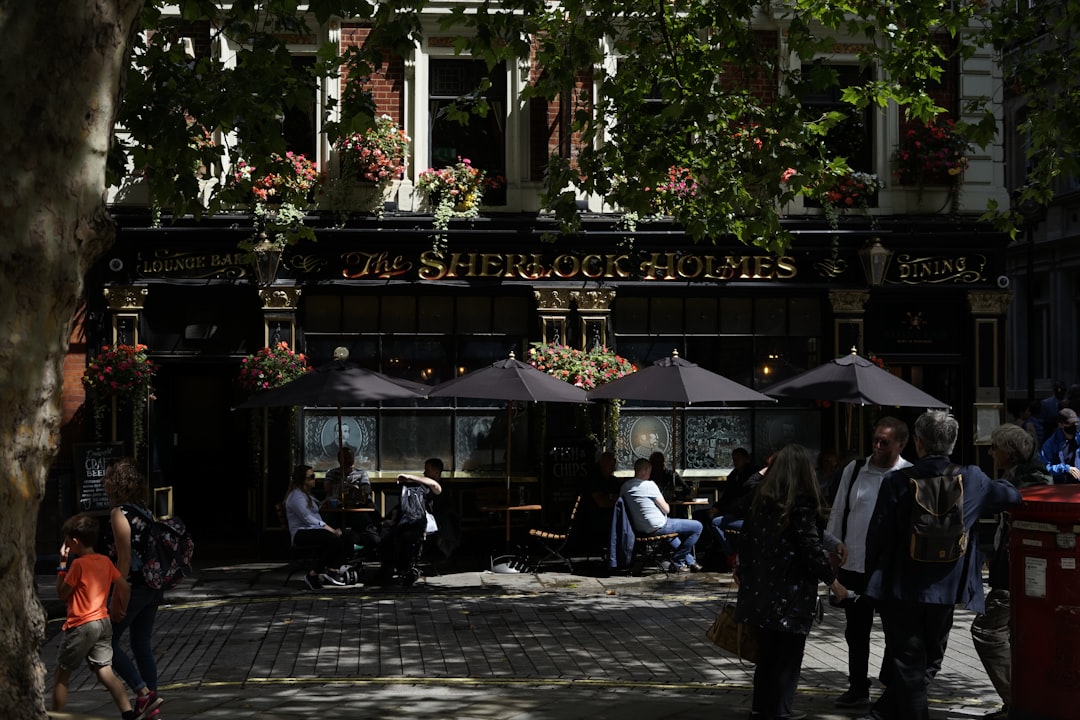
There is no legal definition of a “pub,” yet the word governs a set of customs so specific that a newcomer can breach half a dozen without noticing: you order and pay at the bar rather than waiting for table service, you generally hold no reservation, and when it’s your group’s turn, one person buys the whole round. The very name is a contraction — “public house” — a private home whose front rooms were, centuries ago, opened to the public for drink. This is Guide № 005 in The Love London Guide series.
Get the Full Collectible Guide (Free PDF)
The British Pub — in a beautifully designed, printable booklet. The Love London Guide № 005.
From Roman Tabernae to the Corner Local
Drinking houses in Britain trace back to the Roman tabernae that lined the roads of Londinium, but the institution we would recognise took shape later through three overlapping types: the alehouse, which sold ale brewed on site; the tavern, which sold wine to a wealthier crowd; and the inn, which offered lodging and stabling to travellers. Over time these blurred into the single establishment the Victorians began calling the “public house.” Many pubs still carry the older word “inn” or “tavern” in their names as a fossil of that history.
The elaborate hanging signs so associated with pubs have a practical origin. In 1393 King Richard II required alehouses to display a sign so that the official ale-taster could find and inspect them. Because most people could not read, signs used bold, recognisable images — a red lion, a crown, a coach and horses — which is why so many pubs share the same handful of names to this day.
How Ordering Actually Works
In the vast majority of traditional pubs there is no table service for drinks: you go to the bar, order, and pay at that moment. There is no formal queue, but bar staff generally keep track of who arrived first and will serve in roughly that order, so catching the bartender’s eye matters more than pushing forward. Tipping is not expected on drinks; if you want to show appreciation, the traditional gesture is to offer to buy the bartender a drink with the phrase “and one for yourself.”
Food has become a larger part of pub life, and many places that serve meals do bring food to your table after you order and pay at the bar or note your table number. The term “gastropub” was coined in the early 1990s, widely credited to The Eagle in Clerkenwell, London, which paired a proper kitchen with an informal pub setting and helped shift expectations of what a pub could serve.
The Round, and Other Unwritten Rules
Buying “rounds” is the social engine of a British pub visit. Rather than each person paying for their own drink, one member of the group buys drinks for everyone, and the duty rotates so that over an evening each person takes a turn. It is considered poor form to leave before you have bought your round, and slipping away early to avoid one has its own disapproving shorthand. The custom keeps a group drinking together at a shared pace as much as it splits the cost.
Beer is typically sold by the pint (568 millilitres) or half-pint, and by law those measures must be served in stamped, verified glasses. Cask ale — often called “real ale” — is a distinctly British style that continues to ferment in the cask and is served without added gas pressure, usually at cellar temperature rather than fridge-cold. This is why traditional bitter is not “warm” so much as cool: it is meant to be tasted, not chilled into silence.
Last Orders and the Licensing Clock
The ringing of a bell and the call of “last orders” is one of the pub’s most recognisable rituals. For much of the twentieth century, strict closing times were a legacy of the Defence of the Realm Act 1914, which curtailed opening hours during the First World War to keep munitions workers sober. Those restrictions lingered for decades, with the classic 11pm closing time familiar to generations of drinkers.
The Licensing Act 2003, which came into force in England and Wales in 2005, changed this by allowing premises to apply for more flexible hours, including the possibility of serving beyond 11pm. In practice many pubs still close around 11pm on weeknights, so “last orders” — followed by “time” and, traditionally, “drinking-up time” to finish your glass — remains part of the evening’s rhythm.
Myths Worth Retiring
Myth: British beer is served warm. Cask ale is served at cellar temperature, roughly 11–13°C — cool, not warm, and deliberately not ice-cold so its flavours come through. Lagers and many other drinks are served chilled as elsewhere.
Myth: You should tip the bartender on every drink. Tipping on drinks is not customary in British pubs. The accepted alternative is offering to buy the bartender a drink rather than leaving a cash tip.
Myth: “Pub” names are chosen for whimsy. The repetition of names like the Red Lion and the Crown descends from a time when illiterate customers needed a clear visual sign, and many images referenced royalty or local landowners rather than the publican’s taste.
Frequently Asked Questions
Do I need to book a table at a pub?
For drinks, usually not — you simply arrive and order at the bar. Pubs known for food, especially for Sunday lunch or in busy central areas, increasingly take bookings, so it is worth checking ahead if you are set on eating.
Can children go into pubs?
It depends on the individual pub’s licence and policy. Many pubs, particularly those serving food, welcome accompanied children until early evening, while some remain adults-only. You must be 18 to buy alcohol, though 16- and 17-year-olds may drink beer, wine or cider with a meal if an adult buys it.
What is the difference between a pub, a bar and a gastropub?
A pub is a traditional public house, historically drink-led and community-focused, often with cask ale. A “bar” tends to be a more modern, sometimes cocktail- or spirits-led venue. A gastropub is a pub that puts serious emphasis on its kitchen, offering restaurant-quality food in a pub setting.
More The Love London Guides
The Love London Guide is a numbered series — one tightly focused subject at a time, each with its own downloadable collectible edition. Guide № 001 is Fish and Chips, Guide № 002 is Trooping the Colour, Guide № 003 is The Red Telephone Box, Guide № 004 is English Breakfast Tea, This is Guide № 005. More editions are on the way.
🇬🇧 Join 3,000+ London Lovers
Every week, get hidden stories, local secrets, and travel inspiration from people who live and love it.
Subscribe free — enter your email: