
In the heart of the City of London, behind iron gates and between glass office towers, stand the shells of ancient churches. Ivy climbs their broken walls. Trees fill their roofless naves. Benches sit where pews once stood. These are London’s ruined church gardens — peaceful spaces that hold centuries of English history in their quiet stones.
Most visitors walk past them without a second glance. But step inside, and you step into something remarkable. These spaces preserve the footprints of churches that recorded English life for five, six, even seven centuries. Baptisms, marriages, burials — generations of ordinary people marked their days here.
If you trace your family to London or to England, there is a real chance that your ancestors knew these walls.
Why So Many London Churches Stand in Ruins
London’s ruined churches share a similar story, though the chapter that broke each one differs.
The Great Fire of London in 1666 destroyed 87 of the City’s churches in just three days. Sir Christopher Wren rebuilt 51 of them over the following decades. But many remained abandoned shells for years, their congregations scattered and their parishes merged with neighbours.
Then came the Blitz. German bombing in 1940 and 1941 flattened whole streets in the City of London. Churches that had stood for 500 years disappeared in a single night. Some burned to their foundations. Others lost their roofs and interiors while their ancient stone walls remained standing.
What London did with these ruins was extraordinary. Rather than clear them away, the city planted gardens inside them. Trees grew through gaps in the stone. Wildflowers seeded between old flagstones. The ruins became public gardens — and in doing so, they became among the most historically layered spaces in the city.
🏛 Free Guide: How to Trace Your English & British Ancestry
Step-by-step: GRO records, census 1841–1921, parish registers, the National Archives (Kew), London Metropolitan Archives, and planning a heritage trip. Completely free.
Get the Free Guide → Subscribe free at the guide page to receive weekly London heritage storiesSt Dunstan in the East — The Garden Everyone Falls in Love With
St Dunstan in the East stands in a narrow street off Lower Thames Street, just a few minutes’ walk from Monument and London Bridge. People who find it often say it feels like stumbling into another world.
The church has deep roots. The original building dates back to at least 1100, making it one of the oldest parish churches in the City. The Great Fire of 1666 damaged it severely. Wren rebuilt the tower and added a distinctive Gothic spire — one of his few Gothic works in a career dominated by Baroque and classical forms.
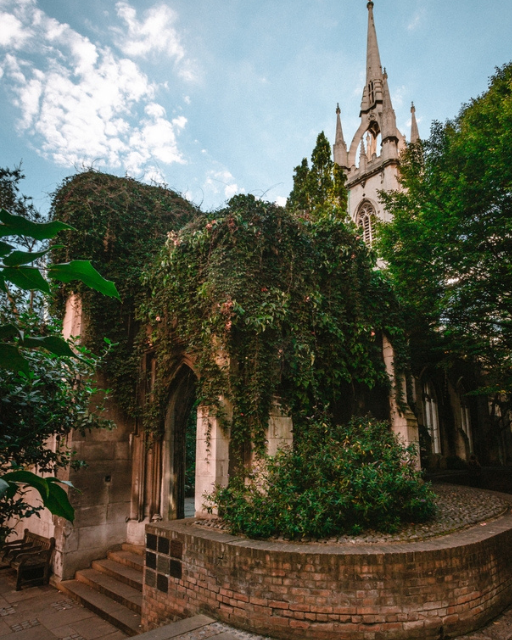
The Blitz ended that. Bombs gutted the building in 1941, leaving only the tower, the walls, and Wren’s elegant spire. The ruins stood empty for decades. Then in 1967, the City of London Corporation turned them into a public garden.
Today, the space looks like something from a fairy tale. Trees grow inside the roofless nave, their canopy filling the space where the ceiling once held. Ivy covers the old stone archways. A small fountain sits at the centre of the garden. Wren’s spire still points skyward above the trees.
People come here to eat lunch, to read, to sit quietly. On a summer weekday, you will find office workers, tourists who have wandered off the main routes, and occasionally someone who simply needed a few minutes of peace.
If your ancestors lived in the City of London — and millions of English families had connections here — they may have walked through this church. The parish registers of St Dunstan in the East survive, some dating back to the 16th century. The London Metropolitan Archives holds these records, and many are now searchable online through Ancestry and FindMyPast.
🏙 Enjoying this? 3,000 London lovers get stories like this every week. Subscribe free →
Christ Church Greyfriars — A Royal History Written in Stone
Walk five minutes north from St Paul’s Cathedral and you find Christ Church Greyfriars on Newgate Street. This church has one of the most dramatic histories in London.
Franciscan friars founded a friary on this site in 1225. Queen Isabella of France — wife of Edward II and mother of Edward III — chose it as her final resting place in 1358. The friary church was the second largest in medieval London, surpassed only by old St Paul’s itself.
Henry VIII dissolved the monastery in 1538 during the Reformation. The church survived as a parish church. Wren rebuilt it after the Great Fire. Then the Blitz gutted it in 1940.
What visitors can explore today is the churchyard and the ruins — a quieter, smaller space than St Dunstan but equally laden with history. The medieval tower still stands. The roofless nave became a garden. Stand in the ruins and consider the centuries this ground has absorbed: Franciscan friars, queens of England, City merchants, and generations of Londoners baptised, married, and buried here across seven centuries.
St Mary Aldermanbury — The Church That Crossed an Ocean
Of all London’s ruined churches, St Mary Aldermanbury has the most extraordinary story — because this church no longer stands in London at all.
The original building stood on Aldermanbury from at least the 12th century. Wren rebuilt it after the Great Fire. The Blitz destroyed it in 1940. The ruins sat undisturbed for two decades.
Then, in the 1960s, Westminster College in Fulton, Missouri — where Winston Churchill had delivered his famous Iron Curtain speech in 1946 — proposed something remarkable. They wanted to create a Churchill memorial, and their idea was bold: move the entire ruin of St Mary Aldermanbury, stone by stone, across the Atlantic and rebuild it in Missouri.
The City of London agreed. Workers numbered every stone. They dismantled the walls, loaded them onto ships, and sailed them to America. Craftsmen in Missouri rebuilt the church following Wren’s original plans, completing the work in 1969. The Churchill Memorial and Library still stands in Fulton today — a piece of London rebuilt on American soil.
The original site in London remains a small churchyard garden. It holds a memorial to two men named John Heminge and Henry Condell — actors who served in St Mary’s congregation. In 1623, they compiled and published the First Folio of Shakespeare’s plays. Without their effort, scholars believe we would have lost half of Shakespeare’s work forever.
The garden marks both a Shakespearean debt and an Anglo-American bond — a fitting combination for visitors from across the Atlantic.
What the Parish Records Can Tell You
These churches matter to anyone tracing English ancestry for one central reason: parish records.
Before civil registration began in England in 1837, the Church of England kept the only systematic records of births, marriages, and deaths. Every parish church maintained registers: pages recording baptisms, wedding ceremonies, and burials. For families in the City of London, those records often reach back centuries.
The London Metropolitan Archives holds the registers of most City of London parishes, including St Dunstan in the East and Christ Church Greyfriars. Many records are now searchable online through Ancestry, FindMyPast, and the London Metropolitan Archives’ own digital catalogue. If your English ancestry traces to London — and a huge proportion of English emigrants to America passed through the city at some point — these records may hold your family.
Standing in the garden of St Dunstan in the East, knowing that your great-great-grandparents may have walked this same ground before they sailed for America, changes how the space feels. The stones are not just old. They mark the beginning of journeys that ended in your family.
How to Visit London’s Ruined Church Gardens
All three of these gardens cost nothing to enter. They welcome visitors during daylight hours throughout the year.
St Dunstan in the East sits on St Dunstan’s Hill, off Lower Thames Street. Monument tube station (Circle and District lines) is the closest stop, a five-minute walk away. London Bridge station is also nearby. The garden opens daily from dawn to dusk.
Christ Church Greyfriars stands on Newgate Street. St Paul’s tube station (Central line) is the best starting point. The churchyard garden opens during the day.
St Mary Aldermanbury occupies a small square on Aldermanbury in the City, closest to the Bank and Moorgate tube stations. The garden with its Shakespeare memorial is open daily.
The best time to visit is a weekday morning. The City of London empties at weekends — the office population leaves and the streets grow quiet. This gives these gardens an eerie stillness that has its own appeal. But on weekday mornings, you can sit among the ruins with coffee in hand while the rest of the city rushes past outside.
Bring a map of the City of London. These spaces do not appear prominently on most tourist maps, and the surrounding streets are narrow and can be confusing. A short walk connects all three gardens, making it easy to spend a morning moving between them.
If you have English ancestry and want to go further than a visit, the London Metropolitan Archives on Clerkenwell Road is open to the public. Staff there can help you locate parish registers and historical documents. You may find a family name you recognise in a register that is 300 years old.
These ruins are places where London’s long story becomes visible. The stones survive. The records survive. The history of ordinary English families — and of some extraordinary ones — survives in these quiet, overgrown places at the heart of the city.
Join 3,000+ London Lovers
Every week, get London’s hidden history, heritage walks, and stories from the city’s remarkable past — straight to your inbox.
Subscribe free — enter your email:
Already subscribed? Download your free London guide (PDF)
Love more? Join 64,000 Ireland lovers → · Join 43,000 Scotland lovers → · Join 30,000 Italy lovers →
Free forever · One email per week · Unsubscribe anytime