
Seen from above, London looks very different from the busy streets below. Rows of cream terraces line quiet roads. Green squares break up the brick and stucco. Far off, the city skyline sits on the horizon. It is a view that makes many people ask the same question: which London neighbourhood would I love to live in?
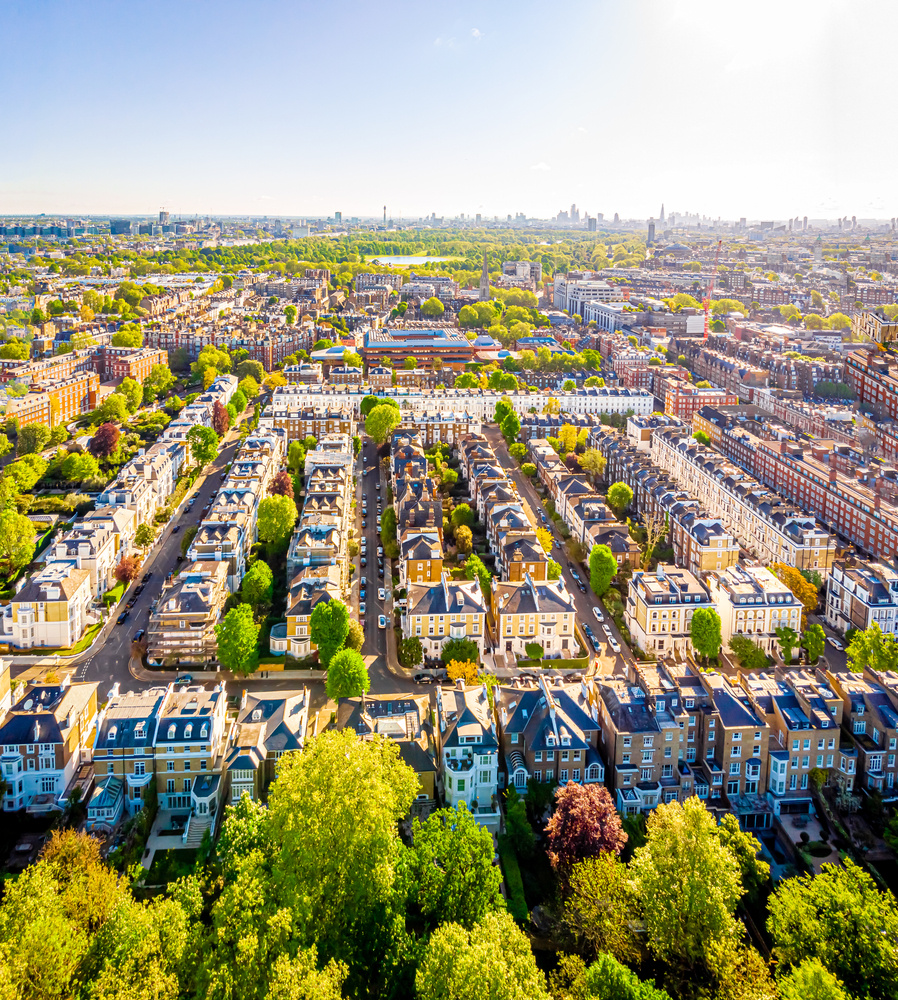
This guide looks at what makes these calm, leafy corners of London so appealing. It also gives you a practical way to decide which area might suit you, whether you are dreaming, planning a move or just choosing where to wander on your next visit.
Love London? Get our best walks, hidden corners and local tips in your inbox. Subscribe to our free London newsletter.
Why London looks so different from above
London is often called a city of villages. Over the centuries it grew by swallowing small towns and hamlets, and many of them kept their own centre, high street and character. From the air you can see this clearly. Dense blocks give way to green patches, then to open parks, then to dense blocks again.
Roughly a third of Greater London is green space, according to the Greater London Authority. The city has thousands of parks, gardens and squares. That is why a morning aerial photo can look almost like a park with houses scattered through it.
The cream and white terraces in the picture are a clue to the age of the area. Much of central and west London was built in the 18th and 19th centuries. Developers laid out streets of tall houses around shared garden squares, and many were finished in pale stucco to look like stone.
The Georgian and Victorian terrace
The classic London terrace is a row of joined houses built in one go. Georgian terraces, from the 1700s to the early 1800s, are usually plain and well proportioned, with tall windows and neat doorways. Victorian terraces are often more decorated, with bay windows, porches and detailed brickwork.
Many of these homes are now split into flats. Some are still family houses. Many are listed buildings, which means owners cannot change the outside without permission. This helps explain why whole streets still look the way they did over a century ago.
If you love this style, look for the words “stucco”, “mansion block” and “garden square” when you search for areas. They usually point to the kind of streets you see in the photo.
Neighbourhoods with cream terraces and green squares
Several areas of west and central London match the view in the photo. Each has its own feel.
Kensington and Notting Hill
This part of west London is known for white stucco terraces, communal gardens and quiet residential streets. Hyde Park and Kensington Gardens are close by, and the museums of South Kensington are a short walk away. Notting Hill adds pastel-coloured houses and the famous Portobello Road Market, which runs most days, with the biggest crowds on Saturdays.
Bayswater and Paddington
Bayswater has long rows of cream terraces facing Hyde Park. It is more mixed than its neighbours, with plenty of cafés and restaurants. Paddington station brings fast links to Heathrow on the Elizabeth line, which is a big plus for travellers.
Islington
North of the centre, Islington has some of the best preserved Georgian squares in London. Canonbury Square and Gibson Square are good examples. Upper Street is lined with pubs, theatres and independent shops, and the Regent’s Canal is close by for a flat, easy walk.
Bloomsbury
Bloomsbury is famous for its garden squares, including Russell Square and Bedford Square. It is home to the British Museum and parts of University College London. It is central, walkable and calm in the evenings.
Greenwich and Blackheath
South-east London offers a different view. Greenwich has a World Heritage Site, a huge park and a river setting. Blackheath, just up the hill, has a village feel, an open heath and good rail links to central London.
Richmond and Kew
In the south-west, Richmond sits beside the Thames and next to Richmond Park, the largest of London’s Royal Parks. Kew is home to the Royal Botanic Gardens, which are a UNESCO World Heritage Site. Both areas feel more like a leafy town than a big city.
Want more neighbourhood guides like this? Join our free newsletter. Subscribe to our free London newsletter.
What it is like to live in these areas
The views are lovely, but daily life matters more. Before you fall for a street, think about the practical side.
- Cost: Pretty, central London neighbourhoods are among the most expensive in the UK. Rents and house prices are usually much higher than in outer areas.
- Space: Older terraces often have high ceilings but small rooms. Outdoor space may be a shared garden rather than a private one.
- Noise: Main roads can be busy. Streets just one or two blocks back are often far quieter.
- Parking: Many streets are controlled parking zones. You may need a permit, and spaces can be scarce.
- Upkeep: Listed or older buildings can cost more to maintain and may have limits on changes.
How to choose your London neighbourhood
Use these simple steps to narrow down the options.
- Set a budget. Work out what you can afford each month, including council tax and travel.
- Check the commute. Use the Transport for London journey planner to test the trip to your work or study at rush hour.
- Look at the travel zone. London fares depend on zones 1 to 9. Living further out can lower rent but raise travel costs.
- Visit at different times. See the area on a weekday morning, a Saturday afternoon and a weeknight. Streets can feel very different.
- Walk to the nearest park. If green space matters to you, time the walk.
- Talk to locals. Café owners and shopkeepers often give the most honest view of an area.
Best ways to see London neighbourhoods as a visitor
You do not need to live in London to enjoy its streets. A few ideas:
- Walk the squares. A morning stroll through Bloomsbury or Islington is free and easy to do on foot.
- Climb a hill. Primrose Hill, Parliament Hill and Greenwich Park all give free skyline views. Primrose Hill is especially popular at sunset.
- Take a viewpoint ticket. Sky Garden, in the City, is free but must be booked in advance. Paid viewing platforms such as The Shard and the London Eye give a higher view of the whole city.
- Use the river. Thames Clippers and other river services let you see several areas from the water.
- Try a day pass. The Tube, buses, DLR and Overground all use contactless payment, with daily caps that keep costs down.
Always check opening times and booking rules before you go, as these can change.
When to visit for the best views
Spring and early autumn are lovely for leafy neighbourhoods. In April and May the trees are fresh and the gardens are in bloom. In October and November the leaves turn gold and the light is soft. Summer mornings give the clearest, brightest skies, like the one in the photo. Winter can be grey, but crisp days still give sharp skyline views.
Go early in the day if you can. Parks are quieter, light is better for photos and the haze that builds up later has not yet arrived.
Photo tips for city views
- Shoot in the first two hours after sunrise for soft light and fewer crowds.
- Use a public viewpoint rather than a drone. Drone flying is restricted in much of London, including all Royal Parks, so check the rules first.
- Include a foreground, such as trees or a rooftop, to give depth.
- Check the weather. Clear days after rain often give the sharpest views.
So, where would you live?
There is no single right answer. Some people want the quiet squares of Bloomsbury. Others want the river and the park at Richmond, or the village feel of Blackheath. The best neighbourhood is the one that fits your budget, your routine and the way you like to spend a Saturday morning.
Tell us your pick on our Facebook page. We would love to hear which part of London has won your heart.
Never miss a London guide. Get the next one free by email. Subscribe to our free London newsletter.