
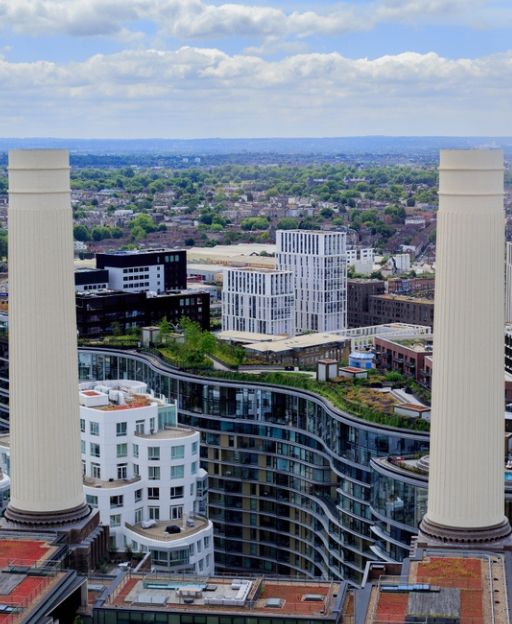
For nearly four decades, Battersea Power Station stood empty on the south bank of the Thames. Its four white chimneys rose over London like monuments to abandonment. The roof had caved in. Pigeons ruled the vast turbine halls. One of the most recognisable buildings in the world was slowly falling apart.
Then someone decided to fix it.
The Building That Changed a Skyline
Battersea Power Station was designed by Sir Giles Gilbert Scott — the same architect who gave Britain the red telephone box. He had a gift for making functional things beautiful.
The station opened in 1933 as the largest brick building in Europe. Inside, the Art Deco turbine hall was extraordinary. Mosaic-tiled floors. Marble-lined control rooms. High ceilings that made you feel small in the best possible way.
At its peak, Battersea provided one quarter of London’s electricity supply. Trams, factories, hospitals — all drawing power from those four chimneys on the river. The station was extended in 1955, adding two more chimneys. The symmetrical silhouette that became famous across the world was complete.
The Day Pink Floyd Flew a Pig Over It
In January 1977, Pink Floyd arrived at Battersea with an inflatable pink pig.
The band was recording Animals, an album about power and corruption inspired by George Orwell’s Animal Farm. For the cover, they wanted something dark and surreal. Battersea — enormous, industrial, slightly menacing — was perfect.
The pig was tethered between two of the chimneys. The wind took it. The pig broke free and drifted eastward over London, eventually heading towards Heathrow Airport. Air traffic control was alerted. The shoot had to start again the following day.
The final photograph — pig floating between chimneys under a grey London sky — became one of the most reproduced images in rock history. After that, Battersea became shorthand for something. Directors kept coming back. The Dark Knight. Children of Men. 1984. Countless music videos. The building had a talent for looking like the end of something.
Nearly Four Decades of Decay
Battersea Power Station closed in 1983. What followed was nearly four decades of very public failure.
One plan proposed turning it into a theme park. Another wanted a football stadium. A third promised Europe’s largest indoor leisure complex. None of them happened.
Developers bought the site and ran out of money. Others arrived, announced grand plans, and disappeared. Squatters moved in. The roof collapsed. Historic England listed the building at Grade II* — too important to demolish, too expensive to fix.
For a generation of Londoners, Battersea was the city’s most magnificent failure. You could see it from the Victoria line. You could see it from trains into Waterloo. It was always there, always massive, always in some new state of deterioration.
🇬🇧 25 Hidden Gems of London Most Tourists Never Find
From secret riverside walks to hidden Victorian tunnels, centuries-old pubs to rooftop gardens with skyline views — our free guide reveals the London most visitors never discover. Join 3,000+ London lovers who get it free.
Get Your Free London Hidden Gems Guide →The Malaysian Rescue
In 2012, a Malaysian consortium paid £400 million for the site. The restoration that followed was unlike anything London had attempted before.
Every one of the original 11 million bricks was catalogued. The Art Deco control room — stripped and damaged over decades — was painstakingly rebuilt. The turbine halls were restored to their original proportions. The four chimneys, demolished in 2004 during a previous failed development, were rebuilt brick by brick using original specifications.
The project took a decade and cost billions. The same architects who had watched previous schemes collapse held their breath. This time, it worked.
Lift 109 — London’s Most Dramatic View
The most striking addition is something the original architects never imagined: a glass lift that runs inside one of the chimneys.
Lift 109 climbs 109 metres — the full height of the chimney — with London visible through the glass as you rise. At the top, the city opens up in every direction. The Shard to the east. The curve of the Thames below. Hyde Park stretching north. Croydon’s towers to the south.
Looking back down inside the hollow chimney from the top is its own experience. The concrete cylinder drops 109 metres beneath you. It feels enormous and strangely quiet.
Tickets for Lift 109 require advance booking. Morning visits offer the best light. If you’re visiting London and want one unexpected experience, this might be it. If you’re still planning your trip, the London trip planning guide has everything you need to organise your visit to the city.
What’s Inside Battersea Power Station Today
Apple chose Battersea for its London campus. Their offices sit inside the original turbine halls, under the same high ceilings where the generators once stood.
Beyond Apple, there are more than 100 shops and restaurants across the site. The original control room is now a private members’ club. A rooftop terrace overlooks the Thames. You don’t need to spend money to visit — walking through the turbine halls is free. The architecture does the work.
Battersea Power Station is on the Northern line — its own station opened in 2021. For more on London’s remarkable hidden architecture, read about what’s actually inside Tower Bridge — another iconic structure with secrets most visitors never find. You might also enjoy reading about the Victorian masterpiece hiding inside London’s financial district.
The Lesson Battersea Teaches
London has always been good at losing things. Medieval churches, Victorian pubs, whole streets of Georgian houses — the city tends to build over what came before.
Battersea Power Station is the counterargument. It is the thing that refused to go. The building that survived five decades of neglect, bankruptcy, and one escaped inflatable pig.
Standing inside the turbine hall now, with the original marble beneath your feet and the rebuilt chimneys visible through the glass above, it’s hard not to feel that something important has been saved. Those who care about London’s built past have been arguing for decades that old things are worth keeping.
Battersea is what happens when they win.
Join 3,000+ London Lovers
Every weekday morning, get London’s hidden gems, culture, and travel inspiration — straight to your inbox.
Subscribe free — enter your email:
Love more? Join 65,000 Ireland lovers → · Join 43,000 Scotland lovers → · Join 30,000 Italy lovers →
Free forever · Unsubscribe anytime