
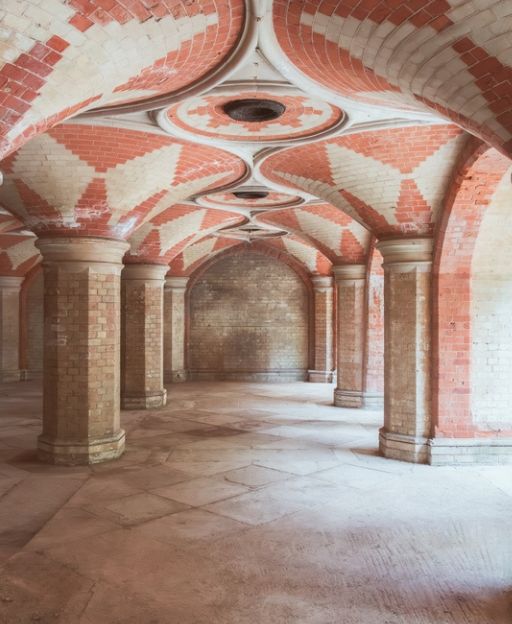
Step down into the Crystal Palace Subway on a quiet morning and the noise of London disappears. Above you, brick arches curve in perfect geometric patterns — cream and terracotta tiles arranged exactly as they were in 1865. There are no trains here. There have been no trains for almost a century. This passageway was built to serve a building that no longer exists.
The Building That Made the World Stop
In 1851, a former gardener named Joseph Paxton designed something that had never existed before. A building made almost entirely of glass and iron, covering 26 acres of Hyde Park.
🏙️ Love London?
3,000 London lovers get hidden history, street-level stories, and local secrets every week. Free, forever — no spam, unsubscribe any time.
Subscribe free — enter your email:
It was so tall that the elm trees in the park — which could not be cut down without public outcry — were simply enclosed inside it. Paxton raised the roof high enough to clear them. The trees became part of the design.
The Great Exhibition of 1851 was Queen Victoria’s vision for an international trade fair, a showcase of British industry and invention. Paxton’s structure — nicknamed the Crystal Palace by the satirical magazine Punch — became its centrepiece. In five months, six million people visited. That was roughly a third of Britain’s entire population.
Nothing quite like it had existed before. Glass and iron. Light and space. An entire palace assembled from prefabricated parts. The Victorians had not seen anything like it. Neither had anyone else.
The Move to Sydenham Hill
After the exhibition closed, the Crystal Palace was not demolished. It was taken apart and rebuilt — on an even grander scale — on Sydenham Hill in South London.
The new version opened in 1854. It sat at the top of a ridge that could be seen for miles in every direction. Inside, the glasshouse held concerts, exhibitions, formal gardens, fountains and prehistoric animal models. It was designed as a permanent cultural attraction for the whole country.
Hundreds of local people worked there. Hotels, tea rooms and boarding houses grew around it to serve the visitors. The surrounding area took the building’s name. It still uses that name today, almost ninety years after the building burned down.
The Subway Built for Six Million Footsteps
As Crystal Palace became one of the most visited destinations in Britain, a practical problem emerged. The high-level railway station sat at one end of the ridge. The palace entrance sat at the other. On a wet winter afternoon, the walk between them was unpleasant enough to put people off.
The solution was an underground passageway. Built in 1865 and designed by Edward Barry — son of the architect who built the Houses of Parliament — the Crystal Palace Subway connected the station directly to the palace grounds.
Barry understood that the subway needed to do more than move people. It needed to set a mood. Visitors stepping off the train would pass through a vaulted brick undercroft, its arches decorated with intricate geometric tilework in red, cream and white. The effect was ceremonial. It told you that what lay ahead was worth the journey.
The subway runs for roughly a hundred metres. It served thousands of visitors every day for more than seventy years. Then the palace burned, and it was sealed up and forgotten.
The Night the Glass Palace Burned
On the evening of 30 November 1936, a fire started somewhere inside the Crystal Palace. Nobody knows exactly where or how.
It moved through the glass and iron with terrifying speed. By the time firefighters arrived in force, there was little left to save. The building that had taken years to dismantle from Hyde Park and rebuild on Sydenham Hill was gone in under two hours.
The glow was visible from eight English counties. Thousands of people stood on surrounding hills and watched. Winston Churchill was among them. He called it “the end of an age.”
The Crystal Palace was never rebuilt. The site was cleared. The subway was sealed and left in darkness. For decades, this extraordinary piece of Victorian craftsmanship sat beneath a South London pavement, largely unknown even to people who walked above it every day.
What the Park Still Holds
Crystal Palace Park is not a typical London green space. Walk through it and you find things that feel out of place, as if they belong to an older, stranger version of the city.
Along the lower terraces stand the Victorian dinosaur models — the first life-size reconstructions of prehistoric creatures ever made, installed in 1854 before Darwin published On the Origin of Species. Some of their anatomy is now known to be wrong. They are still there, more than twenty of them, standing in shallow lakes among the trees. Slightly eerie. Entirely fascinating.
The stone terraces that once held the palace are also still visible. You can walk along them on a weekday morning with almost no one else around, looking out over South London from the same ridge where Victorian visitors once stood in their tens of thousands.
The subway has been restored and is open for guided tours. The tilework is intact. The arches are as impressive as the day Edward Barry designed them. If you want to understand what Victorian London looked like at its most ambitious, this is one of the best places left to see it. Tours are run by the Crystal Palace Subway Project and require booking in advance.
The park is free, open daily, and easy to reach from central London by train or overground. Allow a couple of hours to walk the full terraces and track down all the dinosaur models — they take some finding, which, given what this place once was, seems entirely fitting. If you’re planning your London visit and want to go beyond the obvious sights, the London trip planning guide is a good place to start.
The V&A museum in South Kensington was founded partly with profits from the 1851 Great Exhibition — the same event that gave Crystal Palace its reason to exist. What the V&A hides that most visitors walk straight past is worth knowing before you go. And for another example of Victorian ambition in brick and stone, the building that invented global trade tells a similar story of grand ambition finding an unlikely second life.
The Feeling That Has Not Disappeared
The Crystal Palace Subway was built with a specific purpose: to create a sense of anticipation. To make visitors feel that they were on their way to something extraordinary.
The palace it served has been gone for nearly ninety years. The station it connected to was demolished decades ago. The subway itself spent most of the twentieth century sealed behind a locked door.
Walk through it today, with the park quiet around you and the terraces empty of the crowds that once filled them, and that feeling — of being on your way to something worth seeing — has not entirely gone away.
🇬🇧 25 London Places Most Visitors Miss
From secret riverside walks to hidden Victorian tunnels, centuries-old pubs to rooftop gardens with skyline views — our free guide reveals the London most visitors never discover. Join 3,000+ London lovers who get it free.
Get Your Free 25-Places Guide →Love more? Join 65,000 Ireland lovers → · Join 43,000 Scotland lovers → · Join 30,000 Italy lovers →
Free forever · Unsubscribe anytime