
The Palace of Westminster that you see today is not the medieval palace. A fire on 16 October 1834 destroyed most of it, and Charles Barry and Augustus Pugin built the Gothic landmark that replaced it. Only a few parts of the old palace survived the flames, and the great hall at its heart is the most important one.
A Royal Palace Before Parliament Moved In
Kings lived at Westminster long before anyone built the present towers. Edward the Confessor set up his court here in the 11th century, close to the abbey he was building. His successors kept adding to the site, and William II began Westminster Hall in 1097.
Richard II then had the hall rebuilt in the 1390s. His carpenters gave it the huge oak hammerbeam roof that still spans it. The roof is one of the great achievements of medieval carpentry, and it is the reason the hall is still standing today.
Henry VIII left Westminster as a home after a fire in 1512 and moved his court to Whitehall. The old palace then became a working building. Law courts, offices and the two chambers of Parliament filled its rooms and passages. Over three centuries, people kept squeezing in new rooms until the whole place was a maze.
Burning the Tally Sticks: The Fire of 1834
The Exchequer once kept its accounts on tally sticks. These were hazel sticks with notches that recorded sums of money, then split in two so each side held half the record. Parliament abolished the system in 1826, and for years the old sticks sat in storage.
In October 1834 workmen had to clear them out. They fed the sticks into the furnaces that heated the House of Lords. The flues overheated, and the fire spread into the panelling. By evening, flames were pouring out of the old buildings.
Thousands of Londoners crowded the riverbank and the bridges to watch. The artist J. M. W. Turner was among them, and he painted the blaze more than once. The fire destroyed both chambers, and it burned through the night. Firefighters and a change in the wind saved Westminster Hall, and the great roof survived.
Did you know? The fire began because workmen burned the Exchequer’s old wooden tally sticks in a furnace, and it destroyed most of the medieval Palace of Westminster in one night.
How Barry and Pugin Won the Rebuild
The government chose to hold a competition for the new building. It asked for a design in either the Gothic or the Elizabethan style, so the new palace would fit beside Westminster Abbey and Westminster Hall. Entrants sent in 97 designs. The judges picked the work of Charles Barry in 1836.
Barry was a classical architect, so he brought in Augustus Pugin, the leading Gothic designer of his day. Barry planned the long, orderly layout along the river. Pugin supplied the detail, from the carved stone and the stained glass to the wallpaper, floor tiles and even the inkwells.
The partnership gave the building its famous look. The riverside front runs for hundreds of metres, and Barry kept its lines calm and regular. The towers and spires then break up the skyline, and the carving on every wall brings it to life. Builders laid the first stone in 1840. Barry died in 1860, and his son Edward Middleton Barry helped finish the work. Most of the palace stood complete by about 1870.
🏙️ Enjoying this? 3,000 London lovers get stories like this every week. Subscribe free →
The Elizabeth Tower and the Bell Called Big Ben
The clock tower rises about 96 metres above the river. Builders finished it in 1859, and the Victoria Tower at the far end of the palace stands higher still. Parliament renamed the clock tower the Elizabeth Tower in 2012, for Queen Elizabeth II’s Diamond Jubilee.
The clock came from a design by the lawyer and horologist Edmund Beckett Denison, and Dent’s firm built it. It started in 1859, and its accuracy stunned people who expected a large public clock to run badly.
The name Big Ben belongs to the great bell, not the tower or the clock. Foundry workers first cast the bell in 1856 at Stockton-on-Tees, and it cracked during testing. The Whitechapel Bell Foundry in east London cast a second one in 1858, which weighs about 13.8 tonnes. That bell cracked too, soon after it went into service. Workers turned it a quarter turn and fitted a lighter hammer, and the bell has chimed that way ever since.
Nobody knows for certain who gave the bell its nickname. Most accounts name Sir Benjamin Hall, the commissioner of works whose name appears on the bell.
Surviving Pieces of the Medieval Palace
Westminster Hall is the best of them. It stands at the north end of the palace, and visitors who walk into it today are standing in a room that is nearly 1,000 years old. Pugin and Barry built their new palace around it.
The Jewel Tower is another survivor. Edward III had it built in the 1360s to store his treasure, and it stands across the road from the Victoria Tower. The abbey next door has its own royal history, which we cover in our guide to Westminster Abbey coronations, and its writers’ memorials in Poets’ Corner.
How to See the Palace Today
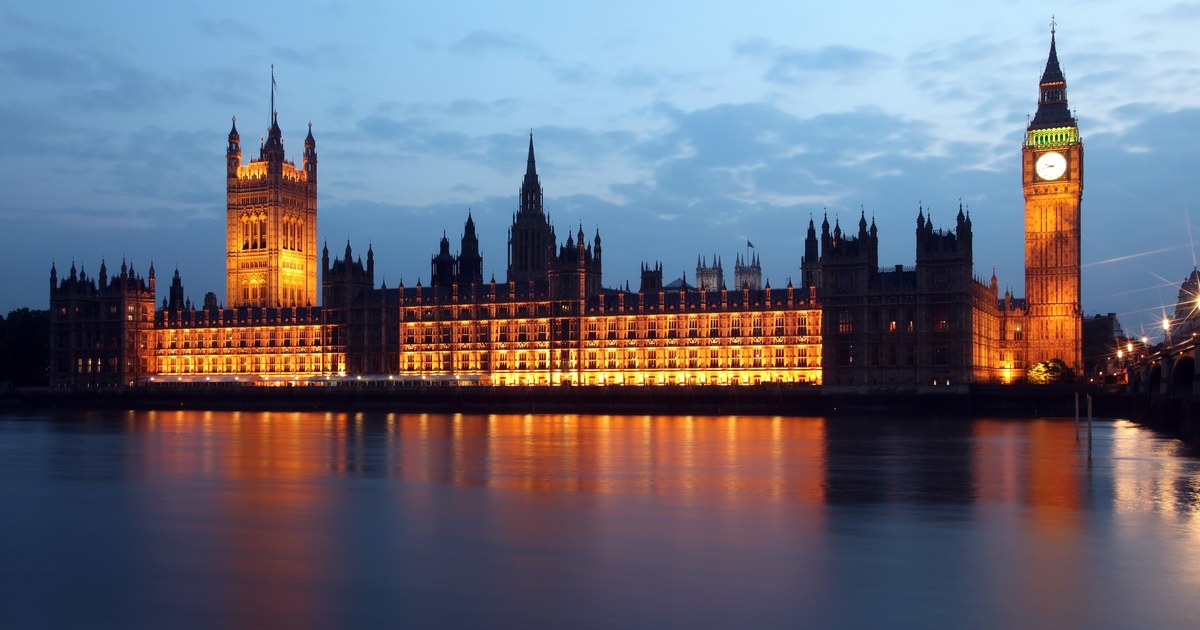
The best free view of the palace is from the South Bank. Walk along the river towards Westminster Bridge, and the whole riverside front opens up across the water. Dusk is the best time, when the lights come on and the stone turns gold, as in the photo above. Our guide to Westminster and the South Bank lays out the walk.
If you want to go inside, check the official UK Parliament website for the current tour options and booking rules before you travel. Tour times change, and it is best to book ahead.
The palace has another link to the Victorian city. Its riverside site gave builders a hard time, and the Thames smell drove members out of the chambers in 1858, an episode we describe in the Great Stink of 1858. For another famous London fire, read how the Great Fire of 1666 began in a bakery.
Frequently Asked Questions
When did the Palace of Westminster burn down?
The fire started on the evening of 16 October 1834. It destroyed most of the old palace in one night, including both the Lords and Commons chambers. Westminster Hall survived.
Who designed the new Palace of Westminster?
Charles Barry won the 1836 competition and planned the building. Augustus Pugin designed the Gothic detail and the interiors. Most of the palace stood complete by about 1870.
Is Big Ben the tower or the bell?
Big Ben is the great bell inside the Elizabeth Tower. People often use the name for the whole tower and the clock, but strictly it means the bell, which weighs about 13.8 tonnes.
Join 3,000+ London Lovers
Every week, get London’s hidden history, heritage walks, and stories from the city’s remarkable past — straight to your inbox.
Subscribe free — enter your email:
Already subscribed? Download your free London guide (PDF)
Free forever · One email per week · Unsubscribe anytime