
In August 1939, workers laid three feet of concrete across the ceiling of a basement below a government building in Westminster. Two weeks later, Germany invaded Poland. Britain declared war — and Winston Churchill needed somewhere to run it from. That place still exists today, unchanged from the moment the lights went out on 16 August 1945.
The Churchill War Rooms are one of London’s most extraordinary heritage sites — not because they have been carefully reconstructed, but because nobody ever changed them. When the war ended, the duty officer stopped the clock, walked out, and locked the door. For nearly forty years, the bunker sat undisturbed beneath the streets of Westminster.
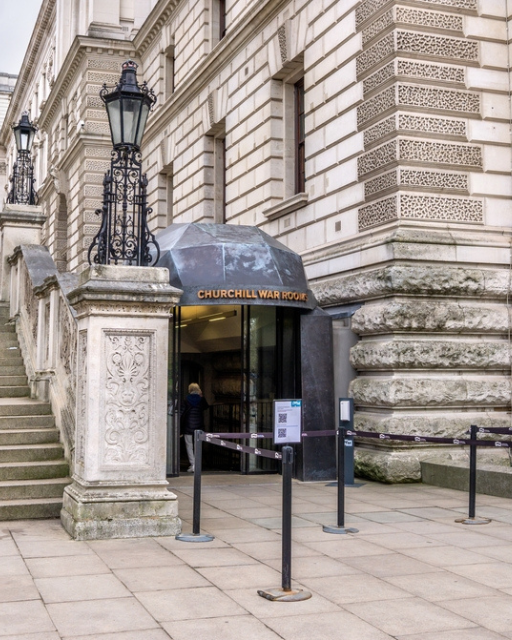
What Are the Churchill War Rooms?
The Churchill War Rooms sit beneath the Treasury building on King Charles Street, just a few minutes’ walk from Parliament Square and Westminster Underground station. During the Second World War, Britain’s senior ministers, military commanders, and Winston Churchill himself used this underground complex to direct the country’s war effort.
Work on the bunker began in 1938. The location was chosen because the building overhead had thick stone floors — enough to provide meaningful shelter during bombing raids. Workers reinforced the ceiling with concrete and fitted the rooms with emergency lighting, a ventilation system, and a telephone network that connected the bunker directly to military headquarters across Britain.
Churchill first used the Cabinet War Room on 17 August 1939. Over the next six years, he returned 115 times. The rooms handled some of the most significant decisions of the entire conflict — from the evacuation of Dunkirk to the planning of D-Day.
The Map Room: Where the War Was Planned
The Map Room is the room most visitors think about long after they leave. Maps covered the walls, tracking every Allied convoy crossing the Atlantic, every U-boat position in the North Sea, and every shifting front line across North Africa, the Pacific, and Europe.
Officers worked here around the clock in eight-hour shifts, receiving coded intelligence from across the globe and plotting the war’s progress in real time. Each piece of information arrived by telephone or dispatch rider, and duty officers updated the maps continuously — adding pins, moving flags, redrawing lines as the situation changed.
The pins and coloured threads you see today are positioned exactly where they stood on 16 August 1945 — the last day anyone worked here. When peace came, the duty officer simply set down his pen and left. Nobody moved a thing. The maps still show the world as it looked in the moment the war ended.
That detail — an entire war frozen at the precise moment of its ending — is what makes this room unlike almost anything else in London. You are not looking at a reconstruction. You are looking at the actual war.
The Cabinet Room: Where Ministers Made the Decisions
Just along the corridor from the Map Room, the Cabinet Room held 36 meetings of the War Cabinet during the conflict. The table stands exactly as it did during those sessions, with notepads and pencils at each place. Churchill sat at the centre of the curved table, his back to the map on the wall.
Here, the senior ministers and military chiefs discussed the decisions that shaped Britain’s survival. They debated the terms of the Atlantic Charter with the United States. They received news of Pearl Harbor and considered how to respond. They planned the campaigns in North Africa and Italy before the invasion of Normandy in 1944.
The room is small. Sit in the chair at the centre of that table and you realise how close together the men who ran the war actually sat. There was nothing grand about it. The ceiling was low, the walls bare, the lighting functional. These were working conditions, not ceremonial ones.
🏙️ Enjoying this? 3,000 London lovers get stories like this every week. Subscribe free →
Churchill’s Private Suite: The Phone That Changed the War
Churchill slept in the bunker only three times, preferring the relative comfort of Downing Street. But his private suite — converted from a broom cupboard — holds something more significant than a bed.
Beside the narrow cot stands a transatlantic telephone, installed in 1943. This device, codenamed SIGSALY, connected Churchill directly to President Roosevelt in Washington. The two men used it to coordinate Allied strategy, including the planning of the Normandy landings. The connection was so secret that fewer than a dozen people in Britain knew it existed.
The phone looks ordinary. A black receiver on a wooden desk. But this was the instrument through which Churchill and Roosevelt made the decisions that shaped the final years of the war. It remains in exactly the same position where they left it.
The People Who Kept the Bunker Running
The Cabinet War Rooms were not just a meeting place for senior officials. Hundreds of staff worked in the wider underground complex, maintaining operations through every raid London endured.
Telephonists, stenographers, cipher clerks, and analysts kept the communications running around the clock. Many were young women recruited from the civil service, relocated to work underground for months at a stretch. They slept in dormitories nearby, ate in a communal canteen, and handled intelligence so sensitive they could not discuss it with their own families.
The working conditions were difficult. The ventilation system struggled to manage the heat and the cigarette smoke from dozens of people working in confined spaces. Staff heard the bombs landing above them but had no way to know what damage each raid caused. They could not leave their posts during attacks — and many finished shifts to find that their homes in other parts of London had been destroyed.
Most of these women remained bound by the Official Secrets Act for decades after the war ended. Several spoke publicly about their work for the first time in the 1990s, when the restrictions finally lifted. Their contributions, invisible at the time, are now acknowledged in the museum’s permanent exhibition.
How the Location Stayed Secret
The entrance on King Charles Street carried no signage. Government workers who used a separate entrance nearby had no idea what operated below them. Even those who worked inside referred to it only as “the office” in conversation — never by name, never by location.
German intelligence knew Churchill maintained an underground command centre somewhere in Westminster. They identified the general area but never pinpointed the building. London’s anti-aircraft defences and the RAF’s night fighters kept German bombers from conducting the precise targeting that might have revealed the site.
The War Rooms remained classified until 1984, when the site opened to the public for the first time. Visitors entered the rooms to find them exactly as the staff had left them nearly forty years earlier. The cigarette ends were still in the ashtrays.
Visiting the Churchill War Rooms Today
The Imperial War Museum manages the Churchill War Rooms and has preserved both the underground Cabinet War Rooms and the Churchill Museum, added in 2005. The Cabinet War Rooms occupy the original bunker space and display the rooms as they appeared in 1945. The Churchill Museum tells the full story of Churchill’s life through personal objects, original documents, and interactive displays.
The museum holds one of the largest Churchill collections in the world. You will find his famous siren suits, personal letters, and the telegram he sent to Eisenhower on the morning the Normandy invasion began. The displays cover his early career in journalism, his time as a soldier in the Boer War, and his two terms as Prime Minister before and after the conflict.
Budget at least two hours for a full visit. The underground rooms are not large, but the detail in them rewards close attention. Audio guides are available in several languages and include original recordings of wartime broadcasts. The guides explain not just what each room contained, but how it functioned during specific phases of the war.
The Churchill War Rooms stand on King Charles Street in Westminster, a short walk from Westminster Underground station (Circle and District lines). They open daily from 9.30am to 6.00pm, with last entry at 5.00pm. Adult tickets cost £29.00 as of 2026; Imperial War Museum members and children under 15 enter free. Book in advance through the Imperial War Museum website to avoid queues — the site draws large numbers throughout the year, particularly during school holidays.
Arriving before 10.00am or after 3.00pm gives you more space in the underground rooms, where narrow corridors can become crowded during peak hours. Photography is permitted throughout the site.
Frequently Asked Questions About the Churchill War Rooms
How long should I spend at the Churchill War Rooms?
Allow at least two hours for a thorough visit. The underground Cabinet War Rooms take around 45 minutes to explore at a comfortable pace, and the Churchill Museum requires another hour to do justice to its displays. If you plan to read exhibit panels carefully or use the full audio guide, three hours is more realistic.
Are the Churchill War Rooms suitable for children?
The museum suits children aged eight and over reasonably well. Children under 15 enter free. The underground rooms are genuinely atmospheric and tend to capture the attention of older children. The Churchill Museum’s interactive elements also engage younger visitors. Pushchairs and prams are not permitted in the underground sections — the corridors are too narrow — so bring a sling or carrier for very young children.
Can I visit the Churchill War Rooms without booking in advance?
You can buy tickets at the door, but queues during peak season — school holidays and summer months — can run to 30 minutes or more. Booking online in advance through the Imperial War Museum website guarantees entry at your preferred time and costs nothing extra. The museum also offers combined tickets with other IWM sites, including HMS Belfast on the South Bank.
How close are the Churchill War Rooms to other Westminster attractions?
The War Rooms sit within easy walking distance of Westminster’s major landmarks. The Houses of Parliament and Big Ben are a five-minute walk north. St James’s Park is directly opposite the entrance. Buckingham Palace is a ten-minute walk west. You can combine a visit to the War Rooms with Westminster Abbey, the National Gallery, or a boat trip on the Thames, all within the same afternoon.
Join 3,000+ London Lovers
Every week, get London’s hidden history, heritage walks, and stories from the city’s remarkable past — straight to your inbox.
Subscribe free — enter your email:
Already subscribed? Download your free London guide (PDF)
Love more? Join 64,000 Ireland lovers → · Join 43,000 Scotland lovers → · Join 30,000 Italy lovers →
Free forever · One email per week · Unsubscribe anytime