
The Blitz began on 7 September 1940. That evening, 348 German bombers crossed the English Channel and dropped incendiary bombs on London’s East End docklands. Fires lit the sky. Over the next 57 consecutive nights, German aircraft bombed London without pause. By the time the raids ended in May 1941, more than 43,000 British civilians had died — around half of them in London.
For American visitors, the Blitz carries a particular pull. Thousands of American families have London connections from this era. Some had relatives who sheltered through the raids. Others had grandparents who worked alongside Londoners in the war effort. A remarkable number of Americans have British ancestors who lived through the bombing — ordinary people whose courage shaped modern history.
London still bears the marks. You can walk streets the German bombers targeted, step inside churches left deliberately ruined as memorials, and visit the underground bunker where Churchill directed the war. This guide shows you where to go, what to look for, and how to research your own family’s wartime story.
St Paul’s Cathedral: The Symbol That Refused to Fall
The most famous image of the Blitz shows St Paul’s Cathedral rising through smoke and flames on the night of 29 December 1940. German bombers had targeted the surrounding City of London with incendiary devices. Warehouses and offices burned all around. But the cathedral stood.
Winston Churchill personally ordered firefighters to protect St Paul’s at all costs. The dean and a team of volunteers climbed the dome each night during raids to dislodge incendiary bombs before they could take hold. Several bombs hit the building directly. One unexploded bomb dropped beside the main foundation — engineers had to defuse and move it with extreme care to prevent the whole structure from collapsing.
Today you can visit St Paul’s and see the Blitz memorial book in the crypt — a record of every Londoner who died during the bombing. If your family lived in the City, you may find a name you recognise. The cathedral also holds the American Memorial Chapel, dedicated in 1958. It honours the 28,000 American servicemen and women who died while based in Britain during the Second World War. The names fill the three windows flanking the altar.
Address: St Paul’s Churchyard, London EC4M 8AD
Nearest Tube: St Paul’s (Central line)
Hours: Monday–Saturday 8:30am–4:30pm; Sunday openings vary — check the cathedral website before visiting.
🏛️ Free Guide: How to Trace Your English & British Ancestry
Step-by-step: GRO records, census 1841–1921, parish registers, the National Archives (Kew), London Metropolitan Archives, and planning a heritage trip. Completely free.
Get the Free Guide → Subscribe free at the guide page to receive weekly London heritage storiesSt Dunstan-in-the-East: A Church Left in Ruins
Walk east from St Paul’s along Cannon Street, then south toward the river, and you’ll find one of London’s most haunting Blitz sites.
St Dunstan-in-the-East ranked among the oldest churches in the City of London. Christopher Wren rebuilt its tower and steeple after the Great Fire of 1666. For nearly 300 years it served the surrounding community. Then the Blitz destroyed most of it.
German bombs gutted the church in 1941. The roof collapsed. The walls cracked and crumbled. After the war, the City of London decided not to rebuild the interior. Instead, the ruins became a public garden.
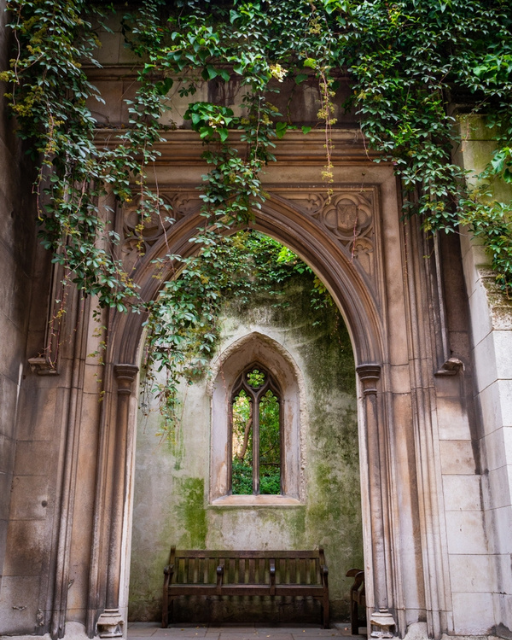
Today ivy-covered Gothic arches frame a quiet courtyard with fountains and benches. Wren’s tower still stands at one end. Roses and climbing plants fill the gaps where walls once rose. Office workers eat their lunch here. Tourists step inside and go quiet.
St Dunstan-in-the-East rewards slow exploration. Walk the full perimeter of the ruins. Look for the scorch marks still visible on some of the older stonework. Stand inside the arch and look up at the open sky where the roof once was. This is what the Blitz actually did to London — and this is what London chose to keep.
Address: St Dunstan’s Hill, London EC3R 5DD
Nearest Tube: Monument (Circle and District lines)
Hours: Open daily, dawn to dusk. Free entry.
The Churchill War Rooms: Underground Command Centre
During the worst of the bombing, Churchill and his war cabinet moved underground. A suite of reinforced basement rooms beneath Whitehall became the nerve centre of Britain’s war effort.
Churchill slept here. His cabinet met here. Planners and codebreakers worked in these low-ceilinged rooms while bombs fell overhead. The original map room still shows Europe as it looked in 1945, with coloured pins marking the final days of the war.
The Imperial War Museum preserves the Churchill War Rooms exactly as they stood at the end of the war. The telephone exchange, the sleeping quarters, the kitchen, the private office — all remain. You can stand in the room where Churchill made his most famous broadcasts. Adjacent to the original rooms, the Churchill Museum tells his full story with documents, photographs, and personal items. A six-metre interactive table lets you browse the entire span of his life.
Address: Clive Steps, King Charles Street, London SW1A 2AQ
Nearest Tube: Westminster (Circle, District, Jubilee lines)
Hours: Daily 9:30am–6pm (last entry 5pm)
Admission: Adults £32; advance booking recommended during peak season.
🏙️ Enjoying this? 3,000 London lovers get stories like this every week. Subscribe free →
The East End: Where the Blitz Hit Hardest
German bombers targeted London’s East End first because it sat closest to the docks — the engine of British trade and supply. Stepney, Whitechapel, Poplar, and Bethnal Green took some of the heaviest raids of the entire campaign.
The bombing destroyed thousands of homes. Entire streets vanished. Families who had lived in the same terraces for generations suddenly had nothing. The East End communities scattered to evacuation billets in the countryside or rebuilt in the same neighbourhoods after the war.
If your family came from the East End — particularly if they arrived in the late 19th or early 20th century as Jewish, Irish, or Eastern European immigrants — the Blitz almost certainly touched their lives directly.
Bethnal Green Tube Disaster Memorial
On 3 March 1943, a false air-raid alarm triggered a rush of people into Bethnal Green Underground station. The crowd surged down the stairs. A woman tripped near the bottom. The crush became catastrophic. 173 people died in minutes — the worst civilian disaster of the entire war — without a single bomb falling.
For decades the authorities kept the event quiet, in part to avoid damaging public morale. Only in recent years did a proper memorial appear outside the station entrance. If you had family in Bethnal Green during the war, visit this site. It tells you something real about the fear that ordinary Londoners carried every night.
Address: Bethnal Green Underground station, Cambridge Heath Road, London E2 9AL
Nearest Tube: Bethnal Green (Central line). Free to visit; the memorial stands outside the station entrance.
How to Trace Your Family’s London Blitz Story
Thousands of American families have London ancestors who lived through the Second World War. Some stayed in London throughout. Others evacuated — children sent to the countryside, parents left behind. Still others served in the Home Guard, the Auxiliary Fire Service, or the Women’s Voluntary Service. Several archives hold records from this period.
The National Archives (Kew)
The National Archives holds the most comprehensive collection of British government records from the war years. Researchers can access Air Raid Precautions (ARP) warden records — these list the wardens responsible for specific streets and districts. Bomb census maps show where every recorded bomb fell across London. Researchers can access many of these records online at nationalarchives.gov.uk or visit in person.
Address: Kew, Richmond, Surrey TW9 4DU
Nearest Station: Kew Gardens (District line or London Overground)
London Metropolitan Archives
The London Metropolitan Archives holds parish records, council records, and civil registration documents for Greater London. If your ancestor lived in London before and during the war, their records likely sit here — birth, marriage, and death certificates; electoral registers; hospital records.
The archive also holds the London Bomb Damage Maps — a complete set of Ordnance Survey maps marked by hand during and after the Blitz to record every bombed building in the city. You can look up a specific address and see what happened to it. This is one of the most remarkable genealogical tools available for WWII London research.
Address: 40 Northampton Road, London EC1R 0HB
Nearest Tube: Farringdon (Circle, Metropolitan, Hammersmith & City, Elizabeth lines)
The Imperial War Museum
The Imperial War Museum holds personal diaries, letters, photographs, and oral history recordings from British civilians who lived through the Blitz. Researchers can access many of these collections directly — the museum’s online catalogue lists what is available for study. The museum also runs regular exhibitions on the Second World War that bring individual stories into sharp focus.
Address: Lambeth Road, London SE1 6HZ
Nearest Tube: Elephant & Castle (Bakerloo and Northern lines) or Lambeth North (Bakerloo line)
Planning Your WWII London Heritage Visit
A focused Blitz heritage day works well if you keep the geography in mind. The City of London sites — St Paul’s and St Dunstan-in-the-East — cluster together and work as a morning walk. Add the Monument (built to commemorate the Great Fire, but standing in the heart of the Blitz damage zone) as a short detour. The Churchill War Rooms sit in Westminster, best as a separate afternoon visit. The East End and Bethnal Green require their own half-day.
The London Metropolitan Archives requires no advance booking for general research, but arrive early — seats are limited and the reading rooms fill quickly during peak season. The National Archives at Kew is best booked in advance if you want specific document boxes retrieved. Both archives offer free access to their reading rooms; some records carry fees for document retrieval or digital copies.
For American visitors researching family connections, the American Embassy website lists resources on the GI heritage trail — a self-guided walk through central London marking sites connected to the millions of American servicemen and women who passed through Britain between 1942 and 1945.
Frequently Asked Questions About the London Blitz
What is the best WWII heritage site to visit in London?
The Churchill War Rooms offer the most complete immersive experience of wartime London — you walk through the actual bunker where Churchill directed the war. For a free and deeply moving visit, St Dunstan-in-the-East costs nothing and requires no booking. The ruins of this Blitz-bombed church sit open daily in the heart of the City of London.
How can I find out if my London ancestors survived the Blitz?
Start at the London Metropolitan Archives (40 Northampton Road, EC1R 0HB). The Bomb Damage Maps let you look up any London address and see whether bombers struck it. Civil registration records — deaths, marriages, and births from the war years — are available there and through the General Register Office. The National Archives at Kew holds additional ARP warden records and casualty documentation.
Can I access London Blitz records online before visiting?
Yes. The National Archives publishes many WWII-era records through their online Discovery catalogue at nationalarchives.gov.uk. Ancestry.co.uk holds digitised London civil registration records and electoral rolls from the 1930s and 1940s. The London Bomb Damage Maps are available to view in person at the London Metropolitan Archives, and a partial digital version appears through the London Picture Archive at lma.culturegrid.org.uk.
Join 3,000+ London Lovers
Every week, get London’s hidden history, heritage walks, and stories from the city’s remarkable past — straight to your inbox.
Subscribe free — enter your email:
Already subscribed? Download your free London guide (PDF)
Love more? Join 64,000 Ireland lovers → · Join 43,000 Scotland lovers → · Join 30,000 Italy lovers →
Free forever · One email per week · Unsubscribe anytime