
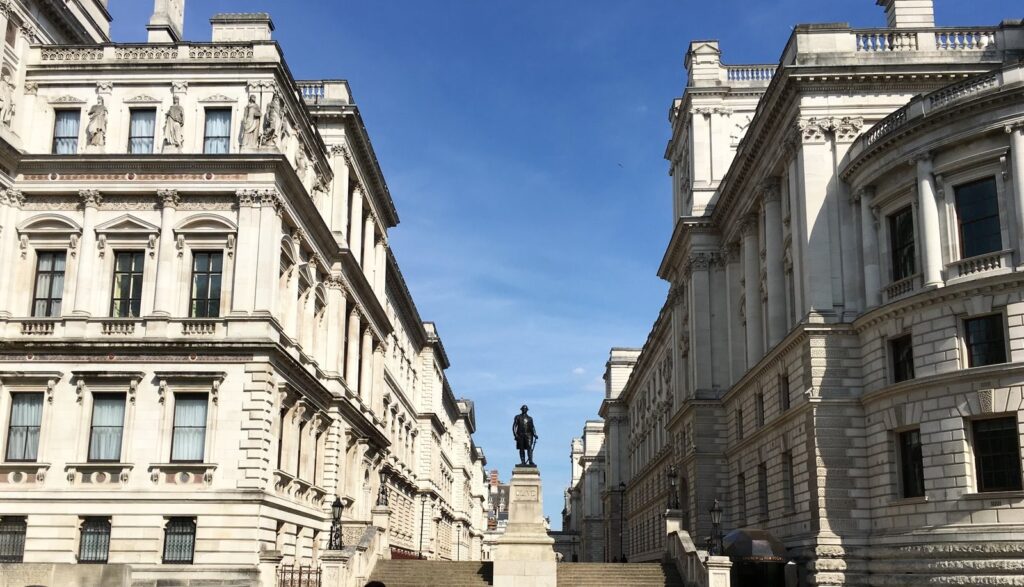
The door to the Churchill War Rooms sits at the bottom of a set of steps on King Charles Street, Westminster. Blink and you’d miss it. Yet behind that plain entrance lies the room where Britain decided to keep fighting — and changed the course of history.
The Churchill War Rooms are London’s most powerful WWII heritage site. They’re not a replica or reconstruction. They’re the real thing, preserved exactly as they were left on the day Japan surrendered in August 1945. The Map Room still has the same pins in the same maps. The same clocks tick on the same walls. The same biscuit tin sits beside Churchill’s desk.
If you have any interest in the Second World War, London history, or what it actually felt like to live through the Blitz, this is where you need to go.
How the War Rooms Came to Be
By 1938, Britain knew war was coming. The question was whether London — and particularly the government — would survive German bombing.
A small group of civil servants identified a set of basement rooms beneath the Treasury building on King Charles Street. The ceilings were reinforced with concrete. The walls were thick enough to offer some protection from bombs. It wasn’t perfect, but it was the best option available.
Workers transformed the space in secret throughout 1939. They installed telephone lines, communications equipment, sleeping quarters, and a Map Room where staff would track the war around the clock. On 27 August 1939 — just days before Germany invaded Poland — the rooms were declared ready.
Churchill himself didn’t become Prime Minister until May 1940. But once he took charge, the War Rooms became central to the British war effort. He held Cabinet meetings here. He slept here during the worst of the Blitz. He used a specially installed telephone in a small cupboard to speak directly with President Roosevelt in Washington.
The staff who worked here — many of them young women — spent months or years underground. They knew they couldn’t talk about what they did. Their families had no idea where they went every day.
What You’ll See Today
The War Rooms cover a large underground complex, and the museum takes you through the most important sections.
The Map Room is the heart of it. Officers worked here 24 hours a day, every single day, from 1939 to 1945 — 2,069 consecutive days without a break. They tracked every convoy, every battle, every movement across every theatre of the war. The pins are still in the maps. The coloured telephones on the desks — different colours for different military services — are still in place. Standing in this room, you understand what it meant to run a global war from a basement.
The Cabinet Room is where Churchill met with his War Cabinet during the heaviest bombing raids. The table, the chairs, the green baize — all original. Churchill sat at the middle of the long side of the table, not at the head. He wanted to see everyone at once. You can sit in the room and look at exactly what he looked at.
Churchill’s bedroom is spare and functional. A single bed, a chamber pot, a desk with a microphone used for his radio broadcasts. Churchill didn’t actually sleep here very often — he preferred to stay at 10 Downing Street even during the Blitz — but the room was always ready.
The Transatlantic Telephone Room is one of the most fascinating spaces in the building. For much of the war, Churchill spoke with Roosevelt through a scrambled phone line from this tiny cupboard. The technology was called SIGSALY, and the Americans built the first machine in Washington. The London version sat at the other end of this room. Churchill reportedly hated using it because the scrambling made his voice sound artificial.
The Churchill Museum
Attached to the War Rooms is the Churchill Museum, which opened in 2005. It covers Churchill’s entire life — from his birth at Blenheim Palace in 1874 to his death in 1965.
The centrepiece is a 15-metre-long interactive table that documents every year of Churchill’s life in extraordinary detail. You can pull up speeches, photographs, documents, and newspaper reports from any period. Churchill was a complicated figure — brilliant, flawed, often wrong, occasionally visionary — and the museum doesn’t shy away from that complexity. You’ll read about his failures as much as his successes.
Look for the original documents on display throughout the museum. There are handwritten notes from Cabinet meetings, personal letters, and draft speeches with Churchill’s corrections in pen. His handwriting is surprisingly clear.
🏙️ Enjoying this? 3,000 London lovers get stories like this every week. Subscribe free →
The People Who Worked Here
The staff of the War Rooms are often overlooked in favour of Churchill himself. But roughly 500 people worked in the complex at any one time, many of them drawn from the Auxiliary Territorial Service (the women’s branch of the British Army) and the Civil Service.
They came to work every day not knowing if the building above them would still be standing when they left. They slept in cramped dormitories. They couldn’t discuss their work with anyone outside. When the war ended, many of them returned to civilian life without ever being publicly recognised for what they’d done.
One of the most remarkable staff members was Elizabeth Layton, Churchill’s personal secretary. She transcribed his dictated speeches, correspondence, and memos at extraordinary speed — often in the middle of the night, while bombs fell above. Her shorthand notes still survive. She described Churchill as an exacting but fair employer who regularly dictated correspondence in his bath.
The Map Room was staffed by officers from all three services — Army, Navy, and Air Force. They worked six-hour shifts around the clock. A duty officer was on call at all times to wake Churchill if developments demanded it.
Visiting Practically
The War Rooms are at Clive Steps, King Charles Street, Westminster. The nearest Tube stations are Westminster (Circle, District, Jubilee lines) and St James’s Park (District, Circle lines). Both are roughly a five-minute walk.
The museum opens at 9:30am daily and closes at 6pm. The last entry is at 5pm. Allow at least two hours — more if you intend to spend time in the Churchill Museum section.
Tickets cost around £30 for adults and £15 for children. Under-fives get in free. The museum runs under the Imperial War Museum, and a combined ticket also gives you access to IWM London in Lambeth.
The site has full accessibility, including lift access to the underground level. Audio guides are available in several languages, and the museum offers free entry for serving military personnel.
Book in advance. The Churchill War Rooms are one of London’s most popular museums, and weekend morning slots fill quickly, especially in summer and around school holidays.
Why This Place Matters
Most WWII museums present the war through the experience of soldiers. The Churchill War Rooms present it through the experience of decision-makers — and through the ordinary people who supported them.
Standing in the Cabinet Room, you think about what it meant to keep going when France had fallen, when German U-boats threatened to cut Britain off from supplies, when night after night the Luftwaffe bombed British cities. The people in these rooms voted to carry on. They chose to fight. That decision cost hundreds of thousands of lives. It also ended the war.
The rooms were preserved rather than restored. Nobody added anything to make them look more dramatic. What you see is what was there. That absence of staging is what makes the place so powerful.
This is London at its most serious. It’s worth a morning of anyone’s time.
Join 3,000+ London Lovers
Every week, get London’s hidden history, heritage walks, and stories from the city’s remarkable past — straight to your inbox.
Subscribe free — enter your email:
Already subscribed? Download your free London guide (PDF)
Free forever · One email per week · Unsubscribe anytime
Frequently Asked Questions
How long does it take to visit the Churchill War Rooms?
Most visitors spend between 90 minutes and two and a half hours. Allow more time if you plan to explore the Churchill Museum in depth — that section alone can take an hour.
Do I need to book tickets in advance?
Yes. The War Rooms are popular and timed entry slots can sell out, particularly at weekends and during school holidays. Book online at the IWM website before your visit.
Is the Churchill War Rooms site accessible for wheelchairs and pushchairs?
Yes. The museum has lift access to the underground level and is fully wheelchair accessible. Staff are on hand to assist visitors with mobility requirements.