
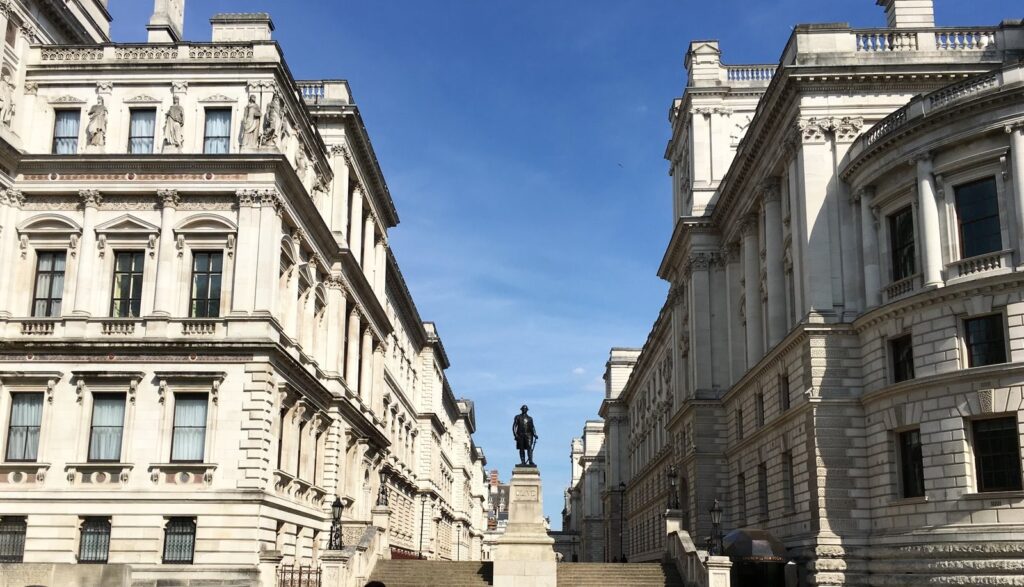
The Churchill War Rooms sit beneath King Charles Street in Westminster, hidden under 3 metres of reinforced concrete. This bunker served as the nerve centre of Britain’s war effort from 1939 to 1945, and every room has been preserved exactly as it was on 16 August 1945 — the day the lights went out for the last time. Today it is one of the most visited heritage sites in London, and one of the most powerful experiences the city offers any visitor with an interest in history.
Want more London history stories? Subscribe free to the London weekly newsletter →
What the Churchill War Rooms Are
During the Second World War, British cities faced nightly bombing raids from German aircraft. London was hit hardest. Between September 1940 and May 1941 — the period known as the Blitz — the Luftwaffe dropped over 43,000 tonnes of bombs on London. More than 30,000 Londoners were killed in that single campaign.
To keep the government running through the bombing, officials prepared a protected base beneath Whitehall. The Cabinet War Rooms — as they were originally called — were purpose-built in an existing basement beneath the Government Offices on King Charles Street. They were ready for use by August 1939, just weeks before war was declared on 3 September 1939.
Winston Churchill used the bunker as his primary base of operations from October 1940. The rooms below ground included the Cabinet Room, where the War Cabinet met 115 times during the conflict; the Map Room, staffed 24 hours a day throughout the entire war; Churchill’s private bedroom and office; and the transatlantic telephone room, where he spoke directly with US President Franklin D. Roosevelt.
The Map Room: Heart of the Bunker
When you walk into the Map Room today, you are stepping into one of the most extraordinary preserved spaces in the world. This is where Britain’s military commanders tracked the progress of the war using pushpins, coloured thread, and paper maps mounted on boards covering every wall.
The clocks on the wall still show the time zones of the Atlantic convoys. The telephones are in place. The duty officers’ chairs face the maps. Nothing has moved since V-J Day in August 1945, when the last duty officer turned off the lights and left.
The Map Room was staffed continuously for 2,114 days — every hour of every day from August 1939 until the end of the war in the Pacific. Men and women rotated through shifts around the clock, tracking everything from convoy movements in the North Atlantic to battles in North Africa and the Pacific. They worked in a room with no natural light, fresh air drawn in through ventilation shafts, and the constant knowledge that bombs were falling somewhere above them.
Churchill’s Private Rooms
Churchill’s bedroom in the bunker is surprisingly modest. A single bed. A bedside cabinet. A gas mask on the table beside it. The room shows a man who had reduced personal comfort to the minimum required to function.
His private office next door is more revealing. Churchill worked through many nights in this room, dictating speeches and memos when he could not sleep. His famous wartime broadcasts were mostly recorded at the BBC, but it was in rooms like this that his words were first written.
The transatlantic telephone exchange contained the world’s first scrambled telephone line, a classified device codenamed SIGSALY. The technology allowed Churchill to speak securely with Roosevelt in Washington without fear of German interception. The equipment filled an entire room and weighed over 50 tonnes. Churchill reportedly told curious visitors that the large box in the corner was a special type of toilet.
🏙️ Enjoying this? 3,000 London lovers get stories like this every week. Subscribe free →
The London Blitz: What the City Endured
To understand the Churchill War Rooms fully, you need to understand what was happening above ground.
The Blitz began on 7 September 1940. That first night, 348 German bombers flew up the Thames and dropped incendiary bombs across east London and the docks. The fires burned for days. Over 400 Londoners died in that single raid.
The bombing continued every night for 57 consecutive nights. After a brief pause, it continued — less regularly but just as destructively — until May 1941. By the end of the Blitz, over 1.4 million homes across London had been damaged or destroyed. Around 30,000 Londoners had been killed. Entire streets in the East End, the docks, and the City of London were flattened.
And yet the city kept working. Buses ran. Shops reopened the morning after raids. The Underground provided shelter for tens of thousands of people each night. Churchill’s government continued to meet in the bunker beneath Whitehall. The phrase “Keep calm and carry on” — printed on wartime posters but little used at the time — has since become almost synonymous with the London spirit of that period.
Where the Ruins Still Stand: A Walk Through Blitz History
One of the most striking reminders of the Blitz stands less than 2 kilometres from the Churchill War Rooms. St Dunstan-in-the-East on St Dunstan’s Hill in the City of London was badly bombed in 1941 and was never rebuilt. Instead of demolishing the ruins, the City of London Corporation converted them into a public garden in 1967.
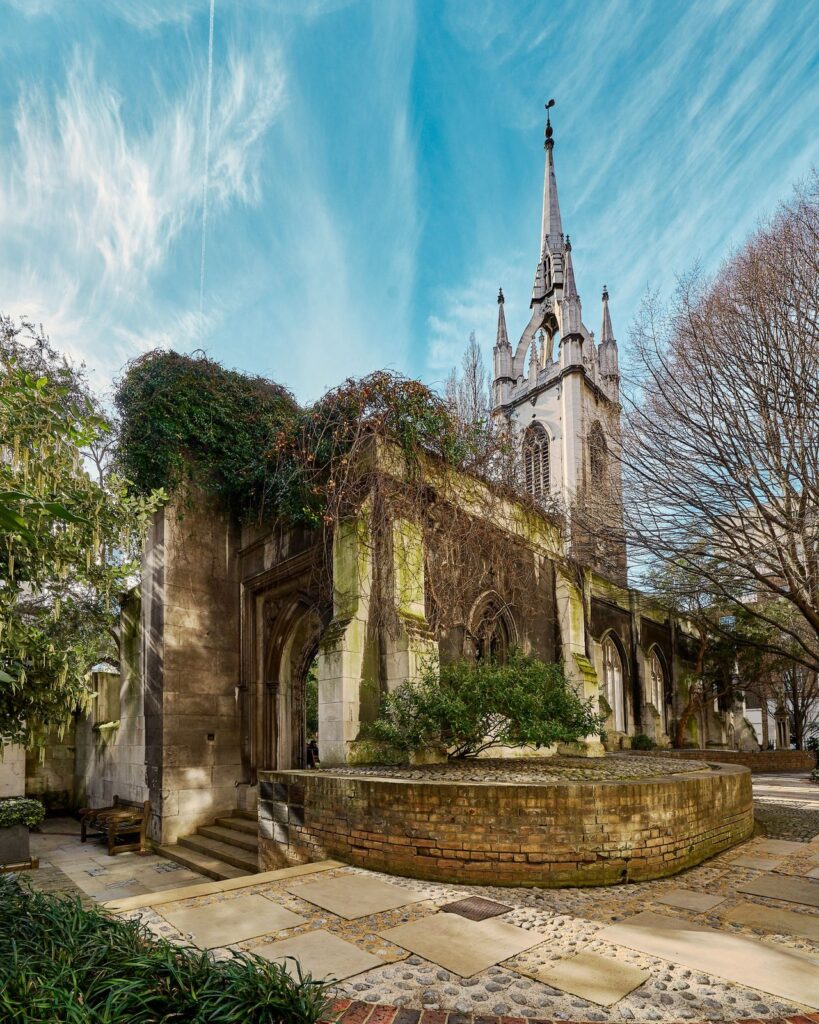
Today, ivy grows through the empty Gothic arches. A bench sits beneath a stone window frame that looks up at the open sky. On summer afternoons, office workers eat lunch where walls once stood. It is one of the most quietly powerful places in London, and almost no tourists find it.
St Paul’s Cathedral, a short walk away, offers another Blitz connection. The cathedral survived the bombing largely intact — famously photographed with its dome rising above the smoke in December 1940 — and the image became a symbol of London’s resilience. The cathedral is still standing. Many of the streets around it are not the same streets that stood before the war.
The Churchill Museum: His Full Story
When the Cabinet War Rooms first opened to the public in 1984, the experience focused entirely on the preserved underground rooms. In 2005, a permanent Churchill Museum was added alongside them, and the two now form a single site run by the Imperial War Museum.
The museum covers Churchill’s entire life, from his difficult childhood at Blenheim Palace to his early military career in Sudan and South Africa, his years as a journalist and author, his decades in Parliament, and his long period in the political wilderness during the 1930s. For most of that decade, Churchill warned publicly about the growing threat from Germany and was largely dismissed. When war came in 1939, he was proved right.
The centrepiece exhibit is a large interactive table allowing visitors to explore his life year by year. Artefacts on display include his wartime correspondence, his famous siren suit — a one-piece garment he wore like pyjamas in the bunker — and recordings of speeches that remain among the most stirring uses of the English language in the 20th century.
Planning Your Visit: Practical Information
The Churchill War Rooms are open every day from 09:30 to 18:00, with last entry at 17:00. They are located at Clive Steps, King Charles Street, Westminster, London SW1A 2AQ — a 5-minute walk from Westminster Underground station (District, Circle, and Jubilee lines) or St James’s Park station (District and Circle lines).
Admission in 2026 costs approximately £28 for adults and £14 for children aged 5 to 15. Children under 5 enter free. An audio guide is included with every ticket. Booking online in advance is recommended, particularly at weekends and during school holidays. Allow at least two hours for a thorough visit — longer if you plan to spend time in the Churchill Museum.
The site is managed by the Imperial War Museum, whose main museum in Lambeth is also free to enter and well worth a visit if you have a second day for London history.
🇬🇧 25 London Places Most Visitors Miss
From secret riverside walks to hidden Victorian tunnels, centuries-old pubs to rooftop gardens with skyline views — our free guide reveals the London most visitors never discover. Join 3,000+ London lovers who get it free.
Get Your Free 25-Places Guide →Already subscribed? Download your free London guide (PDF)
Free forever · One email per week · Unsubscribe anytime