
Most visitors arrive on Gerrard Street and think this is where the story begins. The ornate gates, the red lanterns swaying overhead, the smell of roast duck drifting onto the pavement. It feels ancient, settled, permanent.
You Might Also Love
It isn’t. The real Chinatown — the first one — was three miles east and a century older.
The Sailors Who Stayed
London’s Chinese community didn’t arrive in Soho. It arrived at the docks.
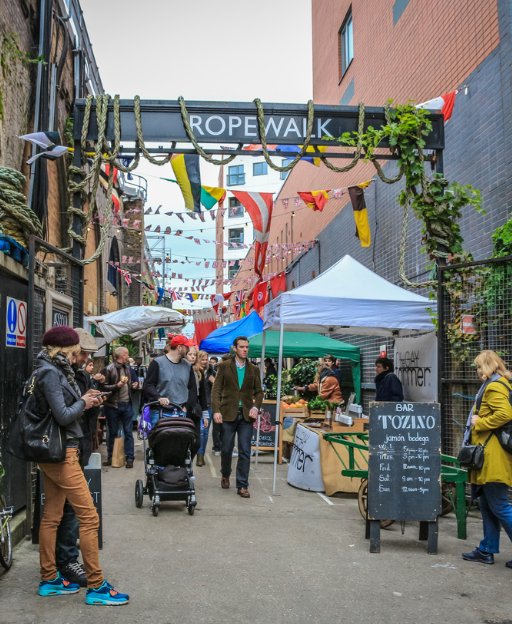
From the early 1800s, Chinese sailors working on East India Company ships began settling in Limehouse, a neighbourhood in the East End beside the Thames. They were experienced navigators, and the trade routes between Britain and China kept them moving back and forth. Some decided to stay.
By the 1880s, Limehouse had a small but distinctive Chinese quarter centred on Pennyfields and Limehouse Causeway. Laundries operated from terraced houses. Boarding houses served sailors passing through. Shops carried goods brought in from Guangdong. It was an ordinary working-class neighbourhood where people happened to speak Cantonese.
The Victorian press had other ideas. Journalists descended on Limehouse to write about opium dens and mysterious Orient, most of it wildly exaggerated. The neighbourhood became a fixture in penny dreadfuls and detective novels. Arthur Conan Doyle sent Sherlock Holmes there. Oscar Wilde based an opium scene in The Picture of Dorian Gray on its streets.
The real residents went about their lives and tried to ignore the spectacle.
A Community Under Pressure
The first decades of the twentieth century were not kind to London’s Chinese community.
The Aliens Order of 1920 placed strict restrictions on where foreign nationals could live and work. Chinese men who had married British women saw their families targeted. The tabloid press ran campaigns against the community that would look deeply racist by any modern standard. Sailors who might once have settled found themselves discouraged from doing so by law.
Despite all of this, the community held on. Mutual aid societies helped families in difficulty. Shared faith — a mix of Buddhism, Christianity, and folk religion — gave the neighbourhood cohesion. The rhythms of daily life continued: children walked to school, shops opened, meals were cooked.
Limehouse Chinatown never grew large. At its peak it was home to perhaps a few hundred permanent residents, with more sailors drifting through. But it was a community in the full sense — with memory, culture, and a sense of place. And it had survived for over a century.
How It Ended
Enjoying this article? Join thousands of London lovers who get our best stories delivered free every weekday morning.
The Second World War delivered the blow that the previous century of pressure had not quite managed.
The East End was bombed heavily during the Blitz. The docks were a primary target. Entire streets around Limehouse were destroyed. Residents scattered — some to other parts of London, some overseas, some simply gone. The community that had built itself on those narrow East End streets was dispersed in a matter of months.
When the war ended, the landscape of Limehouse had changed beyond recognition. The old streets were largely gone. Post-war planners redrew the area entirely. The few Chinese residents who had stayed found that the neighbourhood they had lived in for generations no longer existed.
For most of the 1950s, London’s Chinese community had no fixed centre. Families lived scattered across the city. There was nowhere that felt like theirs in the way Pennyfields once had.
A Fresh Start in Soho
Gerrard Street in the early 1960s was not an obvious candidate for a cultural revival.
It was a run-down West End backstreet known for jazz clubs, irregular businesses, and low rents. But low rents were exactly what a community rebuilding from scratch needed. Chinese restaurants began to appear, one by one, through the mid-1960s. Word spread. More businesses followed. By the early 1970s, Gerrard Street had become the unofficial centre of London’s Chinese community.
In 1974, the street was pedestrianised. This transformed it. Without traffic, the outdoor space opened up. Chinese businesses moved in more quickly. The street took on a different character — slower, more communal, oriented around food and gathering rather than cars passing through.
In 1985, two ornate ceremonial gates were installed at either end of the street, designed in a traditional Chinese style and partly funded by the Chinese government. London’s Chinatown had a front door. It also had, for the first time, a visible statement of permanence. If you want to explore more of London’s lesser-known layers, our free guide to London’s hidden gems covers some of the most surprising corners of the city.
When London Holds Its Breath
Each February, Chinatown does something no other part of London can replicate.
For Chinese New Year, Gerrard Street and the surrounding area fill with an estimated half a million people across the weekend celebrations. Lion dances move through the narrow alleys. Firecracker smoke rises above the rooftops. The restaurants run at full capacity from midday until long after midnight. The sound is extraordinary — drums, cymbals, the crack of firecrackers echoing off brick buildings that were once notorious jazz clubs.
The scale of it is hard to understand until you are standing in the middle of it. London is a city that tends to absorb things quietly, to fold difference into its own texture without making a fuss. Chinese New Year in Chinatown is the opposite. It is loud, unapologetic, and entirely itself.
It is one of the largest Chinese New Year celebrations outside Asia. And it happens on a street that, sixty years ago, barely existed as a community at all. London’s food culture runs deep — the secret side of Borough Market shows how food has always been at the heart of how Londoners mark their communities.
More Than a Postcode
There are around 120,000 people of Chinese heritage living in London today, spread across every borough from Barnet to Bromley.
Many of them rarely visit Gerrard Street. They don’t need to. The supermarkets of Cricklewood and the restaurants of Bayswater serve Chinese communities perfectly well. London’s Chinese population is too large and too spread out to be contained in a single postcode.
But Chinatown still matters. It is a landmark in the fullest sense — not just a place to eat, but a visible marker that says: we are here, we have been here, we are staying. The herbal medicine shops on the side streets carry remedies used for centuries. The supermarkets stock ingredients unavailable elsewhere in Central London. The restaurants serve dishes that families have been eating in London for four generations.
The gates on Gerrard Street went up in 1985, but the community behind them has been in London since the ships first docked at Limehouse in the early 1800s. Two centuries of presence, one displacement, and one rebuilding. That is what those red lanterns are actually celebrating.
Stand on Gerrard Street on a quiet Tuesday afternoon and it might just look like a street full of restaurants. Come back on Chinese New Year and you will understand what this place actually means.
Join 3,000+ London Lovers
Every weekday morning, get London’s hidden gems, culture, and travel inspiration — straight to your inbox.
Subscribe free — enter your email:
Love more? Join 65,000 Ireland lovers → · Join 43,000 Scotland lovers → · Join 30,000 Italy lovers →
Free forever · Unsubscribe anytime
Love London? So Do We.
Join our free newsletter and get the best of London — hidden walks, culture guides, food markets, and local stories — straight to your inbox every week.
Free. No spam. Unsubscribe anytime.