
London is a city of layers. Beneath the glass towers of the City, the Georgian terraces of Bloomsbury, and the Victorian brick of the East End lies something far older — a Roman city called Londinium, founded nearly 2,000 years ago and still visible, if you know where to look.
If your family has roots in England, the Romans may have shaped the very landscape your ancestors lived in for centuries. The streets they planned, the walls they raised, and the river crossing they chose still define how London works today. This is the story of Londinium — and a guide to finding it on foot.
How London Began: The Roman Founding of Londinium
The Romans arrived in Britain in 43 AD under Emperor Claudius, and within a few years they had chosen a site on the north bank of the Thames to build a settlement. The location was practical: a natural ford across the river, gravel banks firm enough to build on, and easy access to the coast for supply ships sailing from Gaul.
They called it Londinium. By around 50 AD, a wooden bridge had been built across the Thames — almost exactly where London Bridge stands today — and a grid of streets was being laid out across the hillsides on either side of what is now the Walbrook stream. Within two decades, Londinium had become the largest Roman settlement in Britain.
The city burned in 60 AD when Boudica, queen of the Iceni tribe, led a revolt that destroyed Londinium, Colchester, and St Albans. Archaeologists have found a thick layer of ash and destruction debris about half a metre underground across much of the modern City — a silent record of that catastrophic night. But the Romans rebuilt, and the new Londinium was grander than before. By the second century, it had a forum (the largest north of the Alps), a basilica, bathhouses, temples, a governor’s palace, and an amphitheatre.
🏙️ Enjoying this? 3,000 London lovers get stories like this every week. Subscribe free →
London Wall: The Most Visible Roman Ruin in the City
Around 200 AD, the Romans built a wall around Londinium. It was roughly three kilometres long, up to six metres tall, and nearly three metres thick at its base, constructed from Kentish ragstone brought up the Thames by barge. The wall defined the boundaries of the city for the next 1,600 years, and sections of it survive today — some standing to considerable height — hidden in plain sight across the modern City of London.
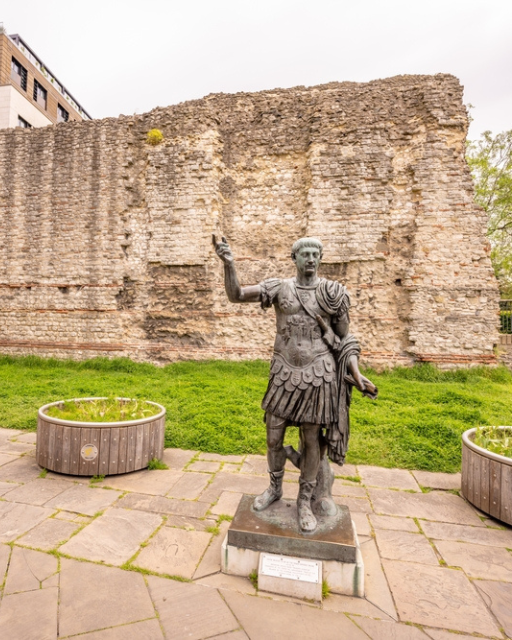
The best place to begin is Tower Hill, where a substantial section of the wall stands beside a bronze statue of Emperor Trajan, who presided over the empire at its greatest extent. The statue is a 1980 replica of a Roman original, but the wall behind it is the genuine article — Roman concrete and ragstone at the base, with medieval brick repairs layered on top as successive generations patched and rebuilt it over the centuries.
From Tower Hill, a walking route follows the line of the wall westward through the modern streets of the City. You’ll find more sections at Cooper’s Row, at Vine Street (where a considerable stretch stands in a car park that has been left deliberately open), and at Noble Street near the Museum of London. Each section tells the same story: a city that has been continuously inhabited since Roman times, built and rebuilt on top of itself, with the original Roman bones still visible at street level if you stop to look.
The Roman Amphitheatre Beneath Guildhall
One of the most remarkable Roman discoveries in London was made entirely by accident. In 1988, archaeologists excavating beneath the Guildhall Art Gallery found the remains of Londinium’s Roman amphitheatre — a large oval arena that could have held around 6,000 spectators. It was built in timber around 70 AD and later rebuilt in stone, used for gladiatorial combat, animal fights, and public executions.
The amphitheatre is open to the public today, accessed through a dedicated display beneath the Guildhall Art Gallery. The experience is atmospheric: you descend into a dimly lit underground space where the curved outline of the original arena has been marked on the floor in dark stone, and sections of the original Roman drainage system and foundations are preserved behind glass. It costs nothing to enter and takes about 30 minutes to explore properly.
Stand in the centre of the marked arena and look up. You are standing where gladiators once entered to the sound of 6,000 Londoners. Above you is the modern Guildhall Yard, where civic ceremonies have been held for centuries. The continuity is extraordinary.
The Museum of London Docklands: Roman Trade and the Thames
Londinium’s power derived entirely from the Thames. The river was the reason the Romans chose this site, and it was through the river that the city grew wealthy — importing wine, olive oil, pottery, and fish sauce from across the empire, and exporting grain, metals, wool, and slaves. The Museum of London Docklands tells this story through a permanent Roman gallery that includes reconstructed quayside buildings and finds from the Thames riverbed that continue to yield extraordinary objects after heavy rain lowers the water level.
The Thames foreshore itself is one of London’s most accessible Roman sites. At low tide, between Blackfriars and London Bridge on the north bank, mudlarkers regularly find Roman pottery shards, coins, and occasionally more significant objects. You can walk the foreshore at low tide legally with a free Thames foreshore permit from the Port of London Authority. The finds are not yours to keep (items over a certain age must be reported to the local finds liaison officer), but even spotting a red Roman pottery fragment underfoot is a tangible connection to the city that was here 1,900 years ago.
Billingsgate Roman House and Baths
Beneath a 1980s office building near London Bridge station lies one of the best-preserved Roman structures in Britain — the Billingsgate Roman House and Baths. The remains include a cold plunge bath, warm rooms, and the underfloor heating system (hypocaust) that circulated hot air beneath the floors — a technology that would not return to Britain until the industrial era. The structure dates from around the third century AD.
Access requires advance booking through the City of London Corporation, which runs tours on selected weekends throughout the year. The tours descend into the basement of the modern building to view the preserved remains, and they sell out quickly — booking several weeks ahead is recommended. This is not a site that makes it onto most tourist itineraries, which makes it all the more worthwhile for those interested in getting beyond the surface of London’s history.
Following Roman Streets on Foot
One of the quiet pleasures of walking the City of London is that many of its streets follow lines established by Roman surveyors 2,000 years ago. The Roman road now called Ermine Street ran north from Londinium and is preserved today in the long straight line of Old Street and Kingsland Road through Hackney and beyond. Watling Street — the great Roman road that ran from the Kent coast through London and northwest toward Wales — is preserved in the name of a street near St Paul’s Cathedral.
The streets within the old Roman city boundary (now roughly the Square Mile of the City of London financial district) reflect the original Roman grid in places. Cheapside follows the line of the main Roman east-west road. Cornhill, at the highest point of the Roman city, is where the forum stood — the administrative and commercial heart of Londinium, covering an area as large as Trafalgar Square.
A good self-guided walking route takes about two hours: start at the Museum of London Docklands, walk to London Bridge to look at the site of the original Roman crossing, follow the Wall Walk from Tower Hill westward to Aldgate, then cut across to the Guildhall amphitheatre, and finish at the surviving section of wall at Noble Street. Every step traces the boundaries of a city that has been continuously inhabited since the first century AD.
The Museum of London: The Best Roman Collection in Britain
The Museum of London — currently in the process of moving to a new home at West Smithfield, with the Barbican site closing in late 2025 — holds the finest collection of Roman London artefacts in the world. The gallery includes the mosaic floors lifted from Roman buildings, everyday objects like combs, shoes, and writing tablets, reconstructed rooms showing how wealthy Londinium residents lived, and an extraordinary range of personal items that make the Roman population feel vivid and immediate.
Among the most compelling finds are the writing tablets recovered from a Roman well in Bloomberg’s London headquarters during its construction. More than 400 wax writing tablets were preserved in the anaerobic mud, and when conserved, they revealed the oldest handwritten documents from Roman Britain — legal disputes, financial transactions, personal letters. One tablet, dated to 62 AD, records a debt for goods supplied. Another is a legal summons. These are the voices of Londinium’s inhabitants, preserved across two millennia.
Why Roman London Matters for American Visitors
For Americans with English ancestry — and there are tens of millions of you — the Roman layer of London is the foundation of a story that eventually led to your family’s presence in the United States. The Romans built the city your ancestors’ ancestors lived beside. The roads they paved were walked by medieval merchants whose descendants eventually crossed the Atlantic. The wall they built defined the area where English law, English commerce, and English language developed over centuries.
If you are tracing English roots, the genealogical records that survive begin in the medieval period — parish registers from the 1500s onwards, the civil registration system from 1837, census records from 1841. But the place those records describe was built on Roman foundations, and understanding the Roman layer gives depth to everything that came after it.
🏛️ Free Guide: How to Trace Your English & British Ancestry
Step-by-step: GRO records, census 1841–1921, parish registers, the National Archives (Kew), London Metropolitan Archives, and planning a heritage trip. Completely free.
Get the Free Guide → Subscribe free at the guide page to receive weekly London heritage storiesPractical Information for Visiting Roman London
Most Roman London sites are free to visit, concentrated within the Square Mile, and easily walkable. Here is a summary of the key sites and how to access them:
- London Wall sections at Tower Hill: Open air, always accessible. Take the Circle or District Line to Tower Hill. The Trajan statue and the wall section are immediately visible as you exit the station.
- Guildhall Amphitheatre: Free entry, open Monday to Saturday 10am–5pm, Sunday noon–4pm. Beneath Guildhall Art Gallery, Guildhall Yard, EC2V 5AE. Takes about 30 minutes.
- Billingsgate Roman Baths: Free, but requires advance booking for weekend tours. Book through the City of London Corporation website. Lower Thames Street, EC3R 6DX.
- Museum of London Docklands: Free entry, open daily. West India Quay, Canary Wharf, E14 4AL. Roman gallery is on the ground floor. Allow at least 90 minutes.
- Bloomberg London (Roman tablets): The Bloomberg Space at 3 Queen Victoria Street includes a free display of some of the writing tablet finds in its entrance area. Open weekdays.
- Thames foreshore mudlarking: Free foreshore permit from the Port of London Authority (pla.co.uk). Best at low tide between Blackfriars and London Bridge on the north bank.
Frequently Asked Questions About Roman London
What is the best Roman ruin to visit in London?
The Guildhall Amphitheatre is the most atmospheric and least-known of London’s Roman sites — free to enter, well-presented, and genuinely surprising in scale. The London Wall sections at Tower Hill are the most accessible and impressive above ground. If you can only visit one, combine both in a single morning: they are about 15 minutes’ walk apart.
How much of Roman London is still visible today?
More than most visitors realise. Substantial sections of London Wall survive at Tower Hill, Aldgate, Noble Street, Cooper’s Row, and Vine Street. The amphitheatre foundations are preserved beneath the Guildhall. The Billingsgate bathhouse survives intact beneath a modern office building. And across the City, the street pattern in places follows lines laid down by Roman surveyors in the first century AD.
Is there a Roman London walking tour?
Yes — the City of London Corporation publishes a free self-guided Roman London walk that takes approximately two hours and covers the main surviving sites. It is available as a PDF from the City of London website and as a printed leaflet from the Museum of London Docklands. Several private tour companies also offer guided Roman London walks, typically lasting two hours and costing around £15–20 per person.
The City That Never Stopped Being a City
What makes Roman London remarkable is not just its age but its continuity. London has been a city — continuously, without significant interruption — since the Romans founded it around 50 AD. That is nearly 2,000 years of urban life in a single place. Cities of comparable age in Europe — Rome, Athens, Jerusalem — feel ancient in a way that London, with its modern skyline, does not. But the bones are there, just beneath the surface.
The next time you walk across London Bridge, you are crossing approximately where the original Roman bridge stood. When you walk up Cheapside, you are following the main street of Londinium. When you look at the Trajan statue on Tower Hill, you are standing on the edge of the wall that enclosed a city of perhaps 50,000 people in the second century — a city your ancestors’ ancestors may have known.
Roman London rewards those who stop to look. It will not announce itself. But it is there.
Join 3,000+ London Lovers
Every week, get London’s hidden history, heritage walks, and stories from the city’s remarkable past — straight to your inbox.
Subscribe free — enter your email:
Already subscribed? Download your free London guide (PDF)
Love more? Join 64,000 Ireland lovers → · Join 43,000 Scotland lovers → · Join 30,000 Italy lovers →
Free forever · One email per week · Unsubscribe anytime