
William Shakespeare lived and worked in London for roughly 25 years. He arrived as a young man from Stratford-upon-Avon and left as the most celebrated playwright in the English language. The city he knew — its taverns, theatres, and crowded streets — still exists in fragments across London today. This guide takes you to the places that shaped him.
Why London Was Central to Shakespeare’s Story
Shakespeare was born in Stratford-upon-Avon in 1564. But it was London that made his career. By the late 1580s he had moved to the capital, joining the world of professional theatre that was flourishing along the south bank of the Thames. There were no purpose-built theatres in England before 1576 — just inn yards and improvised stages. Then, suddenly, within a decade, London became the theatre capital of Europe.
Shakespeare arrived at exactly the right moment. He joined the Lord Chamberlain’s Men, one of the most successful acting companies of the time, and quickly made himself indispensable — as actor, playwright, and eventually as a shareholder in the company’s new theatre. He wrote around 37 plays during his London years, performed before audiences that ranged from penny-paying groundlings to Queen Elizabeth I herself.
For American visitors with English ancestry, or simply for those who love literature and history, tracing Shakespeare’s footsteps through London is one of the most rewarding experiences the city offers. Here is where to go.
Shakespeare’s Globe Theatre, Bankside
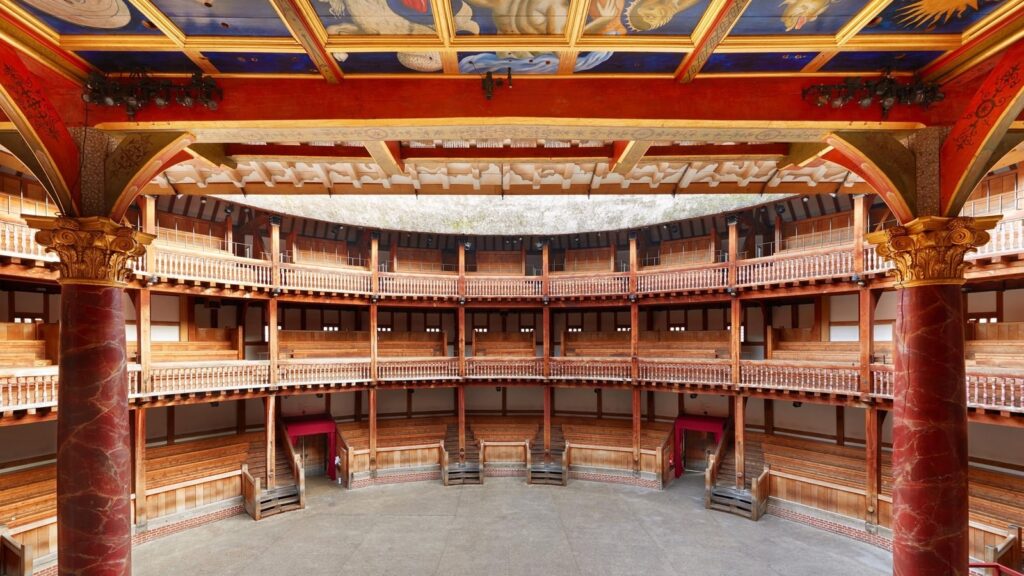
The most famous stop on any Shakespeare pilgrimage is the Globe Theatre on Bankside, in the London Borough of Southwark. The theatre standing today is a faithful reconstruction of the original, built in 1997 approximately 230 metres from where the first Globe stood. The original Globe was built in 1599, partly using timber salvaged from an earlier theatre called — simply — The Theatre, which had stood in Shoreditch.
The design is astonishing. It is an open-air, circular wooden structure with a thatched roof — the only thatched building permitted in central London after the Great Fire of 1666 prompted a ban on such materials. Performances still take place here from April to October, exactly as they did in Shakespeare’s time: standing room in the yard costs around £5, and you stand through the show, rain or shine, just as the original groundlings did.
The attached Shakespeare’s Globe Exhibition is one of the best museum experiences in London. It tells the story of Elizabethan theatre in vivid detail — how plays were staged, how actors prepared, what audiences expected, and how the Globe was eventually destroyed by fire in 1613 (a theatrical cannon misfired during a performance of Henry VIII, setting the thatched roof alight). The exhibition also runs fascinating tours of the theatre itself. Budget at least two hours.
🏙️ Enjoying this? 3,000 London lovers get stories like this every week. Subscribe free →
Southwark: Shakespeare’s Neighbourhood
The Globe stood in Southwark, and Shakespeare himself almost certainly lived nearby during his London years. Southwark in the 1590s was the entertainment district of the city — just outside the jurisdiction of London’s Puritan-leaning city authorities, and therefore free to host theatres, bear-baiting rings, and taverns. It was lively, colourful, and occasionally dangerous.
The George Inn on Borough High Street is a rare survivor from this world. It is the last galleried coaching inn in London, dating in its current form to 1677 but occupying a site where an inn has stood since medieval times. Shakespeare almost certainly drank here, or at its predecessor. It is now owned by the National Trust and still operates as a pub. Order a pint and sit in the courtyard — you are sitting in one of the oldest pub spaces in London.
A short walk along Borough High Street takes you to Southwark Cathedral, where Shakespeare’s younger brother Edmund is buried. Edmund was also an actor, though far less celebrated. The cathedral contains a striking alabaster memorial to Shakespeare himself, installed in 1912, showing the playwright reclining against a backdrop of Elizabethan London. The stained glass window above depicts characters from his plays. It is a peaceful, beautiful space, and often less crowded than the Globe itself.
The Inns of Court and the City
Shakespeare also performed north of the Thames, in the halls and courtyards of the Inns of Court — the institutions where London’s lawyers were trained. The Middle Temple Hall, dating from 1573, hosted the first recorded performance of Twelfth Night on 2nd February 1602. The hall survives almost unchanged. Its double hammer-beam roof is extraordinary, and the long oak dining table is said to have been made from the timbers of Sir Francis Drake’s ship, the Golden Hind.
Middle Temple Hall is open to visitors on weekday mornings (check opening times before visiting). It is often overlooked by tourists, which makes it all the more worth seeking out. Standing in the hall where Twelfth Night first played, with the same beams overhead and the same light falling through the tall windows, is one of those moments that makes London feel genuinely ancient.
Shoreditch: Where London’s Theatre World Began
Before Southwark, there was Shoreditch. The Theatre, built in 1576 by James Burbage, was England’s first purpose-built playhouse. It stood near what is now Curtain Road in Shoreditch, and Shakespeare performed there in the early part of his career. The Rose Theatre, a few years later, was the first on Bankside — and the Globe followed.
Shoreditch today is one of London’s most vibrant neighbourhoods, full of street art, independent coffee shops, and creative businesses. But plaques and markers point to the theatrical history beneath. The Curtain, another Elizabethan theatre that operated near The Theatre, has been partially excavated and interpreted at a development on Curtain Road. It is possible to see the remains through glass panels set into the floor of a modern building — a genuine piece of Elizabethan London underfoot.
Poet’s Corner, Westminster Abbey
Shakespeare is not buried in London — he died in Stratford-upon-Avon in 1616 and was buried in Holy Trinity Church there. But London’s great memorial to him, and to the wider tradition of English literature, is Poet’s Corner in Westminster Abbey.
The corner, in the south transept of the abbey, holds memorials to Chaucer, Spenser, Dryden, Ben Jonson, Samuel Johnson, John Keats, Percy Bysshe Shelley, Lord Byron, Charles Dickens, Thomas Hardy, Rudyard Kipling, T.S. Eliot, and many more. Shakespeare has a large monument here, erected in 1740, showing him pointing to a scroll inscribed with a line from The Tempest. It is one of the most visited spots in the abbey.
Entry to Westminster Abbey requires a ticket, but the visit is worthwhile. The abbey is one of the most historically significant buildings in the English-speaking world, and Poet’s Corner alone justifies the admission price for anyone who cares about literature.
Planning Your Shakespeare Heritage Walk
The best route connects the key sites in a single day. Start at Shakespeare’s Globe and the Globe Exhibition in the morning (arrive at 10am when it opens). Walk east along Bankside to Southwark Cathedral for lunch at the cathedral café — it is quiet, reasonably priced, and you can look at the Shakespeare memorial while you eat. Spend the afternoon at Middle Temple Hall in the City (cross Blackfriars Bridge and walk through the lanes past St Paul’s). Finish in the evening with a walk through Shoreditch if you want to see where it all began.
If you want to see a Globe performance, book well in advance. Tickets start from £5 (groundling standing) and go up to around £50 for seated positions. The groundling experience — standing in the open yard, watching the actors above you — is genuinely unlike anything else in London. Dress for the weather.
Frequently Asked Questions
Where did Shakespeare live when he was in London?
Shakespeare most likely lived in Southwark, close to the Globe Theatre, during much of his London career. Records show he was also a lodger in Silver Street in Cripplegate (in the City of London) around 1604. He is known to have owned property in both London and Stratford-upon-Avon simultaneously.
Is the current Globe Theatre the original building?
No — the current Globe is a modern reconstruction, built in 1997 approximately 230 metres from the original site. The first Globe opened in 1599 and burned down in 1613. A second Globe was built on the same site in 1614 but was demolished in 1644. The modern building is based on detailed historical research into Elizabethan playhouse design.
How long should I spend at Shakespeare’s Globe?
Allow at least two hours for the Globe Exhibition and a guided tour of the theatre. If you plan to attend a performance, the shows run approximately two and a half to three hours. The attached café and bookshop are worth time as well. A full morning visit, including exhibition and tour, is recommended.
🇬🇧 25 London Places Most Visitors Miss
From secret riverside walks to hidden Victorian tunnels, centuries-old pubs to rooftop gardens with skyline views — our free guide reveals the London most visitors never discover. Join 3,000+ London lovers who get it free.
Get Your Free 25-Places Guide →Already subscribed? Download your free London guide (PDF)
Free forever · One email per week · Unsubscribe anytime