
St Pancras Station in London looks like a cathedral that took a wrong turn onto the Euston Road. Its red-brick Gothic front, pointed spires and giant clock tower surprise first-time visitors from the US. Most people expect a railway terminus to be a plain shed. Instead, the Midland Railway built a showpiece in 1868 and added a grand hotel in 1873. This guide explains who built it, why it nearly disappeared, and how to see the best of it today.
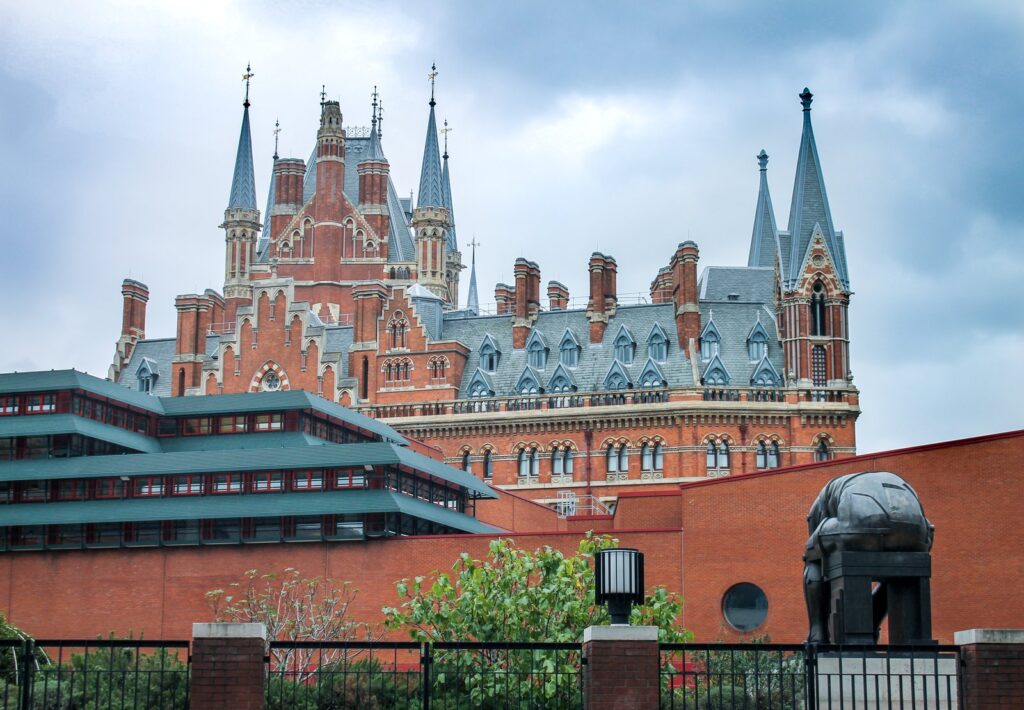
Quick answer: St Pancras opened in 1868 as the London terminus of the Midland Railway. Architect George Gilbert Scott designed the Midland Grand Hotel at its front, which opened in 1873. Engineers William Henry Barlow and Rowland Mason Ordish designed the vast iron train shed behind it. The station sits on the Euston Road, next to King’s Cross.
Why the Midland Railway Built Something This Grand
The Midland Railway came late to London. Its rivals already ran trains into Euston and King’s Cross, so the company had to build its own terminus. It chose a plot on the Euston Road, right beside the Great Northern Railway’s King’s Cross.
The directors wanted to make a statement. A plain station would have done the job, but they wanted passengers from Derby, Leicester, Nottingham and Sheffield to arrive somewhere that looked as wealthy as the company felt. That ambition explains the Gothic style. Victorian architects saw Gothic as a noble, English style, and a medieval-looking hotel told travellers that the railway was serious and respectable.
Did you know? When Barlow’s train shed opened in 1868, its single iron arch was the largest span of any roof in the world.
The Train Shed: Barlow’s Iron Arch
Walk through the station and look up. William Henry Barlow, the Midland’s engineer, designed a single curved roof of iron and glass. Rowland Mason Ordish worked with him on the design. The arch spans the tracks without a single column in the way, so passengers see one huge open space. At the time, that was a feat of engineering.
The builders had a problem underneath. The Midland wanted its platforms raised above street level so that its tracks could cross the Regent’s Canal. That created a huge empty space below the platforms, called the undercroft. The company filled it with a grid of iron columns spaced to suit beer barrels. Brewers in Burton upon Trent sent their beer to London by rail, and the undercroft stored it. Visitors can still sense that practical purpose in the layout of the lower level.
The Graves Beneath the Tracks
Building the station meant clearing part of the Old St Pancras churchyard. Workers moved coffins and bones to make room for the tracks. A young architect named Thomas Hardy, who later became a famous novelist, supervised some of the work. He arranged many of the displaced gravestones around an ash tree, and you can still see the result. Our story of the Hardy Tree and its ring of gravestones tells the full tale. The churchyard sits a short walk from the station.
🏙️ Enjoying this? 3,000 London lovers get stories like this every week. Subscribe free →
The Midland Grand Hotel: A Gothic Fantasy
George Gilbert Scott won the contract for the hotel after a design competition. Scott also designed the Albert Memorial in Kensington Gardens, so he already knew how to build a Gothic showpiece. His Midland Grand Hotel opened in 1873. It had a curving brick front, a grand staircase and a tower topped with a clock.
The hotel did not last in its first form. Guests found the building hard to modernise, and the rooms lacked private bathrooms as expectations changed. The railway closed the hotel in 1935 and turned the rooms into offices. For decades, the Gothic building served as an office block for British Railways staff.
How St Pancras Nearly Disappeared
By the 1960s, British Rail wanted to reduce its London stations and considered demolishing St Pancras. Many people in Britain saw Victorian architecture as old-fashioned and ugly at the time. The poet John Betjeman disagreed. He campaigned loudly to save the station, and his efforts helped win it Grade I listed status in 1967. That legal protection ended any serious plan to knock it down.
Betjeman now stands in bronze on the upper concourse. Sculptor Martin Jennings made the statue, and it shows the poet holding his hat and gazing up at Barlow’s roof. It makes a good photo stop.
The Modern Rebirth
The station found new life in 2007, when Eurostar moved its international services here. Trains now run from St Pancras to Paris, Brussels and Amsterdam. The restoration cleaned the brickwork, repaired Barlow’s roof and extended the platforms. In 2011, the Midland Grand reopened as a luxury hotel after a long restoration. Many Americans now arrive in London by Eurostar from Paris, which means their first sight of the city is this Gothic front.
The station also appeals to film and music fans. The Spice Girls filmed their “Wannabe” video inside the building in 1996, long before the restoration. Harry Potter fans should note that Platform 9¾ sits next door at King’s Cross, not here, although the two stations share a Tube stop and a short walk.
How to Visit St Pancras
- Getting there: Take the Tube to King’s Cross St Pancras, which serves six lines. The station exit opens right onto the concourse.
- Best view of the front: Cross the Euston Road and look back. From the pavement opposite, you can see the full Gothic façade and the clock tower together.
- Look up inside: Stand under the middle of Barlow’s roof and follow the iron ribs to the glass.
- Find the statues: The Betjeman statue and Paul Day’s large bronze “The Meeting Place” both stand on the upper concourse.
- Official information: Check the St Pancras International website for current shop, restaurant and travel details before you go.
- Pair it with more history: Our guide to Victorian workhouses in London and the story of the Great Stink and Bazalgette’s sewers show the other side of the same Victorian city.
Frequently Asked Questions
When did St Pancras Station open?
St Pancras opened in 1868 as the London terminus of the Midland Railway. The Midland Grand Hotel at the front followed in 1873.
Who designed the St Pancras Midland Grand Hotel?
George Gilbert Scott designed the hotel in the Gothic Revival style. Scott also designed the Albert Memorial in London.
Is St Pancras the same as King’s Cross?
No. The two stations are separate buildings on the Euston Road, built by rival railway companies. They stand side by side and share one Tube station, King’s Cross St Pancras. Platform 9¾ is at King’s Cross.
Which trains leave from St Pancras?
Eurostar trains to Paris, Brussels and Amsterdam leave from St Pancras International. Domestic trains to the East Midlands and Kent also use the station. Check the official website for timetables.
St Pancras shows how Victorian Britain liked to build: bold, decorative and slightly theatrical. It also shows how close London came to losing it. Stand on the Euston Road at dusk, when the brickwork glows, and you will see why Betjeman fought so hard.
Join 3,000+ London Lovers
Every week, get London’s hidden history, heritage walks, and stories from the city’s remarkable past — straight to your inbox.
Subscribe free — enter your email:
Already subscribed? Download your free London guide (PDF)
Free forever · One email per week · Unsubscribe anytime