
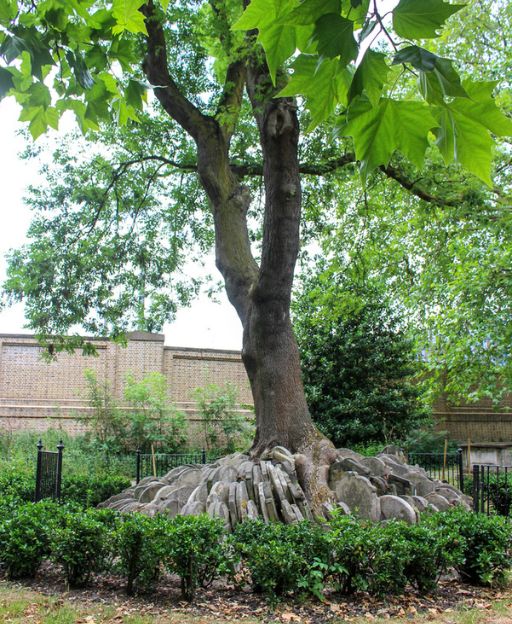
In a small corner of one of London’s oldest churchyards, something strange stands. A circle of Victorian headstones arranged around the base of an old tree, the stones tilted and weathered, the names mostly worn away. It looks like it could be an ancient ritual. The truth is both more recent and more extraordinary.
The man who made it would become one of England’s greatest novelists. But in 1865, Thomas Hardy was just a young man in London, doing a difficult job nobody else wanted.
Before the Novels, There Was an Office
Thomas Hardy arrived in London in 1862, twenty-one years old and full of ambition. He wanted to be an architect. He found work with Arthur Blomfield, a respected London practice, and for the next several years he learned his trade in the city he would later describe with such precision in his fiction.
🏙️ Love London?
3,000 London lovers get hidden history, street-level stories, and local secrets every week. Free, forever — no spam, unsubscribe any time.
Subscribe free — enter your email:
In his twenties, Hardy was meticulous and quietly sensitive — qualities that served him well on the drawing board and, unexpectedly, in the churchyard. He was a young man who noticed things. He remembered faces, places, the quality of afternoon light. Those habits would one day make him famous. First, they made him useful.
In 1865, Blomfield’s office was asked to help with one of Victorian London’s most uncomfortable necessities: the clearance of a churchyard to make way for a railway.
The Railway Needed a Path Through the Dead
The Midland Railway was pushing its new line into the city, heading towards St Pancras Station — the great Gothic terminus that would open in 1868. The route required space. And the space happened to contain the churchyard of St Pancras Old Church, one of the oldest places of Christian worship in England.
Thousands of bodies lay there. Many graves dated back centuries. Victorian London was not sentimental about such things — the city was growing rapidly, and growth meant moving whatever was in the way. But the headstones still needed to be dealt with. Someone had to supervise the work. That responsibility fell, in part, to Arthur Blomfield’s office, and within that office, to young Thomas Hardy.
He was twenty-five years old. The work was methodical and deeply strange.
What Hardy Did Among the Stones
Hardy spent long days in the churchyard as the graves were cleared. His job involved recording the inscriptions on headstones before they were moved and overseeing the reinterment of remains. He later described the experience in his autobiography — grim, necessary work in which the ordinary dead of London were disturbed in the name of progress.
He felt the weight of it. These were not famous people. They were tradesmen, clergymen, mothers, children — ordinary Londoners who had expected to stay where they had been buried. Hardy noticed them the way he noticed everything.
Rather than scatter the headstones or dispose of them carelessly, Hardy did something considered and careful. He arranged a large collection of them around the base of an old ash tree at the edge of the churchyard — stones stacked upright, pressed close against the roots, forming a quiet ring around the trunk. It was orderly. It was respectful. It was also, though he could not have known it, permanent.
He could not have known what would happen next.
The Tree That Grew Around the Stones
Decades passed. Thomas Hardy left London, moved back to Dorset, and wrote the novels that made him famous: Far from the Madding Crowd, Tess of the d’Urbervilles, The Mayor of Casterbridge. He became one of the most celebrated English writers of the nineteenth and early twentieth centuries. He died in 1928.
Back in St Pancras Churchyard, the ash tree was growing.
Slowly, over decades, its roots spread outwards and its bark thickened inward. The tree grew around the headstones, through the spaces between them, until stones and trunk had fused into a single strange formation. Names blurred. Dates faded. The tree absorbed the stones — or seemed to — as if it were trying to remember the people whose names it was slowly erasing.
By the twentieth century, the Hardy Tree had become one of London’s quiet literary landmarks. Authors and curious visitors stood beside it and thought about time: about the arc from a young architect doing difficult work in 1865 to a famous novelist, and back to a tree in a north London churchyard that had grown around the evidence of both.
London is full of literary monuments — you can walk through the very streets that Sherlock Holmes stalked, or visit the corner of Westminster Abbey where the great writers chose to be buried. But the Hardy Tree felt different. It was not planned or commissioned. It happened by accident, through one young man’s instinct for decency.
What You Will Find There Now
The story of the Hardy Tree does not have a tidy ending. In 2023, the ash tree fell. Ash dieback disease had weakened it for years, and it finally came down. The tree that Hardy had inadvertently preserved for over 150 years was gone.
But the circle of headstones remains.
Stripped of the tree that once defined them, the stones now form a low ring on the ground — a peculiar monument that still draws visitors, still prompts the same quiet questions. Some names are legible. Most are not. These are ordinary people who died in the early nineteenth century and expected to stay where they were buried.
St Pancras Old Church itself is still standing, still holding services, still surrounded by its unusual garden of graves. It sits just minutes from King’s Cross and St Pancras stations — two of the busiest railway termini in the world. The irony of that geography is almost too neat: the same railway expansion that disturbed these graves runs just a few hundred metres away.
If you are planning a trip to London, St Pancras Old Church is worth half an hour of your time. It is free to visit, uncrowded, and the kind of place that makes London feel like a city where history keeps surfacing in unexpected corners.
A Monument Nobody Planned
London has many literary shrines. Most of them honour the famous person — the museum, the blue plaque, the bookshop with a window display. The Hardy Tree was different. It honoured the work Hardy did before anyone had heard of him: the careful, human thing he did on a cold day in 1865, when nobody was watching.
That the tree itself is gone makes the story more London, somehow. The city has always moved quickly, always asked its dead to make room for the living. What remains is just a ring of stones in an old churchyard — and the knowledge that the man who put them there had not yet written a single novel.
Come in the morning, when the churchyard is quiet. Bring a bit of patience and a willingness to look for things that don’t announce themselves. The Hardy Tree — or what remains of it — will not disappoint.
🇬🇧 25 Hidden Gems of London Most Tourists Never Find
From secret riverside walks to hidden Victorian tunnels, centuries-old pubs to rooftop gardens with skyline views — our free guide reveals the London most visitors never discover. Join 3,000+ London lovers who get it free.
Get Your Free London Hidden Gems Guide →Love more? Join 65,000 Ireland lovers → · Join 43,000 Scotland lovers → · Join 30,000 Italy lovers →
Free forever · Unsubscribe anytime