
In 1070, William the Conqueror chose a chalk hill overlooking the Thames and ordered a castle built. He wasn’t thinking about comfort. He wasn’t thinking about beauty. He wanted to intimidate the people of London into submission — and it worked.
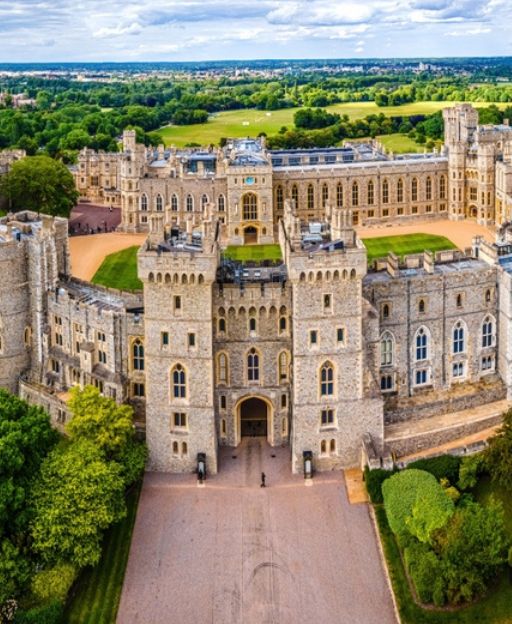
Nearly a thousand years later, that same hilltop fortress is still lived in, still loved, and still one of the most visited places in Britain. Windsor Castle didn’t just survive history. It absorbed it.
How a Military Fortress Became a Palace
William’s original castle was simple — a wooden motte-and-bailey structure with a tower on top. The point was presence, not permanence. It overlooked the Thames valley, commanded the approaches to London, and made clear who was now in charge of England.
🏙️ Love London?
3,000 London lovers get hidden history, street-level stories, and local secrets every week. Free, forever — no spam, unsubscribe any time.
Subscribe free — enter your email:
Over the following centuries, stone replaced wood. Towers were added, courtyards were enclosed, and what started as a stronghold began to look like somewhere people actually wanted to live.
Henry II rebuilt the Round Tower in stone in the 12th century. Edward III transformed the upper ward into a set of royal apartments fit for a court. Henry VIII added long galleries, gardens, and a tiltyard where jousting tournaments drew enormous crowds.
Each monarch left their mark. Windsor wasn’t just maintained — it was loved. For nearly 40 reigning monarchs in a row, this chalk hill above the Thames remained the place they returned to.
The Chapel That Holds the Heart of the Monarchy
The most breathtaking part of Windsor Castle isn’t the castle itself. It’s St George’s Chapel.
Built between 1475 and 1528, it stands as one of the finest examples of Gothic architecture in England. The soaring stone fan vaulting, the rows of colourful heraldic banners, the ancient carved choir stalls — it stops most visitors in their tracks.
Ten British monarchs are buried here, including Henry VIII and George VI, the father of Queen Elizabeth II. Every year, the Knights and Ladies of the Garter — the oldest order of chivalry in England — gather here for their annual service, carrying on a tradition that dates back to 1348.
And in September 2022, after 70 years on the throne, Queen Elizabeth II came here for the last time. She is buried in the King George VI Memorial Chapel, just off the main nave, beside her husband and her parents.
The Queen’s Castle
No British monarch in modern times loved Windsor more than Queen Elizabeth II.
She spent her childhood there during the Second World War, hidden from the Blitz in Windsor’s familiar corridors. She walked its grounds every morning with her corgis. She hosted world leaders in its State Apartments, and slipped away to its private rooms when the pressure of public life became too much.
Where Buckingham Palace was her office — formal, public-facing, unmistakably institutional — Windsor was her home. Photographs from Windsor captured something different: the slightly tilted hat on a Sunday walk, the easy comfort of someone exactly where they belonged.
When COVID-19 hit in 2020, the Queen moved to Windsor and stayed. She celebrated her Platinum Jubilee there. She received her final Prime Minister there. And on 8th September 2022, she died there — quietly, at home, in the place she loved most.
The Long Walk
If you approach Windsor Castle from the south, you’ll walk up the Long Walk.
It’s a straight, tree-lined avenue stretching three miles from the castle gates down to the Great Park below. The original trees were planted on the orders of Charles II in the 1680s. They’ve been replanted twice since then — elms died in the disease epidemic of the 1970s, replaced with plane trees and chestnuts.
Walking up the Long Walk is one of those rare experiences that feels genuinely grand without feeling staged. The scale is almost absurd. The castle sits at the far end like something from a painting, growing larger with every step.
Horse-drawn carriages still use this route during royal visits. Household Cavalry rides along it. On quiet mornings, the only company is a dog walker and a few deer from the royal herd, picking their way through the mist.
What Most Visitors Miss Inside
Windsor’s State Apartments are open to the public when the royal family isn’t in residence, and they reward close attention.
Paintings by Rubens, Rembrandt, and Van Dyck hang in rooms that have changed very little since they were decorated. The Waterloo Chamber — built to commemorate the defeat of Napoleon — contains portraits of every allied leader who contributed to the victory, arranged in one extraordinary room.
St George’s Hall, destroyed by fire in 1992 and magnificently restored, contains what is believed to be the longest dining table in Europe. It can seat 160 people. The ceiling above is hung with the heraldic shields of every living Knight of the Garter.
The 1992 fire damaged 115 rooms. The restoration took five years and was funded by an unusual decision: opening Buckingham Palace to the public for the first time. Visitors paid; Windsor was saved.
Planning Your Visit from London
Windsor is 20 miles from central London — easy to reach by train from Paddington (change at Slough) or direct from London Waterloo in under an hour. The castle is open most days, though parts close when the royal family is in residence. Look for the Royal Standard flying from the Round Tower: if it’s flying, the King is home.
St George’s Chapel closes to tourists on Sundays, when it’s used for worship, and on certain state occasions. The Long Walk is always free and open. Windsor Great Park — covering 4,800 acres — stretches beyond the castle and offers walking, cycling, and some of the quietest green space within an hour of the capital.
Many visitors pair Windsor with a day in London to watch the Changing of the Guard — the Windsor version is smaller and often far less crowded than the London ceremony, but just as moving.
For everything you need to plan a London trip that includes Windsor, the London trip planning guide covers day trips, budgets, timing, and the best ways to see the city and its surroundings without the crowds.
🇬🇧 25 Hidden Gems of London Most Tourists Never Find
From secret riverside walks to hidden Victorian tunnels, centuries-old pubs to rooftop gardens with skyline views — our free guide reveals the London most visitors never discover. Join 3,000+ London lovers who get it free.
Get Your Free London Hidden Gems Guide →Love more? Join 65,000 Ireland lovers → · Join 43,000 Scotland lovers → · Join 30,000 Italy lovers →
Free forever · Unsubscribe anytime