
Tens of thousands of people line The Mall every year to watch it. Most of them wait over an hour in the cold. But very few leave knowing what they actually just witnessed.
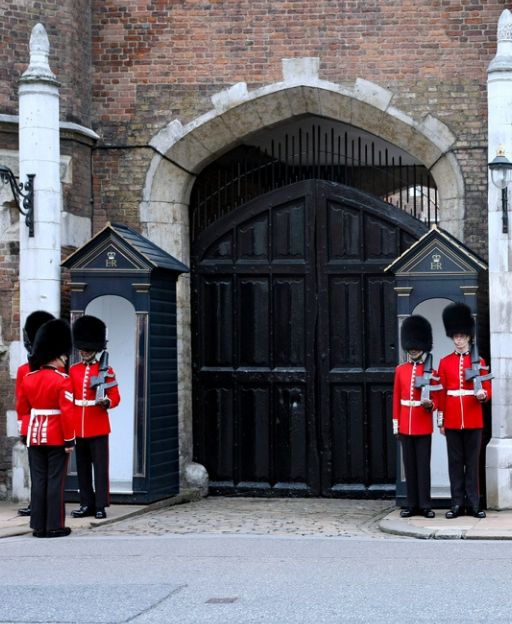
The Changing of the Guard is one of London’s most photographed traditions. It runs with military precision, down to the exact minute. Yet most visitors leave with no idea who those guards actually are, why the ceremony happens where it does, or what the commands being barked across the forecourt mean.
Here is what London locals know — and tourists rarely find out.
The Guards Are Not Just for Show
The men in red tunics and bearskin hats are active-duty soldiers. They belong to one of five regiments of the Household Division — the Coldstream Guards, the Grenadier Guards, the Scots Guards, the Irish Guards, and the Welsh Guards.
🏙️ Love London?
3,000 London lovers get hidden history, street-level stories, and local secrets every week. Free, forever.
Subscribe free — enter your email:
On any given day, one regiment takes over from another. The ceremony is not symbolic theatre. It is a genuine handover of responsibility for guarding the monarch. When those soldiers stand at the gates, they are on duty.
The bearskin hats, which weigh around 700 grams and stand 45 centimetres tall, are made from real bearskin — Canadian black bear, to be precise. Each hat costs around £1,800 and lasts roughly a decade. They are worn in all weather, including the height of a British summer, which the guards endure without complaint.
You can tell which regiment is on duty by looking closely at the uniform details. Buttons in pairs mean the Coldstream Guards. Buttons in threes mean the Scots Guards. A single button spacing, and you are looking at the Grenadiers — the oldest regiment in the British Army.
Why It Happens at Two Palaces
Most visitors assume the Changing of the Guard only happens at Buckingham Palace. It does not.
The ceremony also takes place at St James’s Palace, a short walk away down The Mall. In fact, St James’s is technically the senior royal palace — the reason foreign ambassadors are accredited to the Court of St James’s rather than to Buckingham Palace. Buckingham Palace only became the monarch’s principal London residence in the 1800s, relatively recently in royal terms.
The ceremony begins at St James’s Palace at 11am, where one detachment relieves another. A second detachment then marches down The Mall to Buckingham Palace, and the full handover takes place at 11:30am.
If you want a quieter spot with a far better view, St James’s Palace is the insider’s choice. The crowds are a fraction of what you find at Buckingham Palace, and you can often get within a few metres of the guards themselves.
The Ceremony Does Not Always Happen
This is what catches visitors off guard — and not in a good way. The full Changing of the Guard does not take place every day of the year.
During the winter months, roughly November through March, the ceremony typically runs every other day rather than daily. On the alternate days, a smaller inspection-style ceremony takes place instead, which most tourists miss entirely.
Rain does not cancel it. Moderate cold does not cancel it. But if the monarch is hosting a major state event, or if the schedule falls on certain ceremonial days, the timing can shift. Turning up on the wrong day or at the wrong time is the single most common disappointment visitors experience.
Always check the official calendar before you go. The Household Division publishes the schedule online, updated regularly. Five minutes of research will save you an hour of waiting for something that is not coming.
What the Commands Actually Mean
The orders shouted by the officers sound archaic because they are. Military drill commands in the British Army trace their roots back through centuries of battlefield communication — when orders had to carry across noise and distance without the help of a radio.
“Changing the Guard” is the civilian name. The military calls it “Guard Mounting.” Throughout the ceremony, the Regimental Band plays — a mix of formal marching music and, on ordinary days, a rotating selection that often surprises visitors. Film scores, classic pop songs, and television themes have all featured in recent years.
The moment the band strikes up, something happens to the crowd. People who came to photograph a postcard scene find themselves standing very still and listening. There is a reason for that. Precision, repetition, and ritual trigger something deep in most people. The Changing of the Guard has been happening in some form for over 350 years, and that weight is somehow present in the air.
The Best Spots to Watch
The forecourt of Buckingham Palace is always the most crowded spot. If you want a position at the fence, arrive at least 45 minutes before the ceremony begins. The crowds build quickly, and latecomers often end up watching the tops of bearskin hats from behind a wall of phones.
The Mall offers something different. Standing along the tree-lined avenue gives you a view of the guards marching in formation toward the palace — a more cinematic moment than the ceremony itself, and far less crowded.
St James’s Palace forecourt remains the best-kept secret. Fewer people, better sightlines, and the atmosphere of a genuinely historic building behind the ceremony rather than a tourist backdrop.
If you are visiting with children, position yourselves near the front and bring something to keep them occupied in the first 30 minutes of waiting. The ceremony itself lasts around 45 minutes once it begins, and children who cannot see tend to announce this fact loudly and often.
When you are ready to plan your visit, our London planning guide covers everything you need to build your itinerary — including how to fit the ceremony into a wider day in the area.
What Happens the Rest of the Time
The Guard does not simply appear for the ceremony and vanish. Sentries stand outside both palaces around the clock, every day of the year.
Walk past Buckingham Palace at 2am and you will find guards at their posts. Walk past at 6am on a Sunday and they are still there. They pace a short route in front of their sentry boxes at set intervals. Many tourists, not knowing this, have stepped directly into their path.
The rule about not making them react is real — they are trained to remain impassive. But they are not prohibited from speaking. If someone walks directly into a sentry’s path, the guard will issue a verbal warning. In cases where they feel their safety is threatened, they are authorised to take further action. The tourists in YouTube videos who have learned this the hard way tend to look quite startled.
London is full of traditions that are still genuinely alive rather than simply preserved for tourism. The ravens at the Tower of London are another example — a tradition so old that the Crown still employs a Ravenmaster today, because a superstition says Britain will fall if the ravens ever leave.
These are not performances. They are the city’s living memory, kept going by people who take them seriously.
Why It Still Matters
There is a version of the Changing of the Guard that is purely touristy — something to tick off a list, photograph briefly, and move on from. Plenty of people experience it that way, and there is nothing wrong with that.
But there is another version, available to anyone willing to look a little deeper. The regiment marching past you today is the same regiment that has guarded the monarch for centuries. The commands being called are older than the United States. The building behind the gates has housed every British monarch since Queen Victoria moved in.
None of that is on a sign or in a tour guide leaflet. It is just there, if you know to look for it.
London is like that. The city does not explain itself. It just carries on, and rewards the curious.
🇬🇧 25 Hidden Gems of London Most Tourists Never Find
From secret riverside walks to hidden Victorian tunnels, centuries-old pubs to rooftop gardens with skyline views — our free guide reveals the London most visitors never discover. Join 3,000+ London lovers who get it free.
Get Your Free London Hidden Gems Guide →Love more? Join 65,000 Ireland lovers → · Join 43,000 Scotland lovers → · Join 30,000 Italy lovers →
Free forever · Unsubscribe anytime