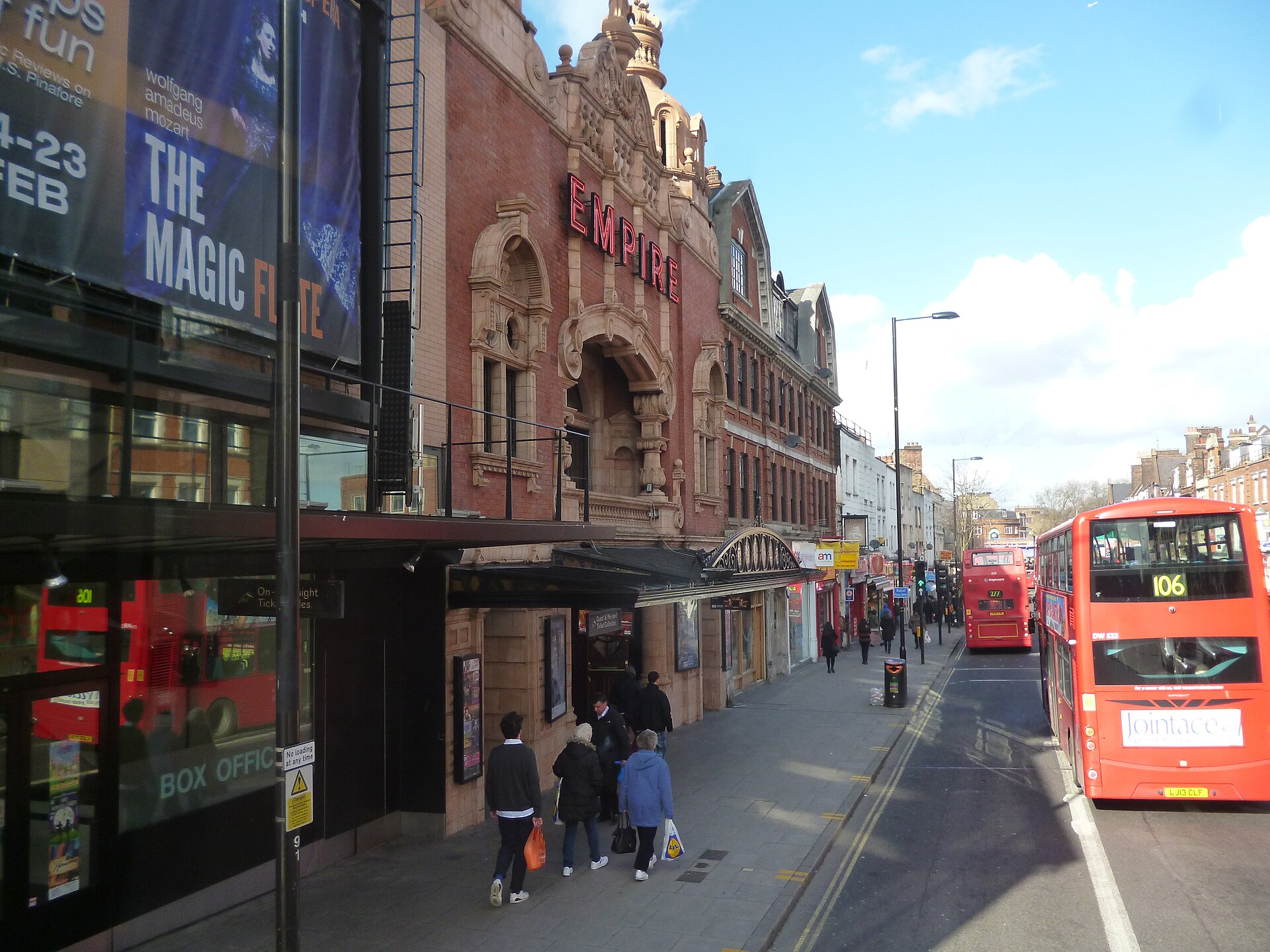
Walk down Mare Street in Hackney on any evening and you might notice the red neon letters glowing above an old terracotta facade. Most people walk straight past. But that building — the Hackney Empire — helped invent how the modern world understands comedy, entertainment, and what ordinary people deserve from a night out.
What Was a Music Hall?
Before television. Before radio. Before cinema. The music hall was how working people entertained themselves.
🏙️ Love London?
3,000 London lovers get hidden history, street-level stories, and local secrets every week. Free, forever.
Subscribe free — enter your email:
A night at the music hall was nothing like an evening at the opera. The audience ate and drank while they watched. They sang along with the performers. They shouted, laughed loudly, and booed if an act failed to hold their attention. It was loud, warm, and entirely unapologetic.
The acts moved fast: comedians, singers, acrobats, impressionists, magicians, and ventriloquists would each take the stage for twenty minutes or so. There was no solemn interval — just one act giving way to the next.
This was entertainment built around ordinary life. The jokes were about landlords and long shifts. The songs were about love, money, and the weekend. Nothing was too grand or too refined for the music hall stage.
Why the East End Led the Way
By the 1890s, the East End of London was one of the most densely populated places in the world. Hundreds of thousands of people lived in streets stretching from Whitechapel to Stepney, from Hackney to Bethnal Green. Most of them worked in the docks, in garment workshops, or at the street markets that lined every main road.
These were not wealthy people. A ticket for standing room at the music hall cost as little as a penny — less than a glass of beer.
The East End’s Cockney community had developed its own culture over generations. They had their own language — the rhyming slang that let market traders talk without outsiders understanding a word. They had their own food, their own pubs, and their own sense of humour. London’s oldest Cockney fast food has run without a pause for more than 200 years — and it began in these same streets.
The music hall gave all of that identity a stage. What happened in East End theatres didn’t stay in the East End. It spread to the whole country.
The Names Who Played Hackney Empire
Hackney Empire opened its doors on Boxing Day 1901. Within months, it had become one of the most sought-after variety venues in London.
Marie Lloyd played here to packed houses. Her songs — cheerful, cheeky, full of meanings the whole audience understood immediately — were anthems of East End life. She sang about landladies and bank holidays, about men who made promises they didn’t keep, and about women who got on perfectly well regardless. She became the undisputed queen of the music hall, and T.S. Eliot later wrote that her death was a genuine loss to the English working class.
Charlie Chaplin performed here as a teenager. He had grown up in Lambeth in real poverty, and the music hall circuit was where he developed the physical comedy — the pratfalls, the precise timing, the instinctive sympathy with the underdog — that would eventually make him one of the most recognised people on earth.
W.C. Fields played here. Stan Laurel played here. The Hackney Empire stage was, in short, the training ground for a generation of international stars.
Frank Matcham and the Building Itself
Hackney Empire was designed by Frank Matcham — the most prolific theatre architect Britain has ever produced. Over his career, Matcham designed or renovated more than 150 theatres across the country. He understood better than anyone what an entertainment building needed to feel like.
The exterior is terracotta red, with Baroque flourishes and a corner tower that makes it immediately unmistakable on Mare Street. Inside, horseshoe balconies wrap around a deep auditorium. Every seat has a clear sightline. The acoustic is warm and generous.
Matcham designed for audiences who had never been inside a theatre before. He wanted the building itself to feel welcoming — a signal that this was a place for everyone, not just the privileged few.
Hackney Empire is now Grade II* listed — one of the highest levels of protection the British government can award. English Heritage considers it Matcham’s finest surviving work.
Nearly Lost
By the 1970s, Hackney Empire had closed as a live theatre. Like so many of Britain’s great music halls during that difficult decade, it had been converted into a bingo hall.
The East End was struggling. The docks had closed, taking much of the local economy with them. The grand old building sat on Mare Street looking out at a neighbourhood in real trouble.
Then, in the early 1980s, a campaign began to save it. The comedian and activist Roland Muldoon led much of the effort, seeing the Empire not merely as a historic structure but as a community resource — a place that could once again connect with the working-class tradition it had always represented.
By 1986, the Empire was back in use. By 2004, a full restoration had returned the interior close to its original condition. It is, today, one of the most loved performance venues in East London.
What Is Here Today
Hackney Empire sits at 291 Mare Street, E8 1EJ. The theatre runs a full year-round programme — comedy nights, live music, touring productions, and a Christmas pantomime that sells out weeks in advance.
The area around it has changed substantially. Hackney is now one of London’s most creative neighbourhoods, with a café culture and arts scene that would have astonished the dock workers who filled these streets in 1901. But the markets of Ridley Road still run. The old street culture is still there, underneath the new.
If you want to explore the other side of this part of London, there’s a hidden East End building with a story you won’t expect. And if you’re putting together your whole trip, our full London planning guide will help you make the most of every day.
An Entertainment Empire
There is a particular kind of pride in places like the Hackney Empire — in the knowledge that something real and lasting was made here, not by money or privilege, but by working people who needed to laugh.
The East End invented something at these music halls that the whole world now takes for granted: the idea that entertainment should belong to everyone, that the best comedy comes from real life, and that ordinary people are worth making a proper stage for.
Walk past on a quiet evening, look up at those red neon letters, and you’re standing in the middle of all of that history. Most people still walk straight past. Now you know what to look for.
🇬🇧 25 Hidden Gems of London Most Tourists Never Find
From secret riverside walks to hidden Victorian tunnels, centuries-old pubs to rooftop gardens with skyline views — our free guide reveals the London most visitors never discover. Join 3,000+ London lovers who get it free.
Get Your Free London Hidden Gems Guide →Love more? Join 65,000 Ireland lovers → · Join 43,000 Scotland lovers → · Join 30,000 Italy lovers →
Free forever · Unsubscribe anytime