
Some pubs are just pubs. The Spaniards Inn is not just a pub.
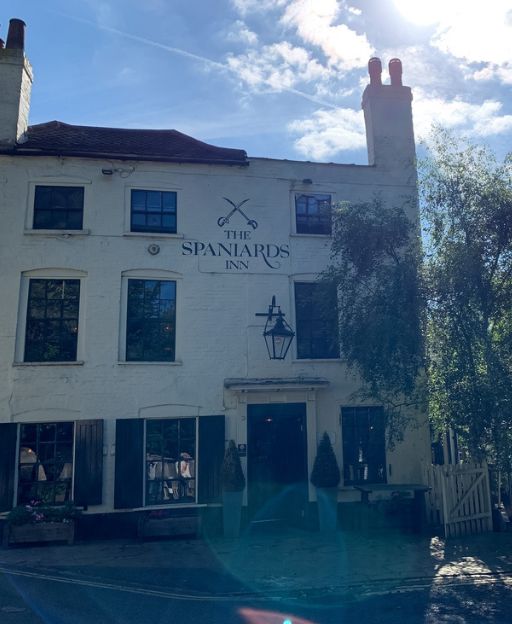
It stands at the top of Hampstead Heath, on a narrow road that forms the boundary between two London boroughs. It has been there since 1585. Charles Dickens set a scene here. John Keats walked across the heath to drink here. Bram Stoker sent characters from Dracula through its front door. Four centuries of writers, drinkers and heath-walkers have passed through its entrance. Most of them came back.
A Pub at the Edge of Two Boroughs
The Spaniards Inn sits on Spaniards Road, which runs along the boundary between Camden and Barnet. The pub itself straddles this line — technically standing in two different parts of London at once.
🏙️ Love London?
3,000 London lovers get hidden history, street-level stories, and local secrets every week. Free, forever.
Subscribe free — enter your email:
That has always made it a place slightly apart from the city. It is close enough to reach easily from central London, but it sits beside the open land of Hampstead Heath, which gives it the feeling of an old country inn rather than a London local.
The building dates to around 1585. The exact origin of the name is debated. Some say it was named after Juan Perez de Soto, the Spanish Ambassador to the Court of St James, who lived nearby in the early 16th century. Others say two Spanish brothers owned the inn and gave it the name. Nobody agrees on which story is right. The mystery is part of its charm.
What is not in dispute is the location. The pub sits where the heath meets the road. Behind it, the land opens up into woodland and meadow. Ahead of it, the narrow road squeezes down toward Highgate. It has always felt like a threshold — between the city and somewhere wilder.
Dick Turpin and the Toll House Opposite
Across the narrow road from the pub stands a small wooden gatehouse. It looks like a garden shed that has been there for centuries. Because it has.
Dick Turpin, the most famous highwayman in English history, is said to have stabled his horse Black Bess in this booth while he planned raids on wealthy travellers crossing the heath. Whether every detail of the story is true is hard to say. Highwaymen did operate on Hampstead Heath in the 17th and 18th centuries. The heath was remote enough to hide in. And the Spaniards Inn, set at its edge, would have been a natural stopping point.
The toll house itself is now a Grade II listed structure. Traffic on Spaniards Road has to squeeze past it on one side. On busy weekend afternoons, a queue of cars sometimes builds up because of it. The tollgate keeper is long gone, but the building has not moved an inch in four hundred years.
There is something satisfying about that. London has torn down and rebuilt itself so many times that surviving buildings from the 1500s feel like a small miracle. This one happens to be next to a very good pub.
How Three Great Writers Found This Pub
Charles Dickens wrote about the Spaniards Inn in The Pickwick Papers, published in 1836. In the novel, Mrs Bardell and her friends visit the pub for tea on Hampstead Heath. It was a well-known landmark even then, and Dickens used it as shorthand for a certain kind of comfortable London afternoon — the kind where nothing much happens and that is exactly the point.
John Keats lived in Hampstead from 1818 to 1820 and walked to the Spaniards Inn regularly. His house — Keats Grove, now a museum — is about twenty minutes’ walk away. During those two years in Hampstead, Keats wrote Ode to a Nightingale, Ode on a Grecian Urn, and The Eve of St Agnes. There is something fitting about the idea of him walking back from this pub, down through the heath in the dark, and then writing poetry about beauty and loss and time.
Bram Stoker’s connection is the most dramatic. In Dracula, published in 1897, Mina Harker and the patients from Dr Seward’s asylum stop at the Spaniards Inn during a tense scene. The pub appears by name. Stoker knew Hampstead well and understood the strangeness the heath could hold at dusk. That sense of being just outside the city, where normal rules might not apply. The Spaniards Inn appears in Dracula because it was already the kind of place where stories happened.
The Beer Garden That Has Been Here for Four Centuries
The Spaniards Inn has one of the most celebrated beer gardens in London. It is large, shaded by old trees, and opens toward a stretch of green that feels nothing like the rest of the city. On a summer afternoon, it fills quickly. On a wet November morning, you can have it almost to yourself.
Inside, the ceilings are low and the rooms are small, the way old English pubs are supposed to be built. Wooden beams, open fires in winter, and worn furniture that took centuries to look this comfortable. The bar area is narrow. The pub was designed for coaches and horses outside and warmth and drink inside. That basic arrangement has not changed.
The food is solid pub food done well. The real drinks are the ales, which change with the season. The staff have heard the Dick Turpin story many times and will tell it again if you ask nicely.
The pub also appears in the background of several films and television productions. Hampstead is a favourite filming location, and the Spaniards Inn has a period quality that directors find useful. If you feel like you have seen it before, you probably have.
Planning Your Visit to the Spaniards Inn
The easiest way to arrive is to take the Northern Line to Hampstead station and walk across the heath. The walk takes about twenty minutes over open ground, passing the swimming ponds and the woodland paths. It is far better than arriving by car. The road is narrow and parking is limited.
The pub is busy at weekends, especially in summer when the beer garden fills up fast. Weekday afternoons are quieter and easier. If you are visiting the heath anyway — and if you are spending time in north London, you should be — the Spaniards Inn is the natural place to stop.
It is worth combining the visit with a walk to the wild swimming ponds on Hampstead Heath, which have been used by Londoners for over three hundred years. Or take the longer path to the hidden garden on the heath that looks like ancient Rome — another corner of this part of London that most visitors never find.
If you are at the start of planning your trip to London, the London travel planning guide is a good place to begin.
🇬🇧 25 Hidden Gems of London Most Tourists Never Find
From secret riverside walks to hidden Victorian tunnels, centuries-old pubs to rooftop gardens with skyline views — our free guide reveals the London most visitors never discover. Join 3,000+ London lovers who get it free.
Get Your Free London Hidden Gems Guide →Love more? Join 65,000 Ireland lovers → · Join 43,000 Scotland lovers → · Join 30,000 Italy lovers →
Free forever · Unsubscribe anytime