
Just south of London Bridge, under the shadow of a Victorian railway viaduct, something remarkable happens every Thursday, Friday and Saturday morning. Traders stack their stalls with sourdough loaves, raw milk cheeses, aged charcuterie and hand-grown vegetables. The smell of roasting coffee and frying chorizo drifts across the cobblestones. And the crowds begin to arrive — just as they have, in one form or another, for more than a thousand years.
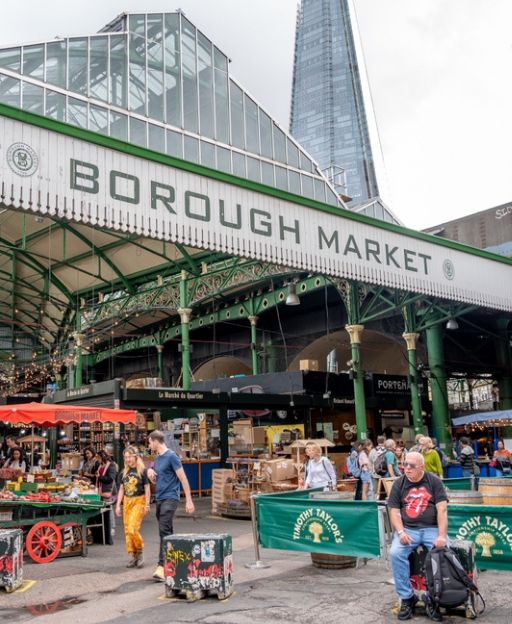
Borough Market isn’t a tourist attraction that happens to sell food. It’s a working market that happened to become one of London’s most beloved places. That’s a different thing entirely.
A Market Older Than Most Nations
The first written record of trading near London Bridge dates to 1014. That was before the Norman Conquest. Before the Tower of London was built. Before English even existed as a language we’d recognise.
For centuries, Borough Market was where produce flowed into the city from the south of England. Fruit from Kent, grain from Surrey, livestock from across the counties — all of it crossed London Bridge and stopped here first.
The market became so crowded and chaotic that Parliament tried to move it in the eighteenth century. Local residents, traders and the Parish of St Saviour’s refused. They bought the land themselves in 1756 and have managed it as a charitable trust ever since. That stubbornness saved it.
The Fire, the Blitz, and the Railway
Borough Market has survived more than most London institutions. The Great Fire of 1666 swept through Southwark. The Blitz dropped bombs on the railway arches overhead. And in the 1990s, a proposed road widening scheme threatened to demolish the market entirely.
Once again, the community fought back. The plans were blocked. Borough Market was given a new lease of life — and within a decade, it had transformed from a tired wholesale market into the extraordinary destination it is today.
The Victorian iron and glass structure you walk through now dates mostly to the mid-nineteenth century, though parts are even older. Look up as you walk inside. Those railway arches belong to the line running into London Bridge station, built directly over the market in 1851. The market simply adapted and carried on beneath them.
If you’re planning a longer visit to the area, the South Bank walk from Westminster Bridge to Tower Bridge takes you right past Borough Market’s doorstep — and through two thousand years of London history along the way.
Enjoying this? 3,000+ London lovers get stories like this every week. Subscribe free →
What You’ll Actually Find Here
Borough Market is not a place to pick up a cheap bag of apples. It’s a place to find a cheese you’ve never heard of, talk to the farmer who grew your salad leaves, and spend twenty minutes choosing between six different varieties of sourdough.
The traders are specialists. Many have been coming to Borough for years, some for decades. You’ll find raw milk cheeses from small British dairies, charcuterie cured in the French tradition by producers based in Somerset, and olive oils sourced directly from single estates in Spain and Italy.
The street food side has grown considerably too. Hot salt beef sandwiches. Venezuelan arepas. South Indian dosas. Welsh rarebit toasties. Proper Scotch eggs that bear no relation to the pale supermarket version. Eating your way around Borough Market on a Friday lunchtime is one of the genuine pleasures of London life.
For a broader guide to what London does best on a plate, the what to eat in London guide covers everything from jellied eels to afternoon tea — and where to find the real thing.
Beyond the Famous Stalls
Most visitors head straight into the covered market and miss what’s around it. The railway arches that run along Stoney Street and Borough High Street hide a rotating cast of independent traders — butchers, cheesemongers, wine importers — who’ve been part of the Borough ecology for years.
Southwark Cathedral stands directly beside the market, its Gothic tower rising above the railway tracks. It’s one of the oldest Gothic buildings in London, and its medieval Great Choir was already ancient when Borough Market’s current site was first established. The combination — medieval cathedral, Victorian ironwork, modern food stalls — is entirely Southwark and entirely London.
If you find Borough Market too busy on a Saturday (it can be genuinely packed by mid-morning), consider its quieter neighbour just a short walk away. Maltby Street Market under the Bermondsey railway arches offers a more intimate alternative — smaller, less famous, and often where Borough’s most adventurous producers go to experiment.
When to Go and What to Expect
Borough Market opens Thursday 10am–5pm, Friday 10am–5pm, and Saturday 8am–5pm. Wednesday sees around twelve stalls. The full market is on Fridays and Saturdays.
Saturday by noon is the busiest point of the week. If crowds aren’t your thing, Friday morning between 10am and noon is the sweet spot — full stalls, fewer people, and the chance to actually stop and talk to the traders without someone elbowing past you.
Getting there is straightforward. Borough tube station on the Northern line is a three-minute walk. London Bridge station, served by both the Jubilee line and National Rail, is equally close. There is no point driving.
What is Borough Market famous for?
Borough Market is one of London’s oldest and largest food markets, known for specialist and artisan produce — British cheeses, sourdough bread, cured meats, seasonal vegetables, and exceptional street food. It has a reputation as a serious food destination, with traders who have often spent years developing their products rather than sourcing them wholesale.
Is Borough Market worth visiting for tourists?
Yes, especially if you’re interested in food. The quality is exceptional and the atmosphere is unlike anything in central London. Go with the intention of eating and buying rather than sightseeing — Borough Market rewards those who engage with it rather than simply walk through it.
When is the best time to visit Borough Market?
Friday morning between 10am and 12pm offers the full market experience with noticeably smaller crowds than Saturday. Saturday from 8am to 10am is also excellent. Avoid Saturday between 12pm and 3pm if crowds bother you — the central section becomes genuinely difficult to navigate.
How old is Borough Market?
Trading near London Bridge is recorded as far back as 1014, making the site over a thousand years old. The market has shifted locations slightly over the centuries, but has been on its current footprint since 1756, when local residents and the parish bought the land to prevent Parliament from closing it down.
There is something quietly moving about a place that has been doing the same thing — feeding the city — through every upheaval London has faced. Plagues, fires, wars, recessions, the near-constant demolition and rebuilding of the city around it. Borough Market just kept opening its stalls.
That kind of continuity is rare. Even in London, it’s rare.
🇬🇧 25 Hidden Gems of London Most Tourists Never Find
From secret riverside walks to hidden Victorian tunnels, centuries-old pubs to rooftop gardens with skyline views — our free guide reveals the London most visitors never discover. Join 3,000+ London lovers who get it free.
Get Your Free London Hidden Gems Guide →Love more? Join 65,000 Ireland lovers → · Join 43,000 Scotland lovers → · Join 29,000+ Italy lovers →
Free forever · Unsubscribe anytime
Subscribe Free