
On a quiet square in Mayfair, behind an elegant Georgian facade, one of the most extraordinary art collections in the world sits almost entirely undiscovered. No ticket queues. No timed entry. No crowds pressing around you. Just you, a handful of other visitors, and some of the finest paintings and objects ever assembled in one place.
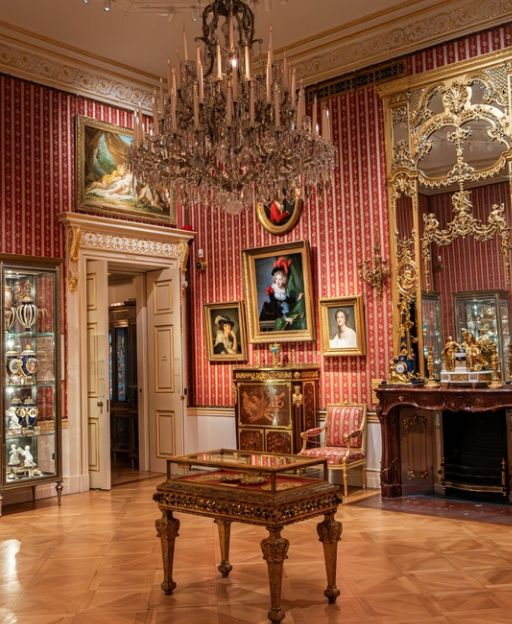
The Wallace Collection is not a secret, exactly. Londoners who know it swear by it. Art historians call it one of the finest collections in Europe. And yet on any given Wednesday morning, you might have an entire gallery to yourself. Tourists stream past Marylebone High Street every day without ever turning the corner to look inside.
What Is the Wallace Collection?
Hertford House is a handsome 18th-century mansion in Manchester Square, just north of Oxford Street. Inside it, four generations of the Seymour-Conway family — the Marquesses of Hertford — quietly assembled one of the greatest private art collections in history.
The fourth Marquess of Hertford spent much of his life in Paris, buying extraordinary works at auction while keeping almost entirely to himself. He was famously reclusive, famously wealthy, and famously obsessive about art. His illegitimate son, Sir Richard Wallace, inherited the collection and moved it to London. When Lady Wallace died in 1897, she left everything to the British nation.
In 1900, the Wallace Collection opened to the public in the same house where it had always lived. It has been free to enter ever since.
The Star Painting Everyone Recognises — and Almost Nobody Knows Is Here
Walk through the Great Gallery on the first floor and you will come face to face with Frans Hals’ The Laughing Cavalier. It is one of the most reproduced paintings in the world. Postcards, biscuit tins, textbooks. Chances are you have seen it a hundred times without ever realising it lives in Mayfair.
The man in the portrait is not actually laughing. It is a slight upward curve of the moustache, a hint of amusement in the eyes. Hals painted it in 1624, when the subject was 26 years old. The brocade of his jacket — if you stand close enough — contains tiny embroidered symbols: arrows, bees, flames, lover’s knots. Nobody knows for certain what they mean.
Standing beside it in the same gallery is Velazquez, Rembrandt, Rubens, Poussin and Titian. The quality is almost absurd. Any one of these rooms would be the highlight of a lesser museum.
If you are planning your first visit to London, the London planning guide has everything you need to build an itinerary around hidden gems like this one.
Enjoying this? 3,000+ London lovers get stories like this every week. Subscribe free →
A Room That Feels Nothing Like a Museum
Part of what makes the Wallace Collection so different is that it was never redesigned to be a museum. It is still a house. The furniture, the porcelain, the clocks, the armour, the tapestries — all of it stays where it was placed. You walk through rooms that feel like someone has just stepped out.
The Sevres porcelain collection alone is the finest outside France. The rococo furniture — Louis XV commodes and marquetry writing tables — is the kind of thing you would expect to see only behind velvet ropes in Versailles. The armoury has a full suit of field armour made for an actual battle, not a ceremony.
And then there is the indoor courtyard. A glazed roof was added in 2000, turning what had been an open courtyard into a light-filled atrium. The Cafe Bagatelle sits in the centre of it — all white tablecloths and afternoon light. It is one of the more pleasant places in London to have a quiet lunch.
For more hidden treasures in central London, the hidden gardens guide reveals dozens of green spaces most visitors walk straight past.
Fragonard’s The Swing — and the Story You Were Never Told
In the Oval Drawing Room hangs Jean-Honore Fragonard’s The Swing. It was commissioned in 1767 by a French baron who wanted to be painted in the bushes beneath the woman on the swing — watching her shoe fly off into the air as her bishop husband pushed her. Fragonard obliged, adding a cherub pressing a finger to his lips.
It is one of the most charming and slightly scandalous paintings of the 18th century. At the Wallace Collection, you can stand a metre away from it in near silence.
Compare that to the Mona Lisa experience at the Louvre — fifty people deep, everyone holding up a phone, the painting barely visible behind bulletproof glass. There is no bulletproof glass at the Wallace Collection. There is barely a queue.
What to See on Your Visit
The collection is arranged across 25 galleries on two floors. Allow two to three hours for a proper visit, though many people find themselves staying longer.
Start with the European armoury on the ground floor — it provides an unexpectedly gripping introduction to centuries of warfare. Then work your way up through the Dutch and Flemish galleries before reaching the Great Gallery, where the most famous paintings hang.
Do not miss the back rooms on the first floor, where Boucher’s pastoral scenes fill entire walls. And take a few minutes in the smaller side galleries, where the Meissen and Sevres porcelain is laid out in original mahogany cases. It sounds like a minor detail. It is not.
If you enjoy London’s free cultural institutions, the Painted Hall at Greenwich is another extraordinary free experience that almost nobody knows about.
Why Locals Keep This Quiet
Ask a Londoner where they go when they want to spend an afternoon surrounded by beauty without the usual museum crowds, and the Wallace Collection comes up often. It is the kind of place people feel slightly protective of. Not because they want to keep it to themselves, exactly. More because they worry what would happen if everyone found out.
The Wallace Collection is the answer to the question most visitors eventually ask: is there anything in London that feels like a genuine discovery? Something you can stand in front of, undisturbed, and simply look?
There is. It is in Mayfair. It is free. And it is waiting.
Is the Wallace Collection really free to enter?
Yes. Entry to the permanent collection is always free. Some temporary exhibitions may have a charge, but the full permanent collection — all 25 galleries including the Laughing Cavalier and The Swing — is free every day the museum is open.
When is the best time to visit the Wallace Collection?
Weekday mornings between 10am and noon are the quietest. The museum opens at 10am daily and is busiest on Saturday afternoons. Even at its busiest, it is remarkably uncrowded compared to London’s larger museums.
How do I get to the Wallace Collection?
The Wallace Collection is at Hertford House, Manchester Square, London W1U 3BN. The nearest Tube station is Bond Street (Central and Jubilee lines), about a five-minute walk. Buses on Oxford Street stop very close by.
What are the must-see works at the Wallace Collection?
The Laughing Cavalier by Frans Hals (Great Gallery, first floor), The Swing by Fragonard (Oval Drawing Room), and the Sevres porcelain collection are all essential. The European armoury on the ground floor is also one of the finest in Britain.
🇬🇧 25 Hidden Gems of London Most Tourists Never Find
From secret riverside walks to hidden Victorian tunnels, centuries-old pubs to rooftop gardens with skyline views — our free guide reveals the London most visitors never discover. Join 3,000+ London lovers who get it free.
Get Your Free London Hidden Gems Guide →Know someone who’d love this? Share on WhatsApp →
Love more? Join 65,000 Ireland lovers → · Join 43,000 Scotland lovers → · Join 29,000+ Italy lovers →
Free forever · · Unsubscribe anytime
Subscribe Free