
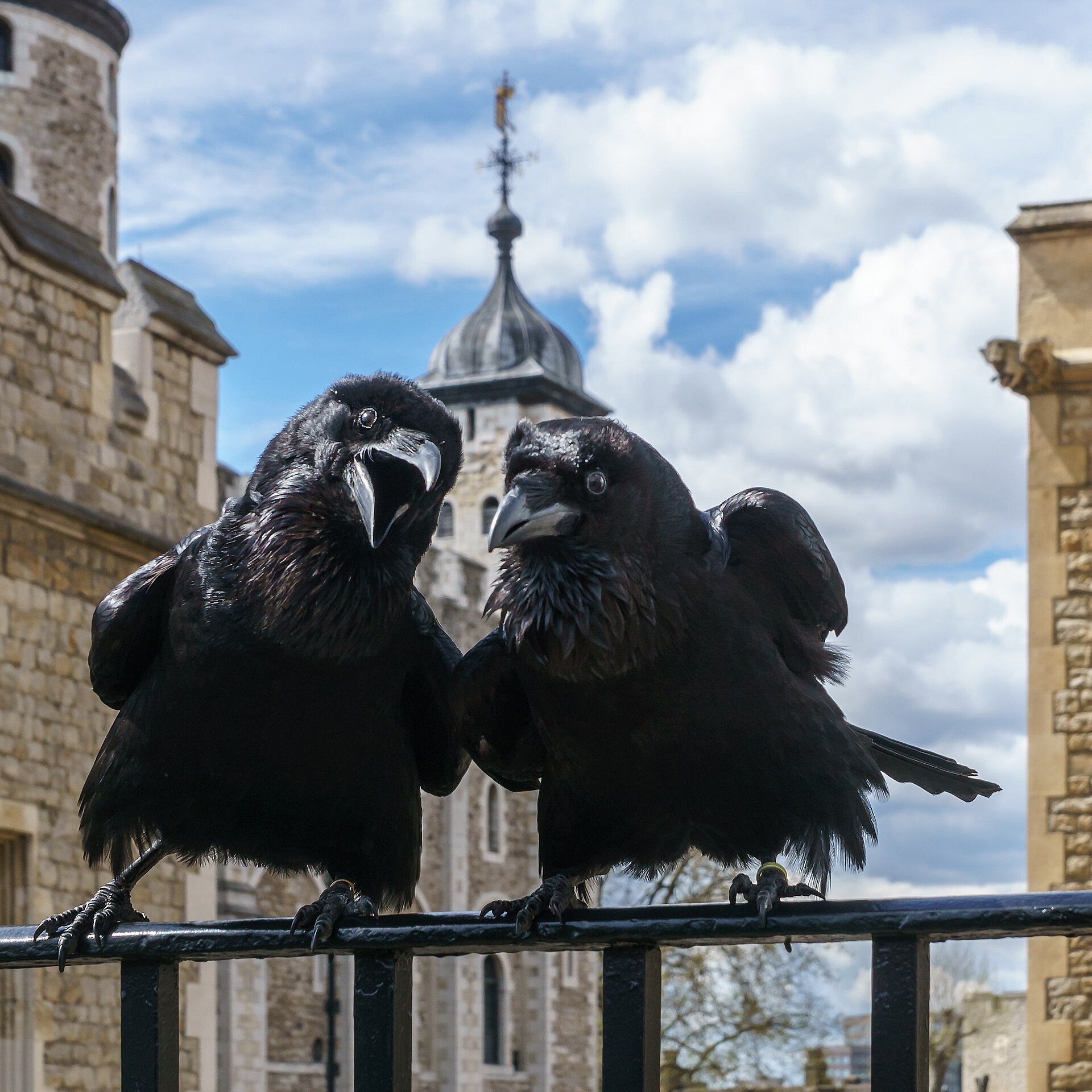
Every morning, before the gates open at the Tower of London, a Yeoman Warder in Tudor dress walks the cobbles carrying raw meat. He stops at six different spots across the grounds. He calls out names — Jubilee, Harris, Poppy, Erin, Georgie, Branwen.
Six large black ravens answer him.
They are not pets. They hold a rank in the British Army. And according to one of Britain’s oldest living superstitions, they are the only thing standing between the Crown and catastrophe.
The Tower of London has stood on the north bank of the Thames for nearly a thousand years. Kings have lived inside it. Enemies of the Crown have been imprisoned within its walls. Two queens were executed on Tower Green. But through all of it — the wars, the intrigues, the centuries of change — the ravens have been there.
The Prophecy Behind the Payroll
The prophecy is blunt and unsettling: if the ravens of the Tower of London are lost or fly away, the Crown will fall, and Britain with it.
🏙️ Love London?
3,000 London lovers get hidden history, street-level stories, and local secrets every week. Free, forever — no spam, unsubscribe any time.
Subscribe free — enter your email:
No one knows exactly when this belief began. The most widely told version traces back to the reign of King Charles II in the 1660s. His Astronomer Royal, John Flamsteed, had established an observatory within the Tower walls. The ravens kept landing on his telescopes, fouling his instruments, and disrupting his work. He wanted them removed.
Charles refused.
Even a king not known for excessive superstition would not risk what the legend promised. Instead, he issued a royal decree: at least six ravens must be kept at the Tower at all times. That decree has never been reversed or forgotten. It remains in force today, more than 350 years later.
The ravens are officially enrolled as soldiers of the Crown. Each has a service number and a rank. Each can be promoted — or, under sufficiently unusual circumstances, dismissed from service. One raven, named George, was formally discharged in 1986. His listed offence: eating television aerials. The paperwork was entirely serious. This is, apparently, the sort of thing that can end a military career in Britain.
The Ravenmaster
The care of the ravens falls to a single Yeoman Warder known as the Ravenmaster — one of the oldest and most unusual job titles in the British military.
For many years, that role was held by Christopher Skaife, who fed each bird a daily diet of raw meat, biscuits soaked in blood, the occasional hard-boiled egg, and — when available — a rabbit. He wrote a book about his charges. He gave interviews. He became something of a minor celebrity. The job itself, however, remains unchanged from what it has always been: show up before dawn, feed the birds, keep them safe, and make sure they never leave.
The ravens are released from their enclosures early each morning. They spend the day roaming the Tower grounds freely — strutting along the cobbles, eyeing the tourists, occasionally inspecting bags that smell interesting. They are not behind barriers. They share the same cobblestones as the visitors, and they know it.
Each bird’s primary flight feathers are carefully trimmed to prevent escape. The ravens can still fly short distances and move freely around the grounds, but they cannot simply leave. The prophecy, after all, does not come with a disclaimer.
At dusk, the Ravenmaster calls each bird back by name. They return to their enclosures and are locked in for the night. This routine happens every single day, in sunshine and rain alike, without exception or variation.
What Almost Happened During the Blitz
The raven population came dangerously close to collapse during the Second World War.
German bombs fell on London night after night during 1940 and 1941. The Tower was not spared. The noise, the fires, and the chaos of the raids scattered the birds. By the end of the war, records suggest only one raven remained on the Tower grounds — a bird named Grip.
One raven is not six. The prophecy hung in the air like smoke over the city.
Winston Churchill, already directing the most complex military effort in modern British history, personally ordered the raven population to be rebuilt. New birds were sourced. The full complement was restored before the war ended.
Whether Churchill believed in the old legend or simply understood that a nation fighting for its survival needed its ancient symbols intact is a question historians still enjoy debating. He kept the ravens. Britain survived. Make of that what you will.
Planning Your Visit
The Tower of London is open to visitors year-round, and the ravens are very much part of the experience. You will almost certainly encounter them.
They tend to claim the grass near the White Tower — the pale stone fortress at the heart of the complex, built by William the Conqueror in the 1080s. The ravens patrol around it as if the place belongs to them. In a sense, it does. They have been here longer than most things in London that still function.
The Ravenmaster gives informal talks and feeding demonstrations on most days. Check the Tower’s daily schedule when you arrive — it is worth building your visit around one of these sessions. Watching a Yeoman Warder call a raven by name and have it come to his glove is one of those moments that stays with you.
If you are planning your first trip to London, the Tower rewards going slowly. Not just for the Crown Jewels in the Jewel House or the Tudor armour on display — but for the quieter details. A raven settling on a battlement, turning its head toward the Thames, watching the river below.
The Tower sits where London keeps its oldest layers. A short walk away, you can find the Roman wall that once enclosed all of Londinium — two thousand years of the same city, still visible in the stone. And for more of Britain’s royal story, Windsor Castle has been home to every monarch for nearly a thousand years, with its own histories the official tours do not always reach.
🇬🇧 25 Hidden Gems of London Most Tourists Never Find
From secret riverside walks to hidden Victorian tunnels, centuries-old pubs to rooftop gardens with skyline views — our free guide reveals the London most visitors never discover. Join 3,000+ London lovers who get it free.
Get Your Free London Hidden Gems Guide →Love more? Join 65,000 Ireland lovers → · Join 43,000 Scotland lovers → · Join 30,000 Italy lovers →
Free forever · Unsubscribe anytime