
Hidden down a narrow alley off Fleet Street, pressed between barristers’ chambers and a garden that most Londoners have never entered, sits one of the strangest and most fascinating buildings in the city. It was built by warrior monks in 1185. It survived the Great Fire, the Blitz, and nine centuries of London’s relentless change. Most people who work nearby have never been inside.
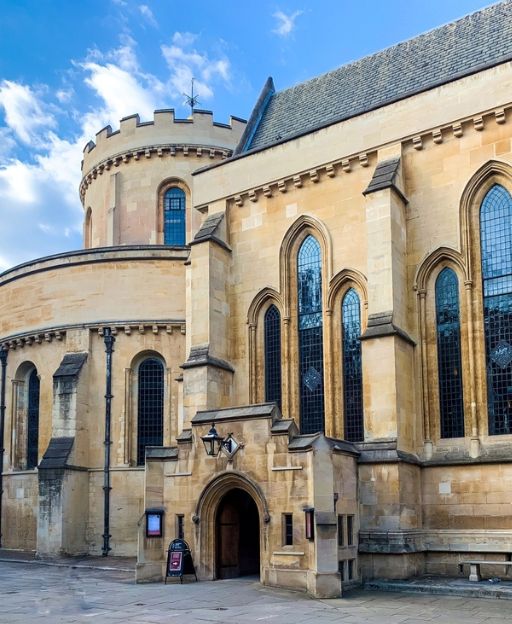
Welcome to Temple Church — the London landmark that most city guides forget to mention, and one of the most extraordinary medieval buildings in England.
Who Were the Knights Templar?
The Knights Templar were a medieval military order founded in the early 12th century to protect Christian pilgrims travelling to Jerusalem. They were part monk, part soldier — sworn to poverty, chastity, and obedience, yet armed to the teeth and bankrolled by half the crowned heads of Europe.
At their height, they controlled vast land across the continent. They built one of the first international banking systems, invented what we would now recognise as the bank transfer, and accumulated power that eventually terrified kings. In 1307, the French king had the Templar leadership arrested and tortured. Their grand master was burned at the stake in Paris in 1314.
But before all that, at the peak of their influence, the English Templars chose London as their headquarters. And when they built their church here in 1185, they wanted it to say something. If you look at the building now, you can still read what they were trying to say.
The Round Nave and What It Means
Most churches are built in the shape of a cross. Temple Church is not. The circular nave — the round section at the western end — was deliberately designed to echo the Church of the Holy Sepulchre in Jerusalem. It was a statement of intent, built in stone. The Templars were making a physical link between London and the Holy Land.
Only five round-naved Norman churches survive in England. Temple Church is the most complete.
Step inside the round section and look up. Pale Purbeck marble columns circle the space, rising into vaulted arches. Light comes in from all sides. The atmosphere is spare and oddly moving — the opposite of London’s usual noise. It is worth sitting in for a few minutes. There is nothing else quite like it in the city, and almost nothing like it in the country.
The rectangular chancel was added later, in 1240, and is brighter and more conventionally Gothic. Together, the two sections make for an unusual and compelling whole. You can walk between them in thirty seconds, but the shift in mood takes a moment to settle.
The Stone Knights on the Floor
Scattered across the floor of the round nave are nine stone effigies of knights. Each lies flat, hands pressed together in prayer, legs sometimes crossed at the knee. Most are in good condition. Some have faces worn almost smooth by centuries of touch and time.
These are among the oldest surviving knight effigies in England. Several date to the late 12th and early 13th centuries. They are made from Purbeck marble — the same dark, polished stone used in the columns around them — and they have an extraordinary quiet dignity.
One of them is William Marshal, Earl of Pembroke. By most accounts, he was the greatest knight who ever lived. He served five English kings, helped negotiate the Magna Carta, and saved England from collapse during a French invasion at the age of seventy-two. He died in 1219 and was buried here, in the church of the order he had served. In a city full of plaques and statues, this is the real thing — a man who shaped medieval England, lying in the floor a few feet from where you stand.
Enjoying this? 3,000+ London lovers get stories like this every week. Subscribe free →
The Da Vinci Code and What It Did
For much of the 20th century, Temple Church was known mainly to lawyers and dedicated history enthusiasts. The Inns of Court that surround it are not exactly tourist territory. Then in 2003, Dan Brown published The Da Vinci Code and placed Temple Church at the centre of one of the most-read thrillers ever written.
Overnight, curious readers began turning up at the gatehouse. Visitor numbers spiked. The clergy fielded daily questions about the Holy Grail. For a while, it must have been rather bewildering for a small medieval church that had previously attracted modest, quiet interest.
The Grail is not buried there. But the church is precisely as atmospheric as Brown described — and the medieval effigies do exactly what he says they do to the imagination. The book brought people to something genuinely worth seeing, which is a rare outcome for that kind of fiction.
Getting There — and the Secret Garden Around It
Temple Church does not announce itself. There is no prominent sign on Fleet Street. To reach it, walk through the Gatehouse arch on Fleet Street — you will find it between numbers 16 and 17 — and continue into the quiet lanes of Middle Temple and Inner Temple. The street noise drops away almost immediately.
The church sits in a courtyard. Around it are the gardens of the two Inns of Court — calm, grassed spaces where barristers have eaten lunch and students have revised since the 16th century. On a summer day, with the courtyard nearly empty, it is one of the most improbably lovely spots in London. You are five minutes from the roar of Fleet Street and it feels like a different world.
If you want to explore more of London’s hidden medieval corners, the hidden medieval worlds of London guide covers several other remarkable surviving sites across the city — many of them equally off the tourist trail. And if you are still planning your visit, the London planning hub is the best place to start. For another extraordinary piece of ancient London hiding in plain sight, the Roman wall hidden across the City is well worth seeking out on the same visit.
When to Visit and What to Expect
Temple Church is generally open to visitors several days a week, though opening times vary and the church is sometimes closed for services and private events. Admission has historically been free or low cost — check the church’s official website before you go, as arrangements change. Services are still held here regularly; the church remains an active place of worship as well as a historic site.
The walk through the Inns of Court is itself part of the experience. The lanes are open to the public during the day, and the gardens are generally accessible. Give yourself an hour at least — not because the church is large, but because the surrounding area rewards slow exploration. There are courtyards, staircases, and carved stone doorways that have barely changed since the 17th century.
It is the kind of London afternoon that costs almost nothing and stays with you for years.
What is Temple Church famous for?
Temple Church is famous for its 12th-century circular nave, built by the Knights Templar to echo the Church of the Holy Sepulchre in Jerusalem. It also contains nine remarkable stone effigies of medieval knights, including William Marshal — widely regarded as the greatest knight of the Middle Ages — and gained wider public attention after featuring in Dan Brown’s The Da Vinci Code.
Where exactly is Temple Church in London?
Temple Church is located in the Inns of Court, between Fleet Street and the Embankment. The entrance is through the Gatehouse arch on Fleet Street, between numbers 16 and 17. It is a short walk from Temple Underground station on the District and Circle lines.
Is Temple Church free to visit?
Temple Church has historically offered free or low-cost entry to visitors. Opening times vary and the church is sometimes closed for private events or services, so it is worth checking the church’s official website before you visit to confirm current admission details and hours.
How old is Temple Church in London?
The circular nave of Temple Church was consecrated in 1185, making the building over 840 years old. The rectangular chancel was added in 1240. The church survived the Great Fire of London in 1666 and was heavily damaged during the Blitz in 1941, but was carefully restored and reopened in 1954.
London hides its oldest places with remarkable efficiency. Temple Church has sat in the same courtyard for nine centuries, largely unannounced, surrounded by lawyers and pigeons and the occasional curious visitor who knew where to look. It deserves more of those visitors.
🇬🇧 25 Hidden Gems of London Most Tourists Never Find
From secret riverside walks to hidden Victorian tunnels, centuries-old pubs to rooftop gardens with skyline views — our free guide reveals the London most visitors never discover. Join 3,000+ London lovers who get it free.
Get Your Free London Hidden Gems Guide →Love more? Join 65,000 Ireland lovers → · Join 43,000 Scotland lovers → · Join 29,000+ Italy lovers →
Free forever · Unsubscribe anytime
Subscribe Free