
In 1685, King Louis XIV of France signed an order that would change London for ever. With a stroke of his pen, he revoked the Edict of Nantes — the decree that had protected French Protestants, known as Huguenots, for nearly ninety years. What followed was one of the great refugee crises of the seventeenth century, and one of the most remarkable chapters in London’s long history of welcoming strangers.
Within a few years, somewhere between 50,000 and 80,000 Huguenots had fled to England. Around 15,000 settled in London alone — mostly in a tight cluster of streets just east of the City, in a neighbourhood called Spitalfields. They arrived with almost nothing. They left behind them one of the most enduring legacies in London’s history.
If you have English ancestry — or French-sounding names somewhere in your family tree — there is a very real chance that one of your ancestors walked these same cobblestones.
Who Were the Huguenots — and Why Did They Run?
The word “Huguenot” is a bit of a mystery in itself. Historians still debate where it comes from — possibly a corruption of a German word for “confederate,” possibly a nickname coined by French Catholics. What’s certain is what it meant: a French Protestant, following the teachings of John Calvin, living in a country that increasingly wanted them gone.
For much of the sixteenth and seventeenth centuries, France was torn apart by religious war. The Edict of Nantes in 1598 brought an uneasy peace, granting Huguenots the legal right to worship, to hold public office, and to live without fear of persecution. For nearly ninety years, it held.
Then came Louis XIV — the Sun King — and his determination to unite France under one faith. The Revocation of the Edict of Nantes in October 1685 ended the peace overnight. Huguenot churches were demolished. Protestant schools were closed. Soldiers were billeted in Protestant homes, with orders to make life unbearable until the family converted — a policy known as the dragonnades, named for the dragoons who carried it out.
Leaving France was, technically, illegal. Tens of thousands left anyway, crossing the Channel in fishing boats, hiding in wine casks, bribing border guards. They came to England because England was Protestant, because it was close, and because — most importantly — King William III actively welcomed them. A Royal Brief in 1681 had already encouraged English parishes to collect money for French Protestant refugees. After 1685, that trickle became a flood.
🏛️ Free Guide: How to Trace Your English & British Ancestry
Step-by-step: GRO records, census 1841–1921, parish registers, the National Archives (Kew), London Metropolitan Archives, and planning a heritage trip. Completely free.
Get the Free Guide → Subscribe free at the guide page to receive weekly London heritage storiesSpitalfields: The Huguenot Quarter
Most of the London Huguenots settled in Spitalfields, a neighbourhood immediately east of the City walls. The name comes from the medieval Hospital of St Mary Spital, which once stood here. By the late 1600s it was already home to a thriving textile trade — and the Huguenots, many of whom were skilled silk weavers from Lyon, Tours, and other French weaving towns, slotted in perfectly.
Within a generation, Spitalfields silk was famous across Europe. The Huguenots brought new techniques, new patterns — damasks, velvets, brocades — and a level of craftsmanship that English weavers had never seen. The neighbourhood boomed. Beautiful terraced houses rose along Fournier Street, Elder Street, and Princelet Street. Many of these houses still stand today, virtually unchanged, their wide weavers’ windows designed to flood the upstairs workrooms with light.
Walking Fournier Street today is one of the most atmospheric experiences in London. At number 14 stands a house built in 1724 for a wealthy Huguenot silk merchant. Its internal proportions, its carved wood panelling, its elegant staircase — all speak of a family that had arrived with nothing and within forty years had rebuilt its fortune entirely.
The Building That Tells London’s Whole Immigration Story
At the corner of Fournier Street and Brick Lane stands a building unlike any other in London. Look at it long enough and you can read the entire history of East End immigration in its stones.
It was built in 1743 as La Neuve Eglise — the New Church — for the Huguenot community of Spitalfields. When the Huguenots assimilated into English society over the following century and no longer needed a French-language congregation, the building was sold. It became a Methodist chapel. Then, as waves of Ashkenazi Jewish refugees arrived from Eastern Europe fleeing pogroms in the 1880s and 1890s, it became a synagogue — the Machzike Hadath, or “Spitalfields Great Synagogue.”
Today it is the Jamme Masjid — the Great Mosque of Brick Lane — serving the Bangladeshi community that began arriving in the 1970s. The same walls, the same foundations, four faiths across three centuries. There is no better symbol of what London has always been: a city that takes people in.
🏙️ Enjoying this? 3,000 London lovers get stories like this every week. Subscribe free →
Huguenot Names You Might Recognise
The Huguenots didn’t stay in Spitalfields. Within a generation or two, those who prospered moved outward — into the City, into the West End, into the English countryside. They married English men and women, changed their names slightly to sound less foreign, and became, in the most complete sense, English. And in doing so, they seeded the British family tree more broadly than almost anyone realises.
Historians estimate that as many as one in five people with English ancestry today has at least one Huguenot ancestor. The names are everywhere, once you know how to look. Here are some of the most common Huguenot surnames found in English and American family trees:
- Bosanquet — from the French Bosanchet; a prominent banking family
- Courtauld — the great textile dynasty, whose descendants founded the Courtauld Institute of Art
- Dollond — the optician family; Peter Dollond invented the achromatic telescope lens
- Garrick — yes, David Garrick, the greatest actor of the eighteenth century, was of Huguenot descent
- Houblon — Sir John Houblon was the first Governor of the Bank of England, appointed in 1694
- Lefroy — Jane Austen’s great love, Tom Lefroy, came from a Huguenot family
- Minet — a banking and legal dynasty in London for over two centuries
- Papillon — meaning “butterfly” in French; a widespread Huguenot name
- De la Rue — the company that today prints banknotes for over 150 countries began as a Huguenot enterprise
Many other families anglicised their names so thoroughly that the French origin is now invisible. The English surname “Bird” sometimes descends from Oiseau. “Newman” could be a translation of Lenoir. “Stone” from de la Pierre. If your family tree has a name that feels slightly out of place — slightly too elegant, slightly too French — it may be worth investigating further.
Christ Church Spitalfields: The Huguenots’ Cathedral
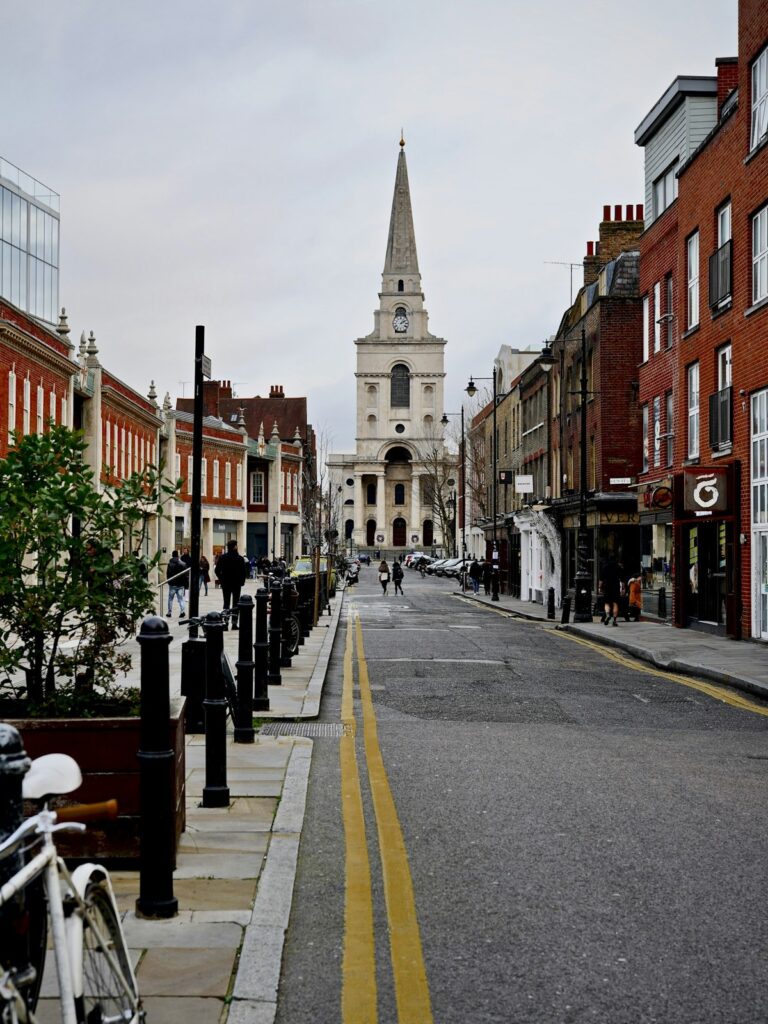
The grandest monument to Huguenot London rises at the top of Commercial Street: Christ Church Spitalfields, designed by Nicholas Hawksmoor and completed in 1729. Hawksmoor was a pupil of Christopher Wren, and Christ Church has all the muscular drama you’d expect from that tradition — a towering white Portland stone facade, a soaring spire, columns that seem almost too large for a neighbourhood church.
The Huguenots worshipped not in Christ Church itself, which was Anglican, but in their own French-language congregations nearby. But the church was built for the neighbourhood they had created, and in its crypt lie the bones of some of the wealthiest Huguenot families of Spitalfields.
The crypt was rediscovered during a restoration project in the 1980s and yielded an extraordinary archive — not just bones, but coffin plates, coffin furniture, and in some cases near-perfectly preserved individuals. Physical anthropologists spent years studying what they found. It is now the most extensively documented post-medieval population in Britain.
Today Christ Church has been beautifully restored and is open to visitors. Stand inside on a quiet morning, when the light comes through the clear glass windows and falls on those vast stone columns, and you can feel the ambition of the community that made this neighbourhood what it was.
How to Trace Your Huguenot Ancestry
If you suspect Huguenot ancestry — or simply want to find out whether you have it — London holds more records than anywhere else in the world.
The Huguenot Society of Great Britain and Ireland is the first place to look. Founded in 1885, the Society has spent nearly 140 years transcribing and publishing Huguenot records. Their publications — available at major genealogical libraries and increasingly online — include registers of French Protestant churches in London going back to the late 1500s. These registers name not just heads of households but spouses, godparents, and witnesses: exactly the cross-referencing a genealogist needs.
The National Archives at Kew holds denization records — the seventeenth-century equivalent of naturalisation papers. If your ancestor applied to become a subject of the Crown, that application is likely still there, 300 years later. Many have been indexed and can be searched online.
The French Protestant Church of London, on Soho Square, maintains archives that stretch back to the 1550s. The congregation is still active, making it one of the longest continuously worshipping Protestant congregations in Britain. Their librarian can help direct you to the relevant registers.
And for those who want to walk where their ancestors walked, the Spitalfields Heritage Trail maps the key Huguenot sites across a compact area that can be covered on foot in a morning. Start at Christ Church, walk down Fournier Street, turn onto Princelet Street, and end at Brick Lane. In the space of half a mile, you’ll pass buildings that haven’t fundamentally changed since the silk weavers first moved in.
Why the Huguenot Story Still Matters
The Huguenots arrived in London as refugees — skilled, educated, and desperate. Within a generation, they had transformed the silk industry, founded the Bank of England, produced England’s greatest actor, built streets of extraordinary beauty, and woven themselves so thoroughly into English life that most people with Huguenot blood don’t even know it.
That is a remarkable story. It is also, in many ways, a very London story — the story of a city that has always been remade by the people who come to it seeking safety, or opportunity, or simply somewhere they can worship as they choose.
Stand on Fournier Street on a quiet afternoon. The houses are still here. The church at the corner has been four things and is still standing. Somewhere in a crypt on Commercial Street, a silk weaver who crossed the Channel in 1686 with nothing but his skills and his faith is at rest in Portland stone.
The East End has changed beyond recognition since then. And yet, in some ways, it hasn’t changed at all.
Frequently Asked Questions
Who were the Huguenots and why did they come to London?
The Huguenots were French Protestants who fled France after King Louis XIV revoked the Edict of Nantes in 1685, ending legal protections for religious minorities. Around 15,000 settled in London, mainly in Spitalfields, where they established a thriving silk-weaving industry and became some of the city’s most influential citizens within a generation.
How do I know if I have Huguenot ancestry?
Historians estimate that up to 20% of people with English ancestry have at least one Huguenot ancestor. Telltale signs include French-sounding surnames in your family tree, or anglicised surnames that may be translations of French names. The Huguenot Society of Great Britain and Ireland maintains comprehensive records and can help you search. The National Archives at Kew also holds denization records for refugees who sought naturalisation from the late 1600s onward.
What Huguenot sites can I visit in London today?
The best place to start is Spitalfields. Christ Church Spitalfields (Nicholas Hawksmoor, 1729) is open to visitors and contains the restored crypt used by wealthy Huguenot families. Fournier Street and Princelet Street retain many original eighteenth-century Huguenot merchant houses. The building at the corner of Fournier Street and Brick Lane — successively a Huguenot chapel, Methodist chapel, synagogue, and mosque — is one of the most extraordinary heritage sites in London.
Join 3,000+ London Lovers
Every week, get London’s hidden history, heritage walks, and stories from the city’s remarkable past — straight to your inbox.
Subscribe free — enter your email:
Already subscribed? Download your free London guide (PDF)
Free forever · One email per week · Unsubscribe anytime