
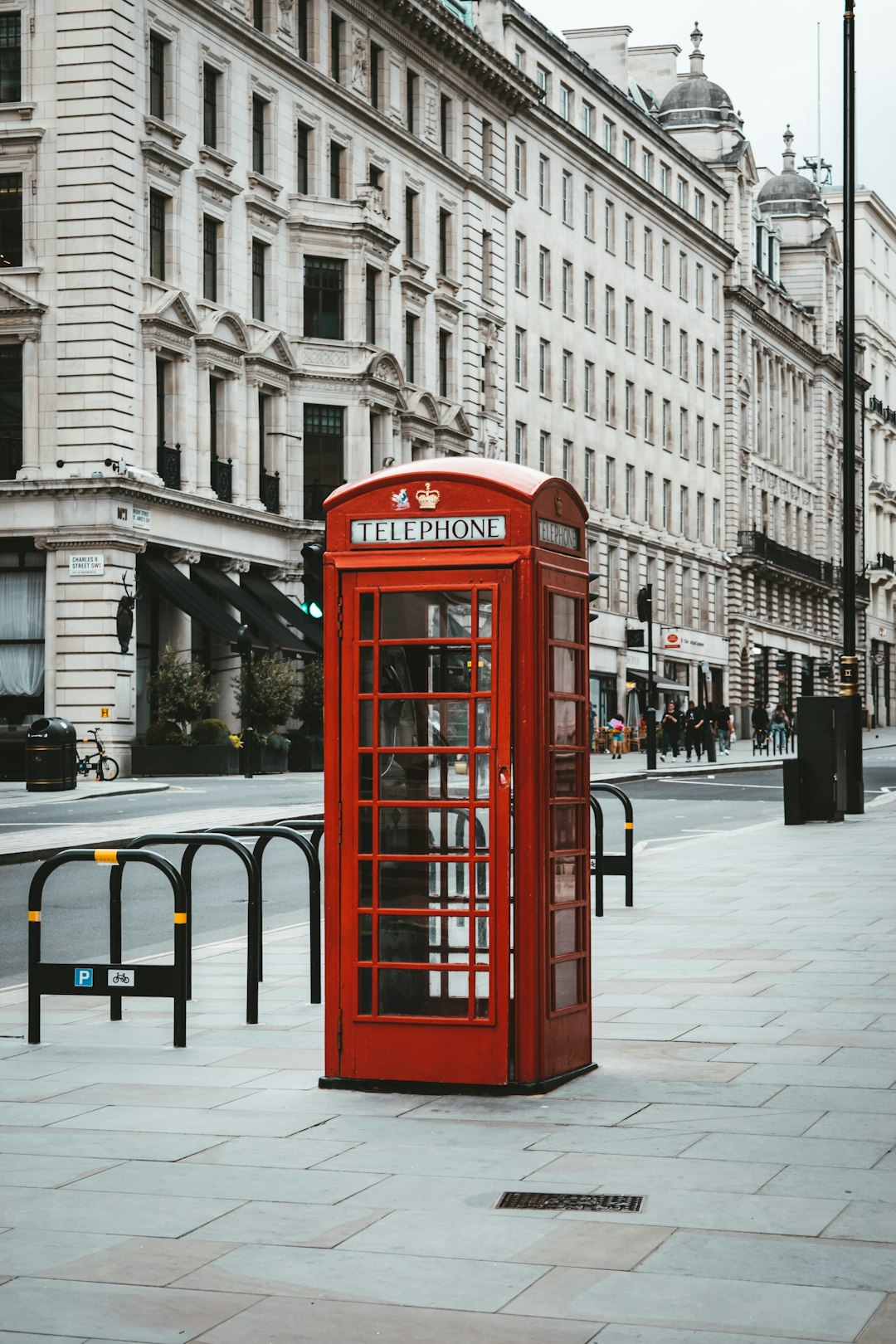
The colour has a name and a number: it is Currant Red, British Standard 381C shade 539, and it was chosen so a box could be spotted from a distance across a grey street. The design most people picture — the domed one with the crown pierced into its crowns — is the K6, drawn up by Sir Giles Gilbert Scott in 1935 to mark the Silver Jubilee of King George V. This is Guide № 003 in The Love London Guide series.
Get the Full Collectible Guide (Free PDF)
The Red Telephone Box — in a beautifully designed, printable booklet. The Love London Guide № 003.
Where the Red Box Came From
The General Post Office ran Britain’s telephone service for most of the twentieth century, and it wanted a standard kiosk. The first national type, the K1, was concrete and unloved. In 1924 the Post Office held a competition, and the winning entry came from Sir Giles Gilbert Scott — the architect who also designed Battersea Power Station and Liverpool’s Anglican Cathedral. His cast-iron K2 of 1926 was expensive and largely confined to London.
The box that spread across the whole country was the K6, a smaller, cheaper refinement of Scott’s design released in 1935. Tens of thousands were installed, and it is the K6 — with its shallow dome, its glazing bars, and the royal crown embossed near the top — that became a fixture of nearly every British high street and village green.
Reading the Details
Scott reportedly wanted the boxes painted silver with a blue-green interior; the Post Office overruled him and chose red for visibility. The crown stamped into the kiosk is a real point of interest for spotters, because it changes with the reigning monarch. Boxes in Scotland often carry the Scottish crown, and the pattern above the door is not fixed across the whole country.
Look closely and you will also find the small differences between models: the K2 has eighteen panes of glass per side and perforated crowns for ventilation, while the K6 uses larger glazing and a different crown treatment. These are the clues collectors and enthusiasts use to date a box on sight.
How to Find One Today
Working payphones have declined sharply as mobile phones took over, and the regulator Ofcom has set out rules on when a public phone can be removed — including protections where a box is the only coverage for miles, or sits at an accident hotspot. Thousands of kiosks have gone, but many survive because they are listed structures. Historic England and the other heritage bodies have given listed status to a large number of K2 and K6 boxes, which legally protects them from demolition.
In central London, reliable places to see them include the row outside the Royal Courts of Justice, the boxes near Covent Garden, and the cluster on Broad Court by the Bow Street area. If you want a photograph without a crowd, the quieter residential streets of Westminster and the City still hold plenty.
A Second Life: Adopt a Kiosk
When BT no longer needs a box, communities can buy it for a nominal sum — famously one pound — through the Adopt a Kiosk scheme. Thousands have been taken on this way. Villages have turned them into the smallest libraries in the country, housed defibrillators inside them, or fitted them with a single shelf of local information.
This is why a red box you pass may no longer contain a phone at all. The shell is protected and beloved, so the practical answer has been to keep the cast iron and change what lives inside it — a working piece of street furniture given a new job.
Myths Worth Retiring
Myth: All red phone boxes are the same design. They are not. The K2, K6, and later types differ in size, glazing, and crown detail, and earlier kiosks like the concrete K1 were never red-iron boxes at all. The one in most photographs is specifically the K6.
Myth: Red was chosen because it is the traditional British colour. Red was chosen for visibility. Scott himself is said to have preferred silver, and the Post Office picked the bright colour so the boxes could be seen easily — the same reason its pillar boxes were red.
Myth: They have all been scrapped. Many remain, both as working payphones and as listed, adopted, or repurposed kiosks. A significant number carry legal protection, which is precisely why you still see them.
Frequently Asked Questions
Who designed the red telephone box?
Sir Giles Gilbert Scott designed the classic kiosks. His K2 appeared in 1926 and the widely-installed K6 followed in 1935, created to mark the Silver Jubilee of King George V. Scott is also known for Battersea Power Station and Liverpool Cathedral.
Do any red phone boxes still work?
Yes. Some still function as payphones, and Ofcom rules protect certain boxes from removal — for example where they provide the only local coverage or sit at accident hotspots. Many others survive as listed structures or have been adopted by communities for new uses.
Why are so many boxes now libraries or defibrillator points?
Through BT’s Adopt a Kiosk scheme, a community can buy a decommissioned box for a nominal sum, often one pound. Because the boxes are valued and frequently protected, keeping the shell and repurposing the interior has proved popular, giving each kiosk a practical second life.
More The Love London Guides
The Love London Guide is a numbered series — one tightly focused subject at a time, each with its own downloadable collectible edition. Guide № 001 is Fish and Chips, Guide № 002 is Trooping the Colour, This is Guide № 003. More editions are on the way.
🇬🇧 Join 3,000+ London Lovers
Every week, get hidden stories, local secrets, and travel inspiration from people who live and love it.
Subscribe free — enter your email:
