
Walk through Brixton on a Saturday morning and your senses are hit all at once. The smell of jerk chicken and plantain drifts from a tiny kitchen at the back of the market. A record shop blasts roots reggae into the street. Somewhere nearby, a gospel choir is warming up for Sunday. You are in one of the most alive places in London — a neighbourhood that has been shaped by arrival, struggle, and fierce, unbroken identity.
How the Caribbean Transformed South London
In June 1948, a ship called HMT Empire Windrush docked at Tilbury Docks in Essex. On board were nearly 500 passengers from Jamaica, Trinidad, and Barbados — men and women who had answered Britain’s call to help rebuild the country after the Second World War.
Many of them ended up in Brixton. It was affordable, had good transport links to central London, and had a labour exchange — a government office matching workers to jobs — right on the high street. What began as a practical choice became a permanent home.
Over the decades that followed, successive waves of Caribbean migrants settled here and built their own world. They opened churches, record shops, hair salons, and food stalls. They brought sound system culture — huge speaker rigs playing reggae and ska in church halls and community centres. Brixton became the heart of Black British life in London.
Electric Avenue: Britain’s First Lit-Up Street
Running off Brixton Road is a short, covered street called Electric Avenue. It doesn’t look like much at first glance — market stalls selling vegetables, spices, and phone cases. But it was, in the 1880s, one of the first shopping streets in Britain to be lit by electric lighting.
It became the beating heart of the Caribbean market through the twentieth century. Stalls selling yams, breadfruit, scotch bonnets, and salt fish sat alongside butchers and fabric merchants. It was a place where the community fed itself and kept its traditions alive.
In 1983, Guyanese musician Eddy Grant turned the street into a global name with his song “Electric Avenue.” The track reached number two in the UK charts. For anyone who knows the area, hearing it still brings a very specific rush of recognition.
The Riots That Changed British Policing Forever
In April 1981, Brixton erupted. For several days, clashes between local residents and the Metropolitan Police spread across the neighbourhood. Cars burned. Buildings caught fire. More than 200 officers were injured, and hundreds of people were arrested.
The immediate trigger was police violence against a young man who had been stabbed. But the tensions had been building for years. Unemployment in Brixton among young Black men was sky-high. Police had been running an aggressive stop-and-search operation — codenamed Operation Swamp 81 — that had swept up hundreds of local people in a matter of days.
The government commissioned Lord Scarman to investigate. His report, published later that year, was a landmark document. It acknowledged for the first time that institutional racism played a role in the breakdown. It led to major reforms in how British police were trained and how they engaged with minority communities. Brixton didn’t just burn — it changed the country.
David Bowie Was a Brixton Boy
David Robert Jones was born on 8 January 1947, in a terraced house at 40 Stansfield Road, Brixton. He grew up nearby in Stockwell before moving north with his family. He would later become David Bowie — one of the most influential musicians the world has ever seen.
Brixton barely knew him during his lifetime. He hadn’t lived there since childhood. But when he died on 10 January 2016, something extraordinary happened. Thousands of people gathered outside a mural of his face on Coldharbour Lane, painted by street artist Jimmy C. They brought flowers and candles. They sang. They cried. The vigil went on for days.
The mural has become one of the most visited spots in south London. Brixton has claimed Bowie fiercely and completely. He is part of the neighbourhood’s story now, as much as the market or the riots or the sound systems.
Brixton Village and the Market That Refused to Die
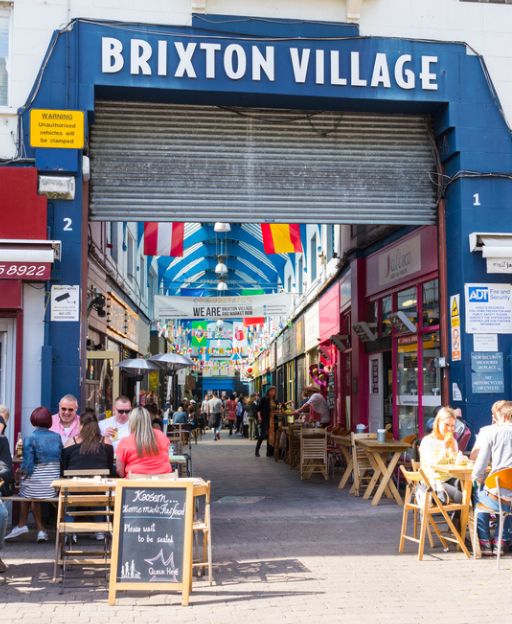
At the heart of Brixton is Granville Arcade, now known as Brixton Village. It is a covered market with a low vaulted ceiling, narrow passages, and the warmth of a hundred small enterprises packed tightly together.
For much of its history it was a traditional Caribbean and African food market. By the 2000s it had fallen into partial decline. Then something unexpected happened — a campaign to fill empty units with artists and food vendors at low rents. Word spread. The market came back.
Today you can eat Nigerian suya, Colombian empanadas, Ethiopian injera, and Sri Lankan curry within fifty metres of each other. The original Caribbean stalls are still there. The market is loud, cramped, and excellent. It is also one of the best places in London to understand what the city actually is — a place built by people who came from everywhere.
If you’re planning a trip to South London, this neighbourhood should be on your itinerary. You’ll find everything you need to plan your time in London here.
What Most Visitors Don’t Find
Beyond the market, Brixton rewards the curious. The Ritzy Cinema on Coldharbour Lane opened in 1911 and is still going — a beautiful old building that shows independent and art-house films alongside mainstream releases.
In the middle of a residential street sits Brixton Windmill, an early nineteenth-century structure that is the only windmill in inner London still standing on its original site. It’s a strange, wonderful sight.
The Black Cultural Archives, on Windrush Square, is the only institution in Britain dedicated specifically to collecting and preserving Black British history. Its archive holds letters, photographs, community publications, and records that would otherwise have been lost.
Caribbean culture has left its mark across the whole of south London — if you want to understand how it shaped other parts of the city, the story of Notting Hill’s Caribbean heritage is equally fascinating.
Brixton has been declared dead a dozen times. Each time, it has proved the obituary writers wrong. It is a place that insists on its own story — complicated, vibrant, and entirely its own. That is exactly why it is worth going.
🇬🇧 25 Hidden Gems of London Most Tourists Never Find
From secret riverside walks to hidden Victorian tunnels, centuries-old pubs to rooftop gardens with skyline views — our free guide reveals the London most visitors never discover. Join 3,000+ London lovers who get it free.
Get Your Free London Hidden Gems Guide →Love more? Join 65,000 Ireland lovers → · Join 43,000 Scotland lovers → · Join 30,000 Italy lovers →
Free forever · Unsubscribe anytime
Subscribe Free