
On one short stretch of road in west London, the houses run from sky blue to bubblegum pink to sunshine yellow. Tourists stop mid-stride to photograph them. Residents film them for social media. Estate agents use them to sell the idea of a neighbourhood. But almost nobody stops to ask why they are this colour — and the answer changes how you see everything about this part of London.
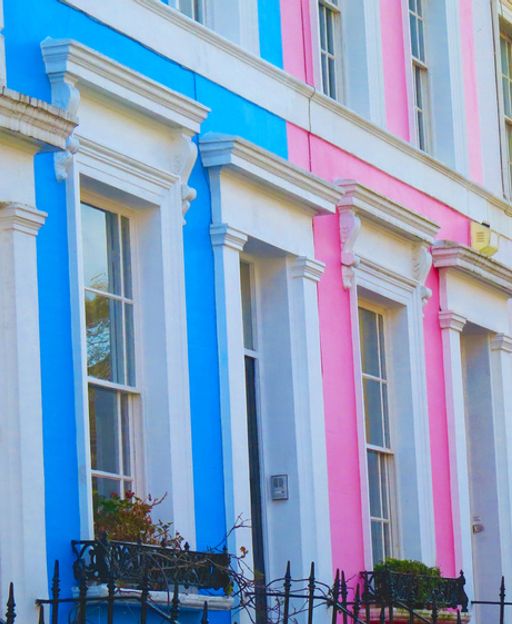
The painted houses of Notting Hill are one of the most recognisable images of London. They appear on postcards and travel guides, on Instagram and in films. They look effortlessly, timelessly London. But they are not a Victorian tradition. They are not an architect’s vision. They are something far more interesting: a statement of identity made by people who had every reason to go unnoticed, and chose instead to be seen.
The Street That Started as a Slum
Victorian terraced houses were built to a formula. Cream stucco or pale stone. Uniform rows, uniform heights, uniform respectability.
🏙️ Love London?
3,000 London lovers get hidden history, street-level stories, and local secrets every week. Free, forever — no spam, unsubscribe any time.
Subscribe free — enter your email:
The houses of Notting Hill started as exactly that. Built in the 1840s and 1850s, they were aimed at middle-class families moving west from the overcrowded city. The intention was gentility. The reality was more complicated.
By the early twentieth century, the middle-class families had moved further out. The houses were divided into bedsits and rooms-to-let. Landlords subdivided floors, blocked off staircases, and collected rent from people who had nowhere better to go. By the 1950s, Notting Hill was one of the most run-down areas in west London — overcrowded, poorly maintained, and largely invisible to the rest of the city.
That invisibility was about to end.
The Ships That Arrived
In June 1948, the HMT Empire Windrush docked at Tilbury with nearly 500 Caribbean passengers aboard. Many were veterans who had served in the British forces during the Second World War. They had answered a call from the British government to help rebuild a country shattered by six years of war.
Thousands more followed over the next two decades. They came from Jamaica, Trinidad, Barbados, and across the Caribbean islands. They came as British subjects, carrying British passports, expecting the welcome due to citizens of the empire.
What many found instead was a country that wanted their labour but not their presence. “No Blacks, No Irish, No Dogs” signs appeared in the windows of boarding houses. Employers offered jobs, then retracted them on sight. The welcome was not what had been promised.
Notting Hill was one of the few areas in London where Caribbean families could find rooms. Rents were cheap because the housing stock was in poor condition. Some landlords here would rent to Black families when others across the city would not. It was not a welcome. It was the door left ajar because no one else wanted the room.
The Riots — and What They Created
In late August and early September of 1958, violent attacks on West Indian residents spread through Notting Hill. White gangs — some organised, some not — moved through the streets for days. Properties were attacked. People were badly hurt.
The police response was slow. The press largely blamed the victims. The government did almost nothing. The experience confirmed what many in the Caribbean community already knew: they were not going to be protected by the institutions around them. They would have to build something for themselves.
Claudia Jones, a Trinidadian journalist and activist who had arrived in Britain in 1955 after being expelled from the United States, understood exactly what was needed. Not just justice — though that too — but visibility. The community needed to show itself, fully and joyfully, to a city that had tried to pretend it wasn’t there.
In January 1959, she organised an indoor Caribbean carnival at St Pancras Town Hall. It was broadcast on the BBC. It was the first time many British viewers had seen Caribbean culture on their screens. Jones called it a “Caribbean answer to the Notting Hill race riots.”
How the Carnival Moved into the Streets
Claudia Jones died in 1964, aged 49. But the event she had started did not die with her. In 1965 and 1966, community organisers in Notting Hill brought the celebration outside. Steel bands played in the streets. Costumes appeared. The sound carried for blocks.
Today, the Notting Hill Carnival is the largest street festival in Europe. Around two million people attend over the August bank holiday weekend. Steel bands, soca music, and elaborate costumes fill the streets for two full days. It is, among other things, an act of defiance that has been running for sixty years.
The painted houses belong to the same story. Caribbean culture is vivid and outward-facing. It does not hide behind neutral tones. As the community settled into Notting Hill through the 1960s and 1970s, residents began painting the facades of their homes in colours that recalled the Caribbean — the deep turquoise of sea water, the pink of bougainvillea, the yellow of sunlight against white walls. It was an act of ownership. It said: we are here, and this is what here looks like now.
The Neighbourhood Today
The houses of Notting Hill are now some of the most expensive in London. A mid-terrace on one of the painted streets can sell for several million pounds. The Caribbean community that gave these facades their colour has largely been priced out — pushed towards Hackney, Brixton, and the outer boroughs by decades of rising values and the steady pressure of gentrification.
But the houses remain painted. The colours stayed even after the people who chose them could no longer afford to stay.
Visitors come from all over the world to photograph these streets. They stay in boutique hotels behind those facades. They eat at restaurants that serve food shaped by the neighbourhood’s heritage. Portobello Road’s famous Saturday antiques market runs through the same streets — a different kind of history, from a different era, layered on top of everything that came before.
If you want to understand how London works — how it absorbs wave after wave of new arrivals and retains some of what each one left behind — Notting Hill is one of the best places to start. The full guide to London’s neighbourhoods will help you plan where to spend your time, but Notting Hill will reward you even if you think you already know it.
Come in the morning, before the weekend market crowds arrive. Walk the residential streets rather than the main road. The light catches those painted facades differently before noon — the blues look deeper, the pinks almost luminous. And if you happen to visit in late August, the carnival will show you exactly why this corner of London looks the way it does: because its people decided, decades ago, that they were going to be impossible to ignore.
For help planning your trip, the London planning guide is the best place to begin.
🇬🇧 25 Hidden Gems of London Most Tourists Never Find
From secret riverside walks to hidden Victorian tunnels, centuries-old pubs to rooftop gardens with skyline views — our free guide reveals the London most visitors never discover. Join 3,000+ London lovers who get it free.
Get Your Free London Hidden Gems Guide →Love more? Join 65,000 Ireland lovers → · Join 43,000 Scotland lovers → · Join 30,000 Italy lovers →
Free forever · Unsubscribe anytime