
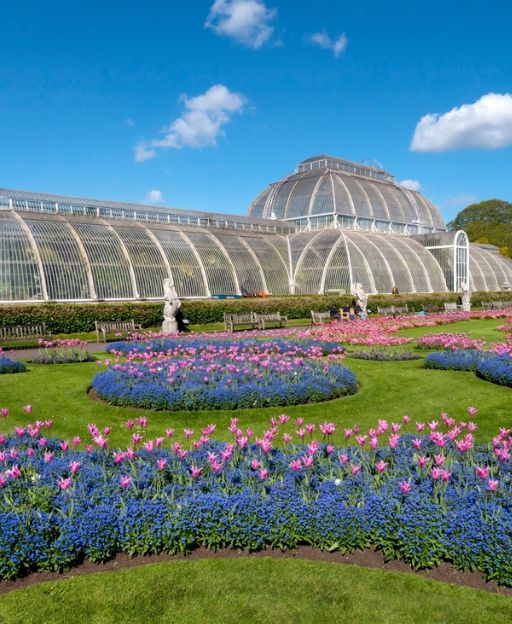
Stand inside the Palm House on a cold London morning and you are, briefly, somewhere else entirely. The air turns thick the moment you push open the door. Light filters through curved glass above you. Around you stand banana trees, palms from Madagascar, a cacao tree from South America. Outside the glass: grey skies, the Thames, London going about its business.
Most visitors come to Kew Gardens for a lovely afternoon. What they get — without quite realising it — is one of the most important places on Earth.
A Garden That Started as a Royal Hobby
Kew did not begin with grand ambitions. In 1759, Princess Augusta — mother of George III — established a nine-acre botanic garden on the grounds of Kew Palace in Surrey, just nine miles from central London. It was a fashionable pursuit for wealthy families of the time: collecting plants from distant places, growing them in walled gardens, impressing visitors.
🏙️ Love London?
3,000 London lovers get hidden history, street-level stories, and local secrets every week. Free, forever — no spam, unsubscribe any time.
Subscribe free — enter your email:
What made Kew different was what happened next. George III gave the gardens royal backing and appointed the great naturalist Joseph Banks as unofficial director. Banks had just returned from Captain James Cook’s first voyage around the world, his notebooks filled with descriptions of plants that Europeans had never seen.
Banks turned Kew into a machine for plant collecting. He sent botanists to the Americas, Australia, Africa, and Asia. Ships arrived at Kew carrying living specimens from every corner of the British Empire and beyond. The garden stopped being a hobby and became something far more serious.
The Plant Hunters Who Changed the Collection
The Victorians were obsessed with plants. Not just for beauty — for medicine, for food, for commerce. Rubber, tea, quinine, cotton: all of these began as wild plants somewhere in the world, and Kew was the place where Britain tried to understand and harness them.
Plant hunters — a real and dangerous profession — were sent to the most remote corners of the world. They scaled mountains in China to find rhododendrons. They waded through South American rainforests for orchids. They bartered with local traders in India for seeds that might cure diseases. Many never came back.
The specimens they sent home built one of the most remarkable collections in scientific history. Today Kew holds over 50,000 living plant species across its 330 acres. Its herbarium — a library of preserved plants — contains seven million specimens collected over 200 years. No other institution on Earth comes close.
The Palm House: A Victorian Engineering Miracle
By the 1840s, Kew needed somewhere to house its growing collection of tropical plants. The solution was the Palm House — and it is still, nearly 180 years later, one of the most remarkable buildings in Britain.
Designed by Decimus Burton and engineer Richard Turner, the Palm House opened in 1848. It stretches 110 metres across and rises 19 metres at its centre. The entire structure is made of curved wrought iron and glass — a technology so new at the time that engineers were inventing the techniques as they went. The shape was not chosen for aesthetics. It was calculated to catch the maximum amount of winter sunlight while withstanding the weight of the structure above.
When you walk inside today, you are stepping into a building that helped define what the Victorian age believed it could accomplish. The plants inside — palms, tree ferns, breadfruit trees — have been growing here for generations. Some of the specimens are irreplaceable. If they were ever lost, the species might disappear entirely from cultivation.
What Kew Is Actually Doing Right Now
The Palm House is the most photographed building at Kew. But it is not the most important one. That distinction belongs to a building most visitors never see: the Millennium Seed Bank at Wakehurst in Sussex, run by Kew.
The Seed Bank currently holds around 2.4 billion seeds from over 40,000 plant species — roughly 15 percent of the world’s wild plant species. The goal is 25 percent by 2030. Scientists from countries across the world partner with Kew to collect and store seeds before habitats are destroyed by climate change, agriculture, or development. It is, in practical terms, a backup drive for life on Earth.
Kew’s researchers are also working to identify new plant species — around 2,000 are formally described each year — and to reintroduce endangered plants into the wild. The garden that Princess Augusta started as a fashionable hobby now employs hundreds of scientists and is treated as an international conservation institution. UNESCO added it to the World Heritage List in 2003.
Planning Your Visit to Kew
Kew Gardens is open year-round and rewards every season. Spring brings 14,000 tulips planted around the Palm House — the sight that draws the most photographs. Summer means the water lily house, the rock garden in full bloom, and open-air concerts on summer evenings. Autumn turns the treetops above the Treetop Walkway gold. Even winter has appeal: the glasshouses become warm sanctuaries from the cold.
Allow at least three to four hours. The 330 acres are more walkable than they sound, but there is more to discover at every turn than any single visit can cover. A good starting point is the Palm House, then the Temperate House — the world’s largest surviving Victorian glass structure, restored in 2018 after a decade of repairs — and then follow your instincts from there.
If you visit with children, the Treetop Walkway at 18 metres above ground is worth the detour. For history, the royal palace hidden inside Kew’s grounds tells one of the saddest stories in British royal history — and most visitors walk straight past it. Kew fits naturally into any week-long London itinerary as a half-day trip out of the centre, and there is full guidance on planning your London visit if you are coming from the US.
Kew is a twenty-minute Tube ride from central London on the District line. It is one of the rare places in this city where you can spend an entire day and leave feeling as though you have seen something genuinely new — even if you have lived in London your whole life.
The plants have been here longer than most of the buildings around them. They will likely outlast us all.
🇬🇧 25 Hidden Gems of London Most Tourists Never Find
From secret riverside walks to hidden Victorian tunnels, centuries-old pubs to rooftop gardens with skyline views — our free guide reveals the London most visitors never discover. Join 3,000+ London lovers who get it free.
Get Your Free London Hidden Gems Guide →Love more? Join 65,000 Ireland lovers → · Join 43,000 Scotland lovers → · Join 30,000 Italy lovers →
Free forever · Unsubscribe anytime