
If you have English ancestry, London is where the paper trail begins. The city holds birth, marriage, and death records going back to the 1530s, census returns from 1841, and millions of pages of parish registers that document ordinary lives across centuries. This guide tells you exactly where to look — whether you are searching from home or planning a research trip to the capital.
Where to Start: Gather What You Already Know
Before you open any archive database, write down everything your family already knows. Full names matter — including middle names and maiden names. Approximate birth years, the name of any English town or county, and the date your ancestor arrived in America are all useful starting points.
Even fragments help. If you know your great-grandfather came from “somewhere in Yorkshire” in the 1890s, that is enough to begin a census search. If you have an old photograph with “Hackney, 1908” written on the back, you already know which London borough to explore.
Keep a research log as you go. Ancestry research can branch quickly, and without notes you will find yourself repeating the same searches weeks later.
The General Register Office: Civil Records Since 1837
Civil registration of births, marriages, and deaths began in England and Wales on 1 July 1837. From that date, every birth, marriage, and death was recorded by local registrars and indexed centrally. These records are the backbone of modern English ancestry research.
The index to these records — covering over 280 million events — is freely searchable online at FreeBMD.org.uk, a volunteer project that has digitised the complete GRO index. You can search by name, year, and district to identify the specific certificate you need.
Once you find a match in the index, you can order the original certificate from the General Register Office for £12.50. A birth certificate gives the child’s full name, date and place of birth, and both parents’ names — including the mother’s maiden name. A marriage certificate lists both spouses, their ages, fathers’ names and occupations, and the witnesses. Death certificates record age, occupation, and cause of death.
Each certificate is a stepping stone to the next generation. Birth certificate gives parents’ names. Parents’ marriage certificate gives their own parents’ names. Each document pushes your tree further back.
🏛️ Free Guide: How to Trace Your English & British Ancestry
Step-by-step: GRO records, census 1841–1921, parish registers, the National Archives (Kew), London Metropolitan Archives, and planning a heritage trip. Completely free.
Get the Free Guide → Subscribe free at the guide page to receive weekly London heritage storiesThe National Archives at Kew: Where England’s Memory Lives
The National Archives sits in Kew, southwest London, about 30 minutes from central London by Underground. It holds over 11 million documents spanning 1,000 years of English history — and it is free to visit.
For ancestry researchers, the most important holdings are the census returns from 1841 to 1921. Every ten years from 1841, census enumerators went door to door recording every person in every household: names, ages, relationships, birthplaces, and occupations. The 1921 census, released in 2022, is the most recent available and is fully searchable online via Findmypast.
The National Archives also holds: wills proved at the Prerogative Court of Canterbury going back to 1383; military service records for both World Wars; naturalisation papers for immigrants who became British subjects; and land tax records, court rolls, and estate papers that document English families at the local level.
Many records are now available online through the Archives’ own Discovery portal, Ancestry.com, and Findmypast. But some records have not yet been digitised, and a visit to Kew can uncover documents you would never find online. You will need a free Reader’s Card — register in advance at nationalarchives.gov.uk. The reading rooms are open Tuesday to Saturday.
🏙️ Enjoying this? 3,000 London lovers get stories like this every week. Subscribe free →
London Metropolitan Archives: The City’s Own Paper Trail
The London Metropolitan Archives (LMA), located in Clerkenwell, holds 105 kilometres of records relating specifically to London and its people. This is where you come for parish registers covering the historic London area from the 1530s onwards — pre-dating civil registration by 300 years.
The LMA holds baptism, marriage, and burial registers for hundreds of London parishes. It also has records from the Corporation of London, the London County Council, workhouses and Poor Law institutions, hospitals, schools, law courts, and livery companies. Rate books list householders street by street, year by year, and can track an ancestor’s movements across London neighbourhoods.
The online catalogue at lma.gov.uk lets you search by parish, date range, and record type. Some records are available to view digitally via Ancestry.com and Findmypast. The reading room at 40 Northampton Road, Clerkenwell, is open Monday to Friday by appointment — book a slot in advance on the LMA website.
Parish Registers Before 1837: The Church Records
Civil registration only began in 1837. Before that, the Church of England kept the official records of baptisms, marriages, and burials from 1538, when Thomas Cromwell ordered every parish in England to record these events. For the 300 years between 1538 and 1837, parish registers are your primary source.
The good news is that a huge proportion of English parish registers have been digitised. FamilySearch.org — run by the Church of Jesus Christ of Latter-day Saints — offers free access to billions of records including millions of English baptisms, marriages, and burials. Findmypast and Ancestry have additional collections, some exclusive.
Non-conformist families — Methodists, Quakers, Catholics, Baptists — kept their own registers, which were collected centrally in 1837. The National Archives holds these non-parochial registers, and many are searchable online. If your ancestor was not Church of England, check for the relevant denominational records.
Be aware that old handwriting can be difficult to read. Resources like familysearch.org offer free handwriting guides for different centuries. The Society of Genealogists in London runs courses, and many genealogical societies offer online help with older documents.
The Best Digital Tools for English Ancestry Research
You do not need to travel to London to begin your research. These digital platforms hold the majority of the most important English records:
- FamilySearch.org — Free access to billions of records including most English parish registers, census indexes, and probate records.
- FreeBMD.org.uk — Free, searchable index to the entire GRO birth, marriage, and death records from 1837 onwards.
- Findmypast.com — The leading specialist in English and Welsh records, with the most complete census collection and the world’s largest newspaper archive for family search clues.
- Ancestry.com — All UK census returns plus millions of additional records; many US public libraries offer free access to members.
- TheGenealogist.co.uk — Strong for English trade directories, Tithe Maps, and military records not found elsewhere.
Start with FamilySearch and FreeBMD before paying for a subscription. These free tools can take you surprisingly far before you need specialist databases.
St Pancras Old Church and London’s Ancient Parish Network
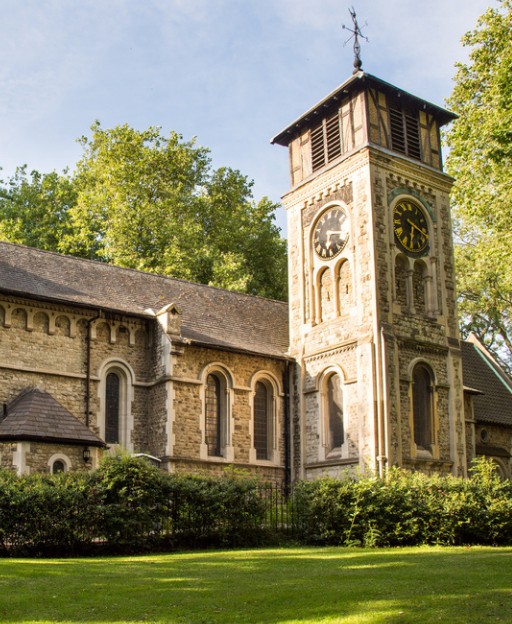
St Pancras Old Church, near King’s Cross, is one of the oldest Christian sites in London. Its current building dates largely from the 19th century, but Christian worship here is recorded from the early medieval period. The churchyard holds graves reaching back centuries, and the parish registers — now housed at the London Metropolitan Archives — are among the oldest surviving London records.
Many London churches have similarly deep histories. St Bride’s on Fleet Street, Southwark Cathedral, St Giles Cripplegate, and All Hallows by the Tower all have registers predating 1600. If your London ancestor came from a specific neighbourhood, searching the relevant parish records at the LMA can reveal generations of family history.
The Society of Genealogists, located near Farringdon, holds one of the largest genealogical libraries in the world, with 250,000 books, tens of thousands of rolls of microfiche, and surname collections donated by researchers over more than a century. It is open to non-members for a daily fee and worth a visit if you are spending a week in London researching.
Planning Your Heritage Research Trip to London
A research trip to London can be both practically productive and personally moving. Seeing the street where your great-great-grandmother was born, or standing in the church where your ancestors were married, makes the paper research feel very real.
Plan your archive visits carefully. The National Archives at Kew requires a free Reader’s Card — register online before you travel. The London Metropolitan Archives requires advance booking for the reading room. Both are free to visit. Build in at least a full day at each archive if you have specific records to find.
Combine your research with a visit to the neighbourhood where your ancestors lived. The 1881 or 1901 census will show you the exact street. Many London streets from that era still exist. Walk them. Find the church. Look at the local cemetery. These places connect you to the people your records describe.
Frequently Asked Questions
How far back can I trace my English ancestry using London records?
Parish registers in England date from 1538, so in principle you can trace a family line back nearly 500 years. Before 1538, records exist mainly for landowners, nobility, and those who appear in legal documents. Most researchers can realistically reach the 1700s with standard archive research, and many can go further with specialist sources.
Do I need to visit London in person to research my English ancestry?
Not necessarily. The majority of census records, GRO civil registration indexes, and a large proportion of parish registers are now available online through Ancestry, Findmypast, and FamilySearch. However, a visit to the National Archives at Kew or the London Metropolitan Archives can uncover documents not yet digitised — especially pre-1800 records and specialist collections like Poor Law records or land tax returns.
What is the most useful English census for Americans tracing ancestry?
The 1881 and 1891 censuses are often the most useful starting points, as they capture the generation most likely to have emigrated to America between 1880 and 1920. Every household member’s birthplace is recorded, which pinpoints the exact English county or town your family came from. Work backwards from there to earlier census years and then into parish registers.
Are London ancestry records free to access?
Many are free. FamilySearch.org is entirely free. FreeBMD, which indexes GRO civil registration records, is also free. In-person visits to the National Archives and London Metropolitan Archives are free. Ancestry.com and Findmypast require subscriptions, but many UK public libraries and US libraries with genealogy departments provide free member access — worth checking before paying.
My ancestor came from London but I don’t know which parish. Where do I start?
Start with the census. The 1841, 1851, 1861, 1871, 1881, 1891, 1901, or 1911 census will show your ancestor’s precise address, often down to the house number and street. Once you have an address, you can identify the historic parish boundaries using the GENUKI website, which maps London parishes in detail. That tells you which parish register to search at the London Metropolitan Archives.
Join 3,000+ London Lovers
Every week, get London’s hidden history, heritage walks, and stories from the city’s remarkable past — straight to your inbox.
Subscribe free — enter your email:
Already subscribed? Download your free London guide (PDF)
Free forever · One email per week · Unsubscribe anytime