
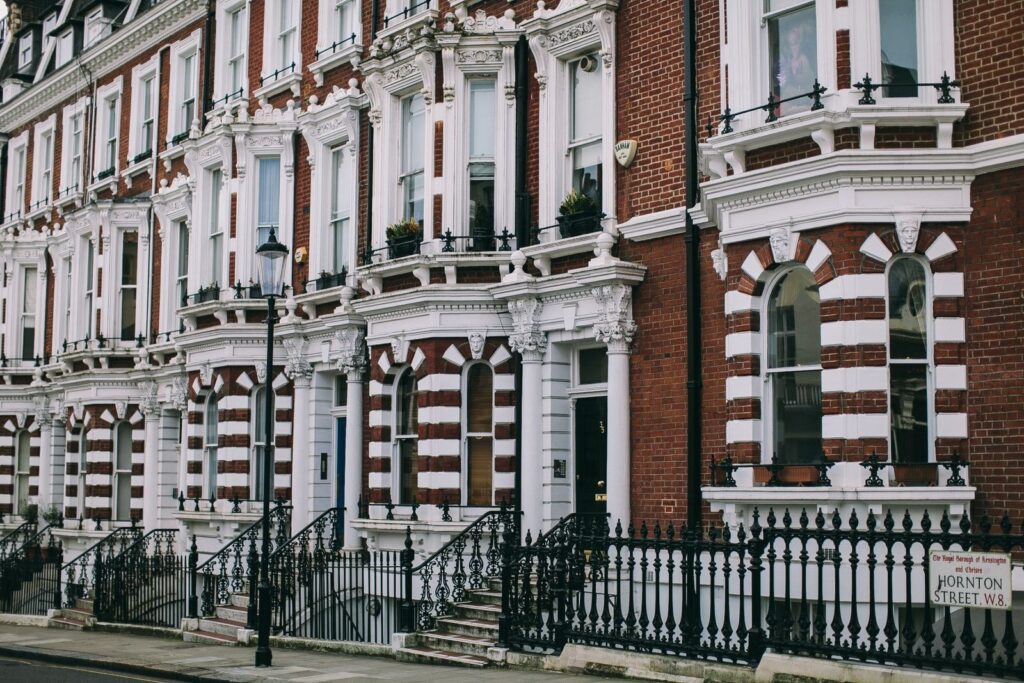
Walk down almost any residential street in Chelsea, Islington, Kensington or Hackney, and you will see them: row upon row of red-brick terraced houses, their white-painted sills gleaming, iron railings still in place, bay windows catching the London light. They look permanent. Immovable. As if they have always been there.
They have not always been there. Every one of those houses has a story. Behind those orderly facades, Victorian London played out the most dramatic social transformation in British history — and most visitors walk right past it without knowing a thing.
This is that story.
How Victorian London Built Itself in 64 Years
Queen Victoria came to the throne in 1837 when London had a population of around 2.3 million. By the time she died in 1901, that number had more than doubled to 6.5 million. In those 64 years, London did not just grow — it reinvented itself entirely.
The terraced house was the engine of that growth. Builders discovered they could pack more homes onto a street by sharing walls — no gaps between houses, no wasted land. A terrace of twelve houses could house twelve families on the footprint of two detached villas. For a city growing at 50,000 new residents a year, that efficiency was not just attractive. It was essential.
Between 1840 and 1880, London’s builders threw up roughly 900,000 new homes. Most were terraces. They came in clear social grades: grand four-storey stucco villas in Notting Hill for the professional classes, neat two-up two-down brick rows in Hackney for the clerks and shopkeepers, and tight back-to-back courts, now largely demolished, for the labourers who built everything else.
What most visitors see today — the well-maintained terraces of South Kensington or Islington — represents only the top and middle of that hierarchy. The full Victorian picture was far messier, far darker, and far more interesting.
The Upstairs-Downstairs World Most People Don’t See
Next time you pass a grand London terrace, look below street level. See that iron gate, those steps leading down to a semi-basement door? That was the servants’ entrance. The household above ground belonged to the family. The world below ground — the kitchen, the scullery, the larder, the servants’ hall — belonged to someone else entirely.
In 1871, one in three women in England and Wales worked in domestic service. A respectable middle-class London household might employ four or five servants: a cook, a parlour maid, a housemaid, a lady’s maid, and a general servant who did everything else. Wealthier households ran to a dozen or more.
These servants lived inside the houses they worked in, but on entirely separate terms. They ate separately, slept in attic rooms with no heating, worked sixteen-hour days, and were addressed by their first name while calling their employers “Sir” or “Ma’am.” The social distance between the basement kitchen and the first-floor drawing room, a physical distance of perhaps ten metres, was in practice a gulf as wide as the century itself.
Many of London’s grand terraces still have their below-stairs geography intact. The Churchill War Rooms, which you may have visited, are in a basement — a reminder that Londoners had always understood the basement as the place where essential, unglamorous work happened.
The Hidden Trades of the Victorian Street
Victorian London was not a quiet place. The street outside those respectable terraces was an astonishing theatre of noise, commerce, and smell that we have almost entirely lost today.
Henry Mayhew, a journalist who spent the 1840s and 1850s interviewing London’s street workers, documented over 130 distinct trades operating in the city’s streets: muffin sellers, watercress girls, crossing sweepers, rat-catchers, pure-finders (who collected dog excrement for the leather-tanning industry), cat’s-meat men who sold horse flesh for domestic cats, and costermongers selling fruit and vegetables from barrows.
The sound of London in 1860 was the sound of iron wheels on cobblestones, of horse hooves, of street sellers crying their wares in competing pitches, of church bells marking the quarter-hour from a dozen different directions at once. The smell was horse — the city had 300,000 horses at its peak — mixed with coal smoke from hundreds of thousands of chimneys, and the particular sharp tang of the Thames at low tide.
Those terraced houses you walk past today would have been surrounded by a human ecosystem of almost incomprehensible variety and noise. The quiet residential streets of modern London are a very recent invention.
🏙️ Enjoying this? 3,000 London lovers get stories like this every week. Subscribe free →
The Darker Side: Poverty, Disease and Reform
The grand Victorian terrace tells only one half of the story. For every Kensington townhouse with a butler and a cook, there was a Whitechapel court where twelve people shared a single room, a Southwark alley where cholera swept through a building in a matter of days.
The 1851 census found that 12% of Londoners were living in conditions that would today be classified as severe overcrowding — more than two people per room, with no running water, no sanitation, and shared outdoor privies serving twenty or thirty families at once. The average life expectancy in the most deprived parts of East London in the 1840s was 37 years. In fashionable Mayfair, it was 55.
The great Victorian reformers — Charles Dickens, Henry Mayhew, Charles Booth — documented this world with painful specificity. Booth’s poverty maps of London, produced between 1886 and 1903, colour-coded every street in the city from wealthy (yellow) to semi-criminal (black). You can still view digitised versions of these maps online today, then walk the same streets and see how much — and how little — has changed.
The Victorian response to urban poverty gave London many of its most distinctive landmarks: the great teaching hospitals at Guy’s and St Thomas’s, the public libraries funded by Andrew Carnegie, the Metropolitan Board of Works that built the sewers and embankments, the London County Council that eventually built the great council estates. The Victorian city’s problems created Victorian London’s institutions — and many of those institutions are still serving the city today.
Hidden Spaces You Can Still Visit
The best way to understand Victorian London is not to look at it from the outside but to get inside it — and there are more opportunities to do this than most visitors realise.
The Geffrye Museum (now the Geffrye, Museum of the Home) in Hoxton is housed in a row of 18th-century almshouses and takes you through a series of recreated English living rooms from 1600 to the present day. The Victorian room, complete with antimacassars on the chairs and a coal fire laid in the grate, is worth the journey alone. Admission is free.
18 Folgate Street in Spitalfields is one of the most extraordinary heritage experiences in London. The house was preserved by the eccentric American collector Dennis Severs as a “still-life drama” — he lived in it without electricity or modern heating and maintained it as if the Huguenot silk-weaving family who had owned it in the 18th and 19th centuries had just stepped out of the room. Candle-lit evening tours are available and bookings are essential. Visiting feels less like a museum visit and more like crossing time itself.
The Whitechapel Bell Foundry — which cast the original Liberty Bell in Philadelphia and Big Ben’s predecessor — operated on the same Whitechapel Road site from 1570 until 2017. The building itself still stands and heritage tours are available in the restored foundry. For American visitors with any sense of history, the Liberty Bell connection alone makes this unmissable.
The Victorian sewers beneath the Thames Embankment — Joseph Bazalgette’s masterwork, built between 1859 and 1875 after the Great Stink of 1858 forced Parliament to act — are occasionally open for guided tours through the London Museum. These brick tunnels, still operational after 165 years, are as impressive an engineering achievement as anything above ground.
The Legacy on Today’s Streets
Once you start looking for Victorian London, you cannot stop seeing it. The red telephone boxes (introduced 1936, but designed in conscious homage to Victorian civic grandeur). The cast-iron drinking fountains, some still working, that the Metropolitan Free Drinking Fountain Association installed from 1859 onwards to encourage sobriety. The ornate pub frontages of Victorian gin palaces that survive in Holborn and Aldgate. The blue plaques marking the houses of Victorian writers, politicians and scientists who changed the world from these addresses.
Charles Darwin lived at 110 Gower Street for a decade before moving to Kent to write On the Origin of Species. John Keats wrote “Ode to a Nightingale” in a garden in Hampstead that you can still visit. Karl Marx spent thirty years in London, writing Das Kapital in the British Museum Reading Room and dying at 41 Maitland Park Road in Haverstock Hill — a blue plaque marks the spot.
The Victorian terraced street you walk down is not just a collection of handsome houses. It is a document — of ambition and poverty, of empire and reform, of 64 years in which a city tried to make itself worthy of being the capital of the world. It did not always succeed. But the effort left its mark on every brick.
Planning Your Victorian London Walk
The best Victorian London walk starts at Paddington Station — a Brunel masterpiece opened in 1854 — and heads east through Bayswater, Notting Hill and Kensington to the great Victorian museums (the V&A, the Natural History Museum, the Science Museum) on Exhibition Road. This is the district built directly from the profits of the Great Exhibition of 1851, and every building tells that story.
For the darker side of Victorian London, walk from Liverpool Street through Spitalfields to Whitechapel. Visit Christ Church Spitalfields (Hawksmoor, 1729, but at the heart of Victorian social reform), walk through Brick Lane — still, improbably, a street of dozens of trading cultures layered one on top of the other — and visit the Whitechapel Gallery, founded in 1901 specifically to bring art to the East End poor.
Set aside a full day for each route. Wear comfortable shoes. And look up — always look up. The Victorian builders put their best work above eye level, in the terracotta friezes and carved keystones and ornate chimney stacks that most people never notice.
Frequently Asked Questions
What is the best area of London to see Victorian architecture?
Kensington and South Kensington offer the grandest Victorian terraces, particularly around Exhibition Road. For more varied Victorian streetscapes, Islington and Hackney in north-east London have been less redeveloped and show a fuller range of Victorian housing types, from grand villas to workers’ cottages.
How many people lived in Victorian London?
London’s population grew from approximately 2.3 million in 1837 to 6.5 million by 1901, making it by far the largest city in the world for most of the Victorian era. At its peak around 1880, London contained roughly one in five of all urban dwellers in England and Wales.
Can you tour inside a Victorian house in London?
Yes — several options exist. The Museum of the Home (Geffrye) in Hoxton offers free entry with recreated Victorian room settings. 18 Folgate Street in Spitalfields runs candlelit evening tours of a preserved Victorian townhouse. Leighton House in Holland Park, the home of the Victorian painter Lord Leighton, is also open to visitors and preserves its original interior almost entirely intact.
🇬🇧 25 London Places Most Visitors Miss
From secret riverside walks to hidden Victorian tunnels, centuries-old pubs to rooftop gardens with skyline views — our free guide reveals the London most visitors never discover. Join 3,000+ London lovers who get it free.
Get Your Free 25-Places Guide →Already subscribed? Download your free London guide (PDF)
Free forever · One email per week · Unsubscribe anytime
Subscribe Free