
Deep in Windsor Great Park, about 25 miles from central London, a set of ancient columns stands quietly in the trees. They’re real. They’re roughly 2,000 years old. And they came from North Africa.
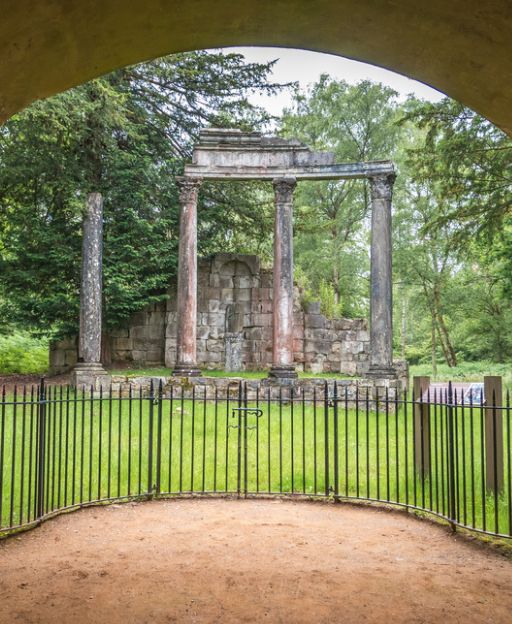
Most people who come across them assume they are a Victorian folly. Some decorative stonework built to add drama to a royal garden. They are not. These are genuine ancient ruins, removed from one of the greatest cities of the Roman world and arranged here on the orders of a king with a taste for the theatrical.
The site is called the Roman Ruins at Virginia Water. It sees a fraction of the visitors that flock to Windsor Castle, a few miles away. There are no queues, no timed entry tickets, no audio guides. Just 2,000-year-old stone, standing in an English park, largely unbothered by the joggers and dog walkers passing nearby.
From North Africa to an English Royal Park
Leptis Magna was one of the finest cities of the Roman Empire. Located on the coast of what is now Libya, it was the birthplace of Emperor Septimius Severus, who ruled Rome from 193 to 211 AD. At its peak, Leptis Magna was among the most prosperous cities in the known world. A place of grand colonnaded streets, a vast amphitheatre, elaborate public baths, and a harbour busy with trade across the Mediterranean.
By the early 19th century, the city lay largely buried under sand. In 1817, a British consul named Hanmer Warrington organised an excavation and arranged for a collection of columns, capitals, and architectural fragments to be shipped to Britain aboard Royal Navy vessels. The removal of ancient stonework from foreign countries raised fewer objections in that era than it would today.
The British Museum received the majority of the pieces. But a selection of the finest columns and architectural elements made their way to Windsor, and to King George IV.
George IV and the Art of the Grand Gesture
George IV had a flair for spectacle on a royal scale. He had transformed Brighton with its extraordinary oriental domes and minarets. He commissioned John Nash to remodel Regent’s Park and design the sweeping terraces that still line it today. He spent lavishly on palaces, pageantry, and anything that made a statement.
When the Leptis Magna columns arrived at Windsor, he saw an opportunity. In 1826, he had them arranged along the southern shore of Virginia Water — a large artificial lake in Windsor Great Park — to create what his landscape designers called a picturesque Roman scene.
The result is genuinely strange and genuinely beautiful. Corinthian columns rise from the grass. Fragments of ancient friezes lie at their base. A stone archway frames the whole composition against a backdrop of English oak and birch. It is part ruin, part theatre. A 2,000-year-old scene staged in a Surrey meadow.
Enjoying this? 3,000+ London lovers get stories like this every week. Subscribe free
Walking to the Ruins
Virginia Water is a large man-made lake, created in the 1740s for William Augustus, Duke of Cumberland. The path around the lake is a popular walk among Windsor locals. Roughly four and a half miles in total, with the Roman Ruins accessible on the southern shore.
When you reach the site, you pass through a stone arch to find the columns arranged on a gentle slope behind iron railings. One column lies fallen in the foreground. The display does not pretend to be a complete ruin. It is clearly curated. But the stonework itself is the real thing. You are looking at masonry that stood in a North African city at the height of Roman power.
Touch the fluted surface of a column and you are in contact with something carved roughly 1,800 years ago. It is an odd sensation in an English royal park. The distant past made suddenly, physically present.
The site is free to enter. Windsor Great Park is open to the public year-round, managed by the Crown Estate. There are no visitor facilities specifically at the ruins. It is simply a place you walk to and stand in, which is part of what makes it feel so untouched.
What Else to See at Virginia Water
The ruins are one stop on a larger walk worth taking in full. Virginia Water lake itself is striking. Wide, peaceful, and surrounded by mature woodland. The Totem Pole at the northern end, a gift from British Columbia for the 1958 Festival of Britain, is another unexpected sight that prompts the same question: how did that end up here?
The Valley Gardens nearby are at their best in spring, when azaleas and rhododendrons cover the hillsides in colour. There is also a cascade waterfall at the western end of the lake, and broad stretches of open parkland that feel genuinely wild for somewhere so close to London.
If you are making a day of it, Windsor Castle is a few miles north and easy to combine with a morning at the lake. The town of Windsor has good options for lunch before or after the walk. For more ideas on planning your time in and around London, the London Planning Hub is a good starting point.
A Story About Empire, and What It Left Behind
The removal of the Leptis Magna stones is part of a longer history of colonial-era collecting that is now viewed very differently. Libya has at various points raised the question of repatriation. Leptis Magna itself is a UNESCO World Heritage Site, one of the best-preserved Roman cities in the world despite generations of looting.
None of this makes the columns less remarkable to stand beside. If anything, it adds weight to the experience. You are not just looking at ancient stonework. You are looking at something that was taken, moved, and repurposed. That now sits in an English park while the city it came from remains one of the most significant Roman sites on earth.
It is the kind of complicated history that London, and the places around it, is full of. If you know where to look.
Frequently Asked Questions
How do you get to the Virginia Water Roman ruins from London?
Take a train from London Waterloo to Virginia Water station. The journey takes around 45 minutes. From the station it is about a 15-minute walk to the lake. The Roman Ruins are on the southern shore, roughly a mile along the lakeside path from the main entrance. You can also drive and park at the Virginia Water car park off the A30.
Is it free to visit the Roman ruins at Virginia Water?
Yes. Windsor Great Park is free to enter on foot and the Roman Ruins are accessible year-round during daylight hours with no tickets or booking required. Car parking charges apply. There are no entry fees or timed entry slots for the ruins themselves.
Are the Virginia Water ruins actually Roman?
Yes. The columns and architectural fragments are genuine Roman stonework from Leptis Magna in modern-day Libya, dating to the Roman period. They were brought to Britain in 1817 to 1818 and arranged here in 1826 on the orders of King George IV. They are not a folly built to look ancient. They are authentic ancient pieces placed in a designed landscape setting.
What else is worth seeing near the Virginia Water ruins?
The full walk around Virginia Water lake takes about 90 minutes and passes a Totem Pole, woodland gardens, and a cascade waterfall. The Valley Gardens are beautiful in spring. Windsor Castle is a short drive away and well worth combining with a visit if you have a full day.
There is something quietly striking about rounding a corner on a Sunday morning walk, past joggers and families, and finding 2,000-year-old Roman columns standing in the English countryside. They do not announce themselves. There is no grand entrance.
Just ancient stones, still standing, in a park that most of London has forgotten exists.
🚂 The Best Day Trips from London — Free Planning Guide
From medieval castles to coastal cliffs, from ancient Roman cities to rolling countryside — discover the most rewarding day trips from London, with everything you need to plan each one. Free, curated, updated for 2026.
Get the Free Day Trips from London Guide →Love more? Join 65,000 Ireland lovers · Join 43,000 Scotland lovers · Join 29,000+ Italy lovers
Free forever. . Unsubscribe anytime.
Subscribe Free