
The first thing you notice is the silence. Just inside the gates of Kensington Palace, away from the cameras and the crowds, there is a garden so precisely planted that every single flower in it was chosen on purpose. And the reason why will stop you in your tracks.
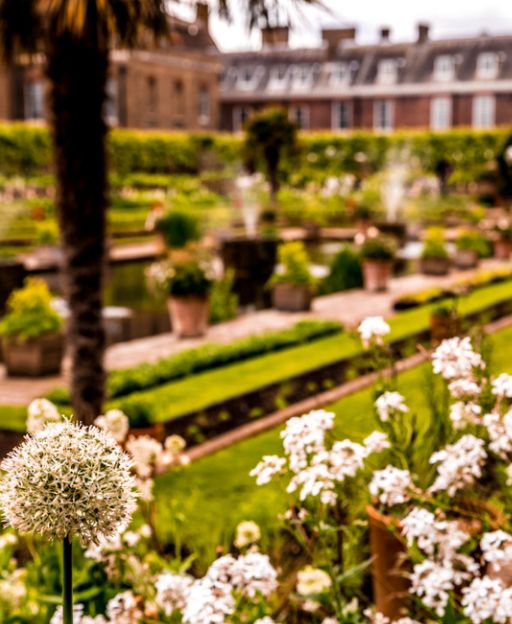
It sits to the south side of Kensington Palace, slightly below the level of the surrounding lawn. Most visitors walk past without stopping. The ones who do stop rarely leave quickly.
A Garden Planted With Grief and Love
The Sunken Garden at Kensington Palace has existed since 1909, designed by Royal gardener Frank Pearce in the formal Dutch style. For decades it drew visitors with its clean geometry, its stone pool, and its symmetrical box hedging.
But in 2017, everything changed.
That summer, the garden was redesigned as a living tribute to Princess Diana, whose former apartments — rooms 8 and 9 — sit directly overlooking it. To mark the 20th anniversary of her death, the Royal Parks planted the garden almost entirely in white.
White forget-me-nots. White cosmos. White astrantia. White roses. These were her favourite flowers, chosen so that she would not be forgotten. The decision came after consultation with Diana’s sons, both of whom had walked these paths as children.
The garden has been replanted in her memory every summer since. It is one of the most quietly powerful memorial spaces in Britain, yet most of the people who pass it each day have no idea what they are looking at.
Why the Flowers Are All White
Flowers carry meaning in Britain in ways that outsiders often miss. White blooms have long been associated with remembrance, with quiet grief, and with love that outlasts the person who inspired it.
The Royal Parks team worked closely with Prince William and Prince Harry to select species Diana loved. Every plant in the central beds was chosen with her in mind — not for spectacle, but for meaning.
The result is extraordinary. In summer, when the garden is at its peak, the whole space glows with a softness that feels deliberate. White flowers catch light differently from colour. They seem to hold it rather than simply reflect it.
Visitors who know the story find themselves slowing down. Those who do not know it often feel the same pull anyway. There is something in the precision of the planting — the care that has gone into every detail — that communicates itself without explanation.
The Garden’s Older Story
Before Diana, the Sunken Garden had its own long history. Edward VII loved Kensington Palace, and the garden became a favoured haunt of those in his social circle during the early 1900s.
The layout has always followed the same formal structure — a rectangular central pool flanked by symmetrical flower beds, with an encircling walkway of pleached linden trees forming a living colonnade overhead. It is one of the finest surviving examples of high Edwardian garden design in London.
Those linden trees are now over a century old. In spring their leaves are vivid green. In autumn, they turn amber and gold. Walking beneath them in October, when the white flowers are gone and the leaves are falling, the garden takes on an entirely different character — one that is no less moving.
The stone urns along the perimeter, the worn paths, the pool that reflects whatever sky is above it — these elements were here long before the memorial replanting and will be here long after. The garden holds more than one story at once.
Enjoying this? 3,000+ London lovers get stories like this every week. Subscribe free →
How to Get There and When to Go
The Sunken Garden sits within Kensington Gardens, which is a Royal Park open to the public entirely free of charge. You do not need a ticket to Kensington Palace to see it. You do not need to book ahead. You simply walk in.
The nearest Underground stations are High Street Kensington (Circle and District lines) and Queensway (Central line). From either, the garden is a 10 to 15 minute walk through the park. It is signed from the main path on the south side of the Palace.
The best time to visit is June through August, when the summer planting is fully established and the white flowers are at their peak. But the spring rotation from April into May — planted with forget-me-nots and white tulips — is equally worth making the journey for.
Early mornings are particularly good. The garden is at its quietest before 10am, and the low summer light catches the flowers in a way that the midday crowd never sees. If you are already planning your time in London, it pairs beautifully with a morning walk through the rest of Kensington Gardens before the city gets busy.
What You Will See When You Arrive
The garden sits below the level of the surrounding lawn — hence the name. You approach from the top of a gentle grass bank and look down into the formal space before descending. This elevated first view is part of what makes the arrival so striking.
The central pool reflects the sky above it. On clear days the water turns a deep blue that makes the white flowers on either side seem to glow. In the linden colonnade, dappled shade creates patterns on the stone path that shift as the day progresses.
London has hundreds of hidden gardens that visitors walk past without ever noticing. The Sunken Garden is different. It is right there, in plain sight, beside one of the city’s most photographed buildings. And still people miss it.
The garden is at its most uncrowded on weekday mornings in June and July. On those visits, you may find yourself almost entirely alone with the flowers, the pool, and the Palace behind you — a rare thing in central London.
A Place That Earns Its Silence
There are places in London that are famous for being famous. The Sunken Garden is not one of them. It draws those who already know to look for it, and those who stumble upon it quietly and find themselves staying longer than they planned.
It rewards slow looking. Every section has a detail worth pausing over — a particular planting combination, a stone urn filled to overflowing, the reflection of the Palace in the pool on a still summer morning. There are benches. Use them.
The Royal Parks contain some of London’s most extraordinary open spaces, many carrying histories that most visitors never learn. The Sunken Garden is simply one of the most personal. This is not a museum piece. It grows and changes with every season. It asks nothing of you except that you take a moment. For a garden planted in memory of someone whose loss is still felt by millions, that feels exactly right.
Is the Sunken Garden at Kensington Palace free to visit?
Yes. The Sunken Garden sits within Kensington Gardens, a Royal Park open to the public at no charge. You do not need a ticket to Kensington Palace to enter the garden — simply walk into Kensington Gardens and follow the signs to the south side of the Palace.
When is the best time to see the white flowers in bloom?
The peak blooming season is June through August, when the summer planting is fully established. April and May also offer a beautiful spring display of forget-me-nots and white tulips. The garden is replanted twice a year, so there is almost always something in flower between April and October.
Why are the flowers at the Sunken Garden white?
Since 2017, the garden has been planted almost entirely in white as a tribute to Princess Diana, whose apartments at Kensington Palace overlook the garden. White flowers — including forget-me-nots, cosmos, and roses — were her favourites. The replanting was arranged in consultation with her sons, Prince William and Prince Harry, to mark the 20th anniversary of her death.
Can I combine a visit to the Sunken Garden with Kensington Palace?
Yes — they are directly adjacent. The Sunken Garden is free to enter from Kensington Gardens. Kensington Palace itself has an admission charge. Many visitors spend time in the garden before or after touring the Palace, and the combination makes for a full morning in this part of west London.
Some places in London carry the weight of what happened there without any fuss. The Sunken Garden does this better than almost anywhere else in the city. Come in summer. Come in the morning. Give it more than five minutes.
🇬🇧 25 Hidden Gems of London Most Tourists Never Find
From secret riverside walks to hidden Victorian tunnels, centuries-old pubs to rooftop gardens with skyline views — our free guide reveals the London most visitors never discover. Join 3,000+ London lovers who get it free.
Get Your Free London Hidden Gems Guide →Love more? Join 65,000 Ireland lovers → · Join 43,000 Scotland lovers → · Join 29,000+ Italy lovers →
Free forever · Unsubscribe anytime
Subscribe Free