
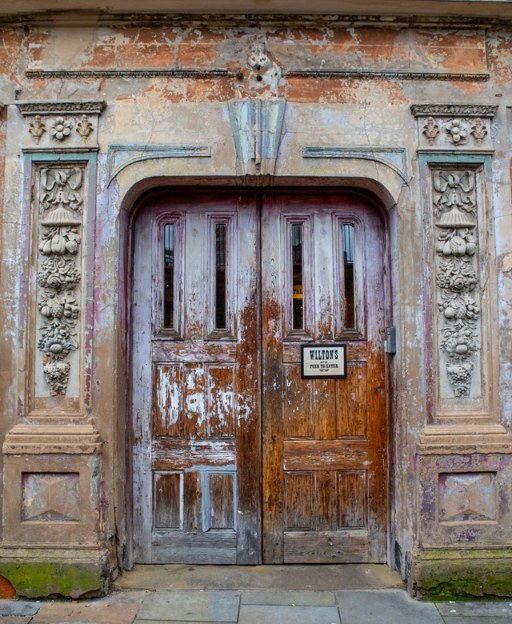
There is an alley in Whitechapel that most visitors never find. It is barely wide enough for two people to pass. The building at the end of it looks as though it has been slowly dissolving into the pavement for decades. The paint has been peeling for over a century. The ornate wooden door has seen better days than these.
That building is Wilton’s Music Hall. And it is the oldest surviving grand music hall in the world.
What Is Wilton’s Music Hall?
Wilton’s opened in 1858–59, built by a publican named John Wilton on Graces Alley in the East End of London. At the time, music halls were the entertainment of the working class — the pubs and clubs where ordinary Londoners went to drink, to laugh, and to forget the working week.
The grand saloon held hundreds of people beneath gaslit chandeliers. There was a raised stage and a gallery for those who could afford to look down at the crowd below. Outside, the streets of Whitechapel hummed with dock workers, market traders, and immigrants freshly arrived from across Europe, all making their way in one of the busiest cities on earth.
It was, in every way, a building built by and for the people of East London. Not for kings or parliament or the Church. For ordinary people who worked hard and deserved a night out.
The Entertainment That Made Victorian London Nervous
Music halls were not respectable in Victorian England. The clergy disapproved. The newspapers worried. Here were working men and women, sharing a room, drinking ale, watching bawdy comedy routines and sentimental songs sung at the top of someone’s lungs.
Wilton’s was no exception. The performers who played here were the entertainers of their day — singers, comedians, acrobats, and variety acts whose names are largely forgotten now but who once filled this hall to the rafters several nights a week.
The atmosphere was nothing like today’s theatre. Audiences ate, drank, and talked throughout the show. Performers had to earn the attention of the room. There was no polite applause at the appropriate moments. The crowd either liked you or they didn’t, and they were not shy about saying so.
It was raw and loud and alive in a way that the polished theatres of the West End never quite managed to be. Victorian London had a heartbeat, and places like Wilton’s are where you would have heard it most clearly.
Enjoying this? 3,000+ London lovers get stories like this every week. Subscribe free →
How the Hall Was Nearly Lost Forever
By the 1880s, the Victorian temperance movement and moral reformers were putting increasing pressure on music halls across London. Concerns about alcohol, impropriety, and the free mixing of social classes led to tighter regulation across the capital. Wilton’s closed as a public entertainment venue.
A Methodist mission took over the building and used it to provide food and shelter for the desperately poor of the East End — a neighbourhood that, in the late nineteenth century, was home to some of the worst poverty in Europe. In its own way, the building continued to serve the community it had always belonged to.
But the grand saloon fell silent. At various points the building served as a rag warehouse. The ornate interior gathered dust and damp. Bomb damage during the Second World War weakened the structure further. By the 1960s, demolition seemed not just possible but likely. A developer had plans for the site, and the building was earmarked for clearance.
The Campaign That Saved It
In 1965, a group of people who genuinely cared about London’s history formed the Friends of Wilton’s Music Hall. Among its most prominent supporters was the poet John Betjeman, already well known for fighting to save Victorian buildings from the postwar bulldozers.
Betjeman could see what others could not — that the distressed, peeling, half-forgotten interior of Wilton’s was not a liability. It was the entire point. A building that had survived this much, that still held this much of the original Victorian fabric, was irreplaceable. Restore it too aggressively and you would destroy the very thing that made it worth saving.
The campaign ran for decades. Slowly, the building was stabilised and kept alive. Eventually, with significant support from the Heritage Lottery Fund, a major restoration programme was carried through. The hall reopened as a working venue — and one crucial decision was made about how to restore it.
The peeling paint would stay. The distressed plasterwork would stay. The building would be maintained in a state of what its curators call arrested decay. The wear and weariness of 160 years of London life is not something to be covered over. It is something to be preserved.
If you enjoy discovering London’s hidden historic spaces, the story of the Painted Hall ceiling that took 19 years to complete is another extraordinary place that most tourists never find.
A Living Venue, Not a Museum
Today, Wilton’s hosts theatre, jazz, opera, spoken word events, film screenings, and a great deal more. It is a proper working venue with a regular programme of events, not a heritage attraction sealed behind glass for people to admire from a respectful distance.
When you sit in the audience, the peeling walls are all around you. Bare brick shows through in places. The ghost of the Victorian interior — the gilded columns, the gallery above, the deep stage — is still very much present, but worn, weathered, and completely honest about what it has been through.
The Royal Albert Hall is magnificent. The West End theatres are polished and perfectly maintained. Wilton’s is something else entirely. It is a room that feels as though it has absorbed two centuries of human joy, hardship, laughter, and loss, and is quietly holding all of it for you to feel when you sit down inside it.
There is nowhere quite like it in London. Possibly nowhere quite like it in the world. Before you visit, have a read through our complete London planning guide — it covers everything from getting around to the best times to visit.
Where exactly is Wilton’s Music Hall?
Wilton’s Music Hall is at 1 Graces Alley, Whitechapel, London E1 8JB. It is a short walk from Aldgate East or Shadwell stations. The entrance can be easy to miss — look for the small alley sign and the distinctive weathered facade with its peeling paint and ornate stonework above the door.
What kind of events does Wilton’s Music Hall host?
Wilton’s hosts theatre productions, jazz and classical concerts, opera, spoken word nights, film screenings, and community events. The programme changes regularly, so check the Wilton’s Music Hall website directly for the current schedule and to book tickets in advance.
When was Wilton’s Music Hall built?
Wilton’s was built in 1858–59 by publican John Wilton. It operated as a music hall until the 1880s, after which it became a Methodist mission. The building has been in near-continuous use ever since, making it both the world’s oldest surviving grand music hall and one of East London’s most important heritage sites.
Is it worth visiting even if there is no show on?
Absolutely. Wilton’s offers guided tours of the building for those who want to explore its history and architecture without attending a performance. The building itself — the peeling walls, the ornate Victorian interior, the sheer weight of atmosphere in the place — is the attraction. Even an empty Wilton’s is one of the most remarkable rooms in London.
🇬🇧 25 London Places Most Visitors Miss
From secret riverside walks to hidden Victorian tunnels, centuries-old pubs to rooftop gardens with skyline views — our free guide reveals the London most visitors never discover. Join 3,000+ London lovers who get it free.
Get Your Free 25-Places Guide →📲 Know someone who’d love this? Share on WhatsApp →
Love more? Join 65,000 Ireland lovers → · Join 43,000 Scotland lovers → · Join 29,000+ Italy lovers →
Free forever · Unsubscribe anytime
Subscribe Free