
Most visitors to Greenwich come for the Cutty Sark, the Royal Observatory, and the chance to straddle the meridian line. They queue, they photograph, they leave. And just metres away, behind an unremarkable door, sits one of the most jaw-dropping painted ceilings in all of Europe.
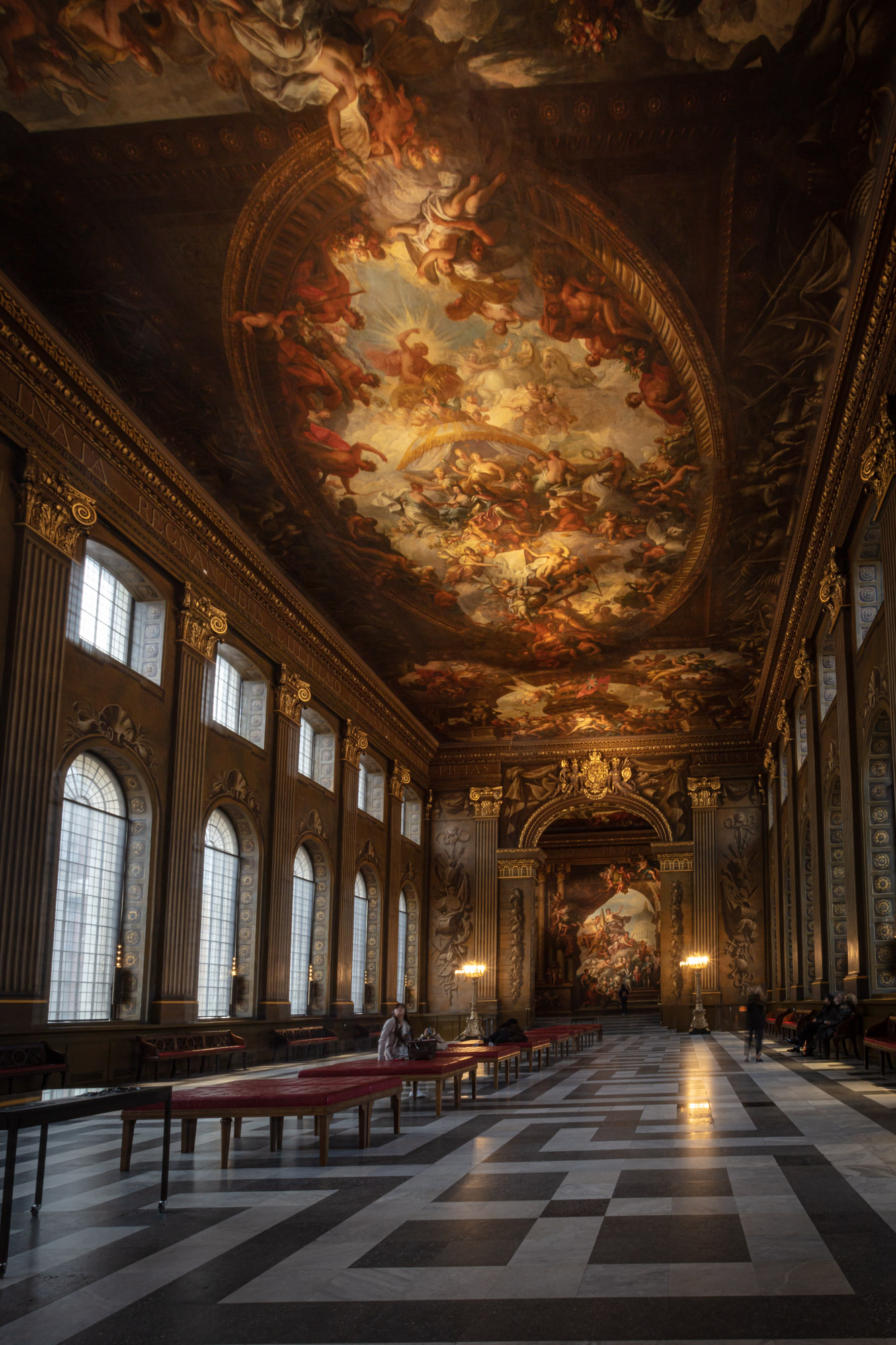
The Painted Hall at the Old Royal Naval College has been called Britain’s Sistine Chapel. It is not an exaggeration. It is a baroque masterpiece on a scale that makes your neck ache and your eyes blur. And it is free to enter.
The Ceiling That Rivals Rome
When Sir James Thornhill began work on the Painted Hall in 1707, he had an enormous task in front of him. The ceiling stretched 106 feet long and reached upward into a barrel vault that seemed to belong to another world entirely.
He was painting allegory. Naval power. The triumph of Britain on the seas. Figures swirling in impossible positions above your head, draped in crimson and gold, pointing to the future.
The detail is staggering. Every square foot tells a story. At the centre, William III and Mary II are presented as divine rulers, flanked by classical gods and personifications of the seasons. Time reveals truth. Architecture gestures towards heaven.
Thornhill was paid £3 per square yard for the ceiling and £1 per square yard for the walls. The total surface covers over 40,000 square feet. He worked for 19 years.
When you stand beneath it today, 300 years later, you can feel the weight of that labour.
The Man Who Spent 19 Years Looking Up
Sir James Thornhill is not a household name. He should be. He was the first English-born painter to receive a knighthood, and this hall is the reason why.
But Thornhill did not just paint grandeur. He painted himself into it.
Look carefully at the lower right corner of the ceiling. A man with his palm outstretched — not in supplication, but in a recognisable gesture. He is asking to be paid.
It is one of the great acts of artistic cheek in British history. Here, amid kings and queens and gods of the sea, is the man who made it all possible, quietly demanding his invoice be settled.
He also included his son-in-law. That son-in-law was William Hogarth, who would go on to define British satirical painting. There is a certain pleasure in knowing that one of Hogarth’s earliest appearances on a public canvas is in the corner of a ceiling, put there by his father-in-law.
The Night Nelson Came Home
In January 1806, the body of Admiral Horatio Nelson was brought here from the Victory.
He had died at Trafalgar three months earlier. The nation needed to grieve properly, and the Painted Hall was the stage.
For four days, tens of thousands of people filed past his coffin in this very room. The hall was draped in black. The painted figures above watched in silence. London had never seen a lying-in-state quite like it.
When his funeral procession finally left for St Paul’s Cathedral, it was one of the largest London had ever witnessed. But it started here, in this hall, beneath this ceiling.
If you stand in the Painted Hall and look up, you are looking at the same ceiling Nelson never saw — but that held watch over him for his last nights in England.
Enjoying this? 3,000+ London lovers get stories like this every week. Subscribe free →
What Most Visitors Miss
The Upper Hall is where most visitors go. But step through into the Lower Hall — the entrance vestibule — and take a moment with the walls.
Thornhill painted these too, though they receive far less attention. Here the allegory becomes more intimate. Naval officers and maps. The great sea routes of empire.
And then there is the floor. Stand in the centre of the Lower Hall and look down at the black-and-white marble. Now look again. The pattern shifts. What appeared to be flat suddenly seems to have depth. It is a trick of geometry, deliberate and precise.
Thornhill was showing off. He could do anything.
If you are visiting Greenwich for the meridian line and the observatory, you are already on the right side of the river. The Painted Hall is a ten-minute walk, and it costs nothing.
The London planning hub can help you build a full day in Greenwich — the Cutty Sark, the market, the park, and the hall all sit within easy walking distance of each other.
Planning Your Visit
The Painted Hall is inside the King William Building of the Old Royal Naval College, on the south bank of the Thames in Greenwich.
Entry is free, though a suggested donation of £5 is appreciated. The hall is open daily, typically from 10am to 5pm. Check the official site for seasonal variations.
The DLR is the easiest route — Cutty Sark station puts you at the gates in moments. From central London, you can also take a Thames Clipper from Embankment or Waterloo, which adds its own pleasure to the journey.
The South Bank walk is a good companion piece if you want to spend a full day on the river.
Avoid weekends in summer if you want the hall to yourself. A Tuesday morning in spring will give you forty feet of painted ceiling and very few other people to share it with.
Frequently Asked Questions
What is the Painted Hall and where is it in London?
The Painted Hall is a spectacular baroque painted room inside the Old Royal Naval College in Greenwich, south-east London. Painted by Sir James Thornhill between 1707 and 1726, it is often called Britain’s Sistine Chapel and is free to enter.
Is the Painted Hall at Greenwich free to visit?
Yes, entry to the Painted Hall is free, with a suggested donation of £5. It is open daily from approximately 10am to 5pm. The Old Royal Naval College itself is a UNESCO World Heritage Site and sits a short walk from the Cutty Sark DLR station.
What is the connection between the Painted Hall and Nelson?
Admiral Horatio Nelson’s body lay in state in the Painted Hall for four days in January 1806, three months after his death at the Battle of Trafalgar. Tens of thousands of Londoners came to pay their respects before his state funeral at St Paul’s Cathedral.
How long did it take to paint the Painted Hall?
Sir James Thornhill spent 19 years completing the Painted Hall, from 1707 to 1726. The painted surface covers over 40,000 square feet, making it one of the largest painted interiors in Britain.
When is the best time to visit the Painted Hall in Greenwich?
Weekday mornings outside of summer school holidays are quietest. A Tuesday or Wednesday morning in spring or autumn gives you the best chance of having the hall largely to yourself — a completely different experience from a busy weekend afternoon.
Most people leave Greenwich having ticked the meridian, photographed the Cutty Sark, and eaten a market crepe. They carry a photograph of a line on the ground.
A few — the ones who wandered through the right door — carry something else. The memory of standing beneath 40,000 square feet of paint, of looking up until their neck ached, of finding a man with his palm outstretched in the corner of a ceiling, asking quietly to be paid.
Go through that door.
🇬🇧 25 Hidden Gems of London Most Tourists Never Find
From secret riverside walks to hidden Victorian tunnels, centuries-old pubs to rooftop gardens with skyline views — our free guide reveals the London most visitors never discover. Join 3,000+ London lovers who get it free.
Get Your Free London Hidden Gems Guide →Love more? Join 65,000 Ireland lovers → · Join 43,000 Scotland lovers → · Join 29,000+ Italy lovers →
Free forever · Unsubscribe anytime
Subscribe Free