
The Monument to the Great Fire of London does not stand where it does by accident. It stands 202 feet tall because it is exactly 202 feet from the spot where London burned.
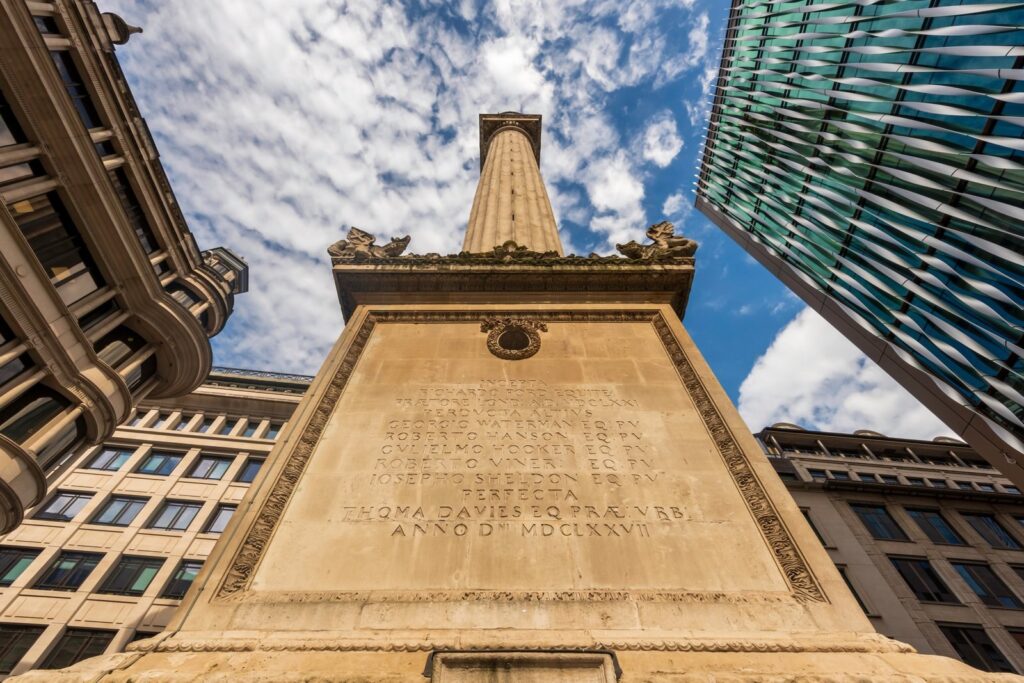
That is not a coincidence. Christopher Wren put it there on purpose. Every inch of that column tells you something you are supposed to figure out on your own.
Most visitors walk past without noticing.
The Night London Burned
On 2 September 1666, a fire broke out in a bakery on Pudding Lane in the City of London. It started just after midnight on a hot, dry Sunday morning after a long summer drought.
The medieval city was built almost entirely of timber. Streets were narrow. Houses leaned towards each other overhead. The fire moved fast, driven east by a strong wind, jumping from roof to roof before anyone could stop it.
By the time it burned itself out four days later, 13,200 houses had been destroyed. Eighty-seven churches were gone, including the original St Paul’s Cathedral. Over 70,000 people — nearly the entire population of the old City — were left without homes.
Fewer than ten people are known to have died directly in the fire. But it erased a city that had stood for over a thousand years. What London built in its place would be something entirely different.
Why Wren Made It Exactly 202 Feet Tall
Work on The Monument began in 1671, five years after the fire. Christopher Wren designed it alongside his close collaborator, the scientist Robert Hooke. Construction took another six years.
They chose a location on Fish Street Hill, as close to Pudding Lane as the street layout would allow. Then they measured the distance.
The Monument stands exactly 202 feet from the bakery where the Great Fire started. So Wren made the column exactly 202 feet tall. If you tipped the column over towards the east, the golden top would land on the precise spot where London burned.
It is a memorial that contains its own measurement. The golden urn of flames at the very top is not decoration. It is the far end of an invisible line pointing directly back to Pudding Lane.
Wren wanted visitors to understand this without being told. The column speaks for itself, if you know to ask the question.
If you are planning a trip to visit The Monument and explore the historic City of London, our complete London trip planning guide covers everything from transport to the best times to go.
The Column That Was Also a Scientific Instrument
Wren and Hooke were both Fellows of the Royal Society. They were not content to build a simple memorial. They wanted the column to do scientific work.
The sealed interior shaft was designed as a zenith telescope — a device for observing stars at the precise moment they pass directly overhead. A stone column, isolated from wind and vibration, was theoretically ideal for such measurements.
Hooke used it to try to measure stellar parallax: the tiny apparent shift in a star’s position caused by the Earth’s movement around the Sun. Success would prove once and for all that the Earth orbits the Sun, not the other way around.
He failed. The instruments of the day were not precise enough. Stellar parallax would not be successfully measured until 1838, by Friedrich Bessel in Germany.
But the attempt was real. The Monument was used for barometric experiments too, measuring changes in air pressure at different heights. An enormous scientific instrument hidden inside a city memorial — and none of this appears on the signs outside.
The same restless ambition runs through everything Wren touched after the Great Fire. His rebuilt London churches — over fifty of them — each carry their own hidden stories. You can read about how Wren rebuilt London’s skyline after the Great Fire on this site.
Enjoying this? 3,000+ London lovers get stories like this every week. Subscribe free →
Climbing All 311 Steps
Inside The Monument is a spiral staircase of 311 steps, each carved from Portland stone, winding upward in a tight helix around a central column.
There is no lift. You climb or you don’t go. Most people who start the ascent finish it, though it is steeper than it looks and the stairwell is narrow enough that you will press against the wall to let others pass coming down.
At the top is a small viewing gallery — enclosed in a safety cage added in the 1840s after a series of suicides — that gives you an extraordinary view across the City of London. Canary Wharf rises to the east. St Paul’s Cathedral sits to the west. Below you, the narrow lanes of the old City run in patterns that would not look entirely unfamiliar to Wren himself.
When you reach the top, staff hand you a certificate confirming you completed the climb. It is one of London’s more unusual traditions — a formal document for climbing a very old column. Children tend to love it.
The Monument is open every day except Christmas Day. Admission costs around £6 for adults and £3 for children. It is modest value for one of the most distinctive views in central London, and one of the few places where you can stand at the same height as the fire that changed the city.
The Inscription That Was a Lie for 150 Years
The base of The Monument carries Latin inscriptions on four sides describing the Great Fire, the rebuilding that followed, and the civic resolve of those who rebuilt it.
For 150 years, one part of that inscription was a lie.
In 1681, a new line was added to the south face: a claim that the fire had been started by “the treachery and malice of the Popish faction.” In plain terms, it blamed Catholics for burning London.
The accusation was false. Several investigations had found no evidence of arson. The fire had been an accident. But in the anti-Catholic climate of Restoration England, the lie served a political purpose.
Alexander Pope noticed. In his poem Moral Essays, he wrote: “Where London’s column, pointing at the skies / Like a tall bully, lifts the head, and lies.”
The offending line was removed in 1831, when Catholic emancipation made it politically untenable to keep it. The inscription you read today is accurate. But knowing the history gives the carved stone a different weight entirely.
For more of the City’s long, layered history, the South Bank walk through 2,000 years of London history pairs beautifully with a visit to The Monument.
Can you climb The Monument to the Great Fire of London?
Yes. The Monument is open to visitors every day except Christmas Day. There are 311 steps to the viewing gallery at the top, and you receive a certificate when you complete the climb. Allow around 15 to 20 minutes for the ascent and the same coming down.
How much does it cost to visit The Monument in London?
Admission costs approximately £6 for adults and £3 for children (prices may vary — check the official City of London website before your visit). It is one of London’s better-value paid attractions, offering a remarkable view from the top and a certificate to take home.
Where exactly is The Monument in London?
The Monument is at Monument Street, EC3R 8AH, in the City of London, close to London Bridge. The nearest Underground station is Monument (Circle and District lines), a one-minute walk away. It is also around five minutes’ walk from London Bridge station, which serves National Rail and the Jubilee and Northern lines.
What is the best time to visit The Monument?
Weekday mornings are the quietest, especially outside school holidays in July and August. The viewing gallery is open-air, so a clear day gives the best visibility across the City and towards St Paul’s Cathedral and Westminster. Queues can build at weekends and in summer afternoons.
London has been burned, bombed, flooded, and rebuilt more times than most cities can count. Each time, it has come back stubbornly itself.
The Monument does not mark a disaster. It marks the moment London decided to start again.
Stand at its base. Look up at that golden urn of flames, 202 feet above you. Then look east along Monument Street, towards Pudding Lane — 202 feet away. Wren knew exactly what he was doing.
🇬🇧 25 London Places Most Visitors Miss
From secret riverside walks to hidden Victorian tunnels, centuries-old pubs to rooftop gardens with skyline views — our free guide reveals the London most visitors never discover. Join 3,000+ London lovers who get it free.
Get Your Free 25-Places Guide →📲 Know someone who’d love this? Share on WhatsApp →
Free forever · Unsubscribe anytime
Subscribe Free