
In September 1666, a fire started in a bakery on Pudding Lane and burned for four days. By the time the last embers cooled, 87 of London’s churches were gone. The man chosen to replace them had never built a church in his life.
His name was Christopher Wren. He was 33 years old, better known as a mathematician and astronomer than an architect. Over the following 36 years, he designed and built 51 new churches across the City of London. Most Londoners still walk past them every day without a second glance.
The City That Burned
The Great Fire of 1666 didn’t begin with drama. A small oven in a bakery on Pudding Lane caught light just after midnight on 2nd September. By morning, the wind had spread the flames east across tightly packed timber streets. Within four days, 13,200 houses, 87 churches, and most of the medieval City of London had been reduced to ash and rubble.
🏙️ Love London?
3,000 London lovers get hidden history, street-level stories, and local secrets every week. Free, forever — no spam, unsubscribe any time.
Subscribe free — enter your email:
The scale of the loss was almost impossible to grasp. Entire parishes had vanished. The skyline that had defined London for centuries was gone. But the fire also opened a door — a chance to rebuild the city from scratch, with stone instead of timber, and a new generation of architects to lead the way.
King Charles II appointed Wren as Surveyor of the King’s Works and handed him the task of rebuilding the churches. It was the commission of a lifetime — and one that would define both a man and a city.
Fifty-One Churches, Each One Different
Wren’s brief was simple in theory and vast in practice: rebuild 51 churches to replace those destroyed in the fire. He started in 1670. The last steeple wasn’t completed until 1717.
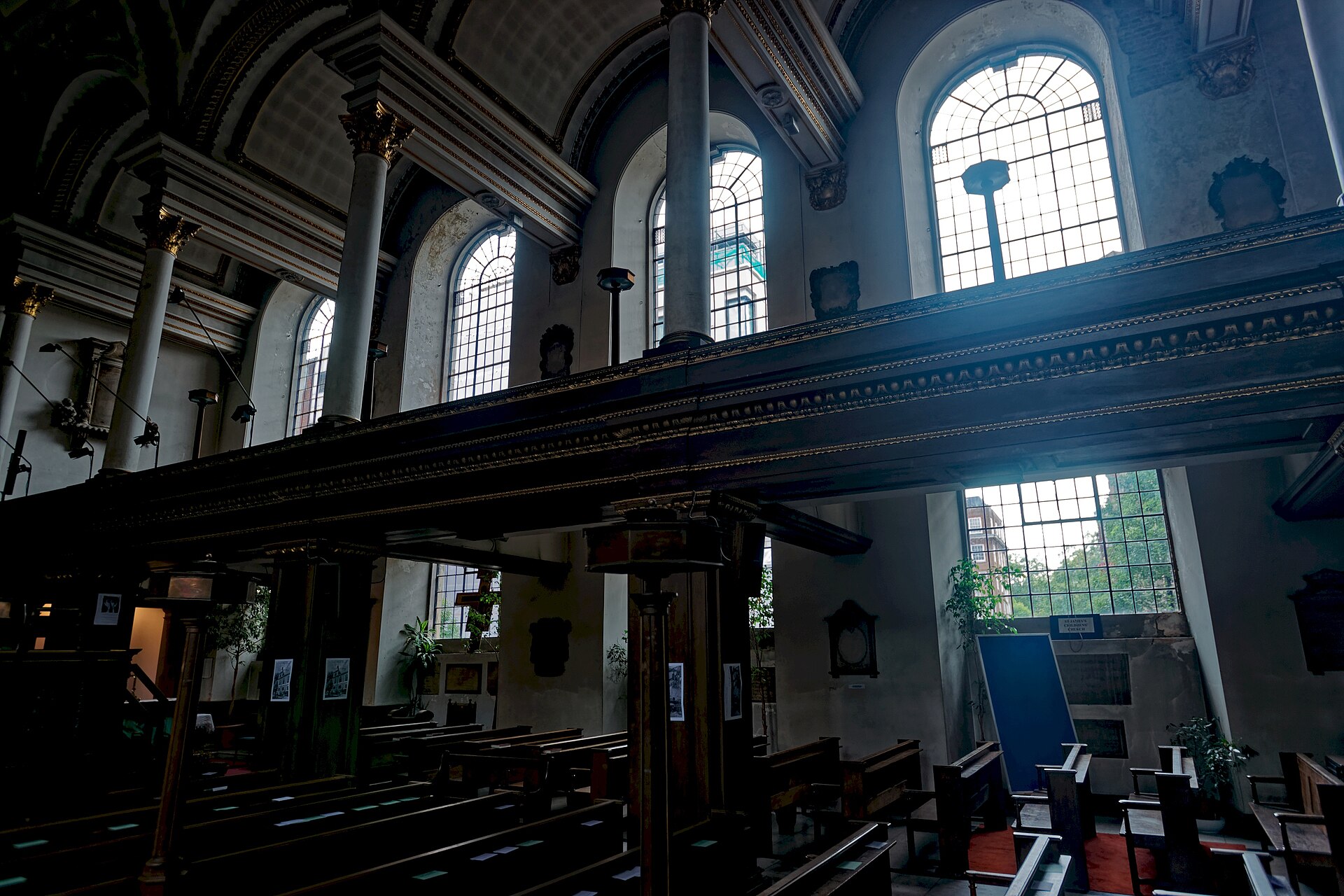
What makes Wren’s achievement remarkable isn’t just the number. It’s that each church is different. Working within the irregular street grid of the medieval City — no two plots alike, each hemmed in by lanes and alleys — Wren designed every church individually. Some are wide and bright. Others are narrow and dark. Some have elaborate carved interiors. Others are almost plain.
The steeples became his trademark. St Bride’s on Fleet Street has a tiered stone tower that rises in five diminishing stages. The story goes that a local baker saw it and copied the design in sugar paste — and that’s how the tiered wedding cake came to be. Whether the tale is true or not, the steeple has been copied all over the world.
St Mary-le-Bow in Cheapside is perhaps even more famous for what it can’t be seen: its bells. According to Cockney tradition, you are only a true Londoner if you were born within earshot of Bow Bells. The bells were silenced during the Second World War, and many East Enders who had been evacuated out of the city said they felt the silence more than anything else.
The Ruin That Became a Garden
Not all of Wren’s churches survived the twentieth century. St Dunstan in the East, built between 1670 and 1671, was badly damaged during the Blitz in 1941. The roof collapsed. The interior was gutted. Rather than demolish the shell or restore it to use, the City of London Corporation made an unusual decision: leave the outer walls standing and plant a garden inside.
Today, you can push through a small iron gate off St Dunstan’s Hill and step into one of the most remarkable spaces in London. Ivy covers the old stone columns. Fig trees press against the Gothic arches. A small fountain trickles somewhere in the middle. Wren’s steeple still rises above the trees, perfectly intact, framed against the sky.
On a weekday lunchtime, you’ll find office workers eating sandwiches on the old stone ledges. On a Sunday morning, you’ll have it almost to yourself. Either way, it’s 10 minutes’ walk from the Monument — a natural stop if you’re planning a day in the City of London.
The Churches Worth Seeking Out
Most of the surviving Wren churches cluster within the Square Mile — the original City of London. They sit between modern glass towers and Georgian counting houses, their stone facades darkened by centuries of London weather. Many are open during weekday lunchtimes. All are free to enter.
St Stephen Walbrook, off Cannon Street, is widely regarded as Wren’s finest interior work. The dome above the nave — small, perfectly proportioned — is a direct rehearsal for St Paul’s. In 1953, a young rector named Chad Varah started taking telephone calls from people in crisis here. That ministry became the Samaritans.
St Bride’s on Fleet Street is the journalists’ church. Reporters and editors have been married and mourned here for centuries. The crypt holds a museum tracing the history of Fleet Street’s press trade, from Wynkyn de Worde’s printing press in the 1500s to the last paper to leave in the 1980s.
St Mary Abchurch, tucked into a narrow court off Cannon Street, is easy to miss and impossible to forget. The carved limewood reredos at the east end was made by Grinling Gibbons — the finest wood carver of his generation — and took four years to complete. It survived the Blitz and still stands today, largely unchanged from the day Wren first saw it.
The walk between these churches also takes you past the Monument, the 61-metre column whose height equals the exact horizontal distance to the bakery on Pudding Lane where the Great Fire began — Wren’s way of marking the catastrophe that made his career possible.
The Cathedral Above It All
Every Wren church trail ends with the same view: St Paul’s Cathedral rising above Ludgate Hill, the largest and most ambitious of everything Wren built. He was appointed to design it in 1675, after two earlier designs were rejected by the clergy as too radical. The compromise that was finally approved took 35 years to build. Wren visited the site regularly until he was well into his eighties.
He died in 1723 at the age of 90 and was buried in the cathedral crypt. His memorial stone is one of the most quietly powerful in London. It reads, in Latin: Lector, si monumentum requiris, circumspice. If you seek his monument, look around you.
The Wren churches are not glamorous. They don’t appear on most London bucket lists. But walk through the City on a quiet morning, turn down a lane you’ve never taken, and you’ll find them: a stone doorway here, a carved font there, a steeple cutting the sky above an office block. A city rebuilt, stone by stone, by one man in a lifetime.
🇬🇧 25 Hidden Gems of London Most Tourists Never Find
From secret riverside walks to hidden Victorian tunnels, centuries-old pubs to rooftop gardens with skyline views — our free guide reveals the London most visitors never discover. Join 3,000+ London lovers who get it free.
Get Your Free London Hidden Gems Guide →Love more? Join 65,000 Ireland lovers → · Join 43,000 Scotland lovers → · Join 30,000 Italy lovers →
Free forever · Unsubscribe anytime