
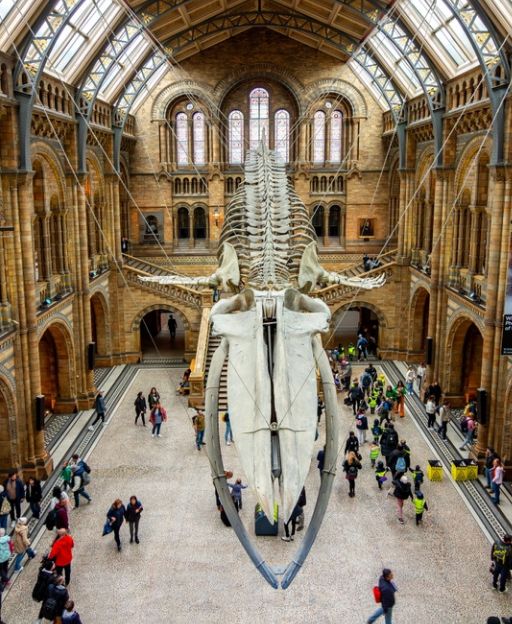
The moment you step through the doors of the Natural History Museum in London, something stops you cold. You look up, and suspended above your head is a 25-metre blue whale skeleton, vast and ghostly white in the light flooding through cathedral windows. People stand still for a full minute, necks craned, just looking. And they’ve only found the first secret.
The Building Is Already the First Exhibit
Alfred Waterhouse designed this extraordinary building in the 1870s, and he hid something in the stone that most visitors walk straight past. Look closely at the terracotta tiles that cover every surface of the facade and interior walls. Hundreds of animals, plants, and extinct creatures are carved into them. Living species appear on the east wing. Extinct species decorate the west wing.
The building itself tells the story of life on Earth before you’ve set foot in a single gallery. The main entrance hall — now called Hintze Hall — stretches 170 feet from end to end. It was designed deliberately to feel like a church. The architect wanted science to inspire the same sense of awe as religion. He called it a “cathedral to nature.”
The details reward close attention. Monkeys perch in the stone arches. Fish swim along the columns. Butterflies are fixed forever in the terracotta as though caught mid-flight. Every square foot of the facade has something in it. Most visitors walk past all of it without a second glance.
Hope — The Whale Who Replaced a Famous Friend
In 2017, the museum made a decision that divided the country. Dippy, the beloved diplodocus skeleton that had greeted visitors in the main hall for over 100 years, was carefully removed and sent on a national tour. In its place, they hung a blue whale skeleton — a real one, 25 metres long, named Hope.
Getting Hope into position was an engineering project of considerable scale. The skeleton had been held in storage for decades. Conservators spent months cleaning and reassembling over 800 bones. The installation required tonnes of scaffolding and careful work, piece by piece, high above the hall floor.
The result stops people in their tracks. Blue whales are alive today. Unlike Dippy, who represents something that vanished 65 million years ago, Hope is a reminder. These animals still swim the same oceans as us. They are still here, still in danger, still requiring protection. The museum hung her there to make that point to five million visitors every year.
The Secret Garden Nobody Mentions
On the west side of the museum grounds, tucked behind a gate that most visitors walk straight past, there is a wildlife garden that almost nobody knows about. It opened in 1995. During the summer months, it is open to visitors — but you have to seek it out.
Inside, over 2,500 species of plants, insects, and birds have been recorded. Real hedgehogs move through it at night. Birds breed in the hedgerows. Wildflower meadows recreate specific British habitats — chalk downland, ancient woodland, meadow, and a working pond full of activity.
It was built to demonstrate something simple: that wildlife can survive in the middle of a city if you give it the conditions it needs. On a summer afternoon, standing in the long grass with bees working through the flowers, it is easy to forget entirely that you are in Zone 1.
Enjoying this? 3,000+ London lovers get stories like this every week. Subscribe free →
The Vault — A Room That’s Easy to Miss and Impossible to Forget
Deep in the corner of the Earth Hall, easy to overlook on the way to the dinosaur gallery, there is a small room called the Vault. It holds what may be the most concentrated collection of extraordinary objects in the museum — all compressed into a space barely bigger than a large wardrobe.
Moon rock, brought back by Apollo astronauts. A fragment of Mars. Gemstones that took geological ages to form. A diamond the size of a thumb. Meteorites older than the solar system itself. None of it is behind velvet ropes — the cases are close enough to press your face against.
Most visitors walk past the entrance entirely. The door is easy to miss, and there’s no grand sign pointing the way. Those who find it tend to stay for a long time, moving slowly from case to case. It is, by some measure, the most remarkable small room in London.
The Story Behind Darwin’s Position on the Stairs
At the top of the grand staircase in Hintze Hall, Charles Darwin sits in a marble chair, looking down at the visitors below. He has been there since 1885. What most visitors don’t know is that his position was the result of a slow institutional argument that took years to settle.
The original design for the landing intended it to display a religious figure — something representing divine creation. By the time the building opened in 1881, the scientific establishment had prevailed. Darwin was placed at the top of the stairs. Richard Owen — who founded the museum but had publicly opposed Darwin’s theory of evolution — received a smaller statue near the ground floor entrance.
The building arranged them in a hierarchy without a single word of explanation. You walk in, look up, and there is Darwin above you, looking down at Owen below. It has been that way for 140 years. Whether you notice it or not is entirely up to you.
When to Visit and What to Know Before You Go
The Natural History Museum is free to enter, open every day from 10am to 17:50. The permanent collection — including Hope, the dinosaur gallery, the Vault, and the mineral galleries — is entirely free. Some temporary exhibitions carry a separate charge.
The museum gets very busy at weekends and during school holidays. The best approach is to arrive just before opening and queue briefly at the door. The first 45 minutes, before the school parties and tour groups arrive, are a different experience. Hintze Hall with only a handful of visitors is something else entirely.
The dinosaur gallery fills quickly and stays crowded through the day. The Vault, the upper bird and insect galleries, and the wildlife garden stay considerably quieter. If you’re visiting with children, this is one of London’s finest free family days out — we’ve put together a full London with kids guide with more ideas for making the most of it.
The Science Museum and the Victoria and Albert Museum are both within a short walk on Exhibition Road — also free, also world-class. For a full guide to London’s free museums, see our complete free museums guide. And if you’re still in the early stages of planning your London trip, the London planning hub is the best place to begin.
Is the Natural History Museum in London free?
Yes, the Natural History Museum is free to enter every day of the year. The permanent collection — including Hope the whale, the dinosaur gallery, the Vault gemstone room, and all the mineral and fossil galleries — is entirely free. Some temporary exhibitions have a separate entry charge, which varies by show.
What is Hope at the Natural History Museum?
Hope is the name of the 25-metre blue whale skeleton that hangs in Hintze Hall, the main entrance hall of the museum. She replaced Dippy the diplodocus in 2017. The name Hope was chosen as a reminder that blue whales are still alive and still need protecting — unlike the extinct creatures elsewhere in the museum.
When is the best time to visit the Natural History Museum?
Arrive just before 10am on a weekday morning for the quietest experience. Weekends and school holidays are extremely busy, especially the dinosaur gallery. Midweek mornings give you the best chance of seeing Hintze Hall without large crowds — the first 30 to 45 minutes after opening are often remarkably peaceful.
Where is the Natural History Museum’s Wildlife Garden?
The Wildlife Garden is on the west side of the museum grounds, accessible through a gate that’s easy to walk past. It opens to the public in late spring and summer — exact dates vary each year. It’s free to enter and is one of the least-visited parts of the museum, which makes it one of the most rewarding.
On the way out, look up one more time. Hope hangs there in the light, bones pale against the Victorian stone, bigger than seems possible for something that once moved through the sea. London has always been good at this — building something vast, filling it with wonder, and then letting you find the quiet details for yourself.
🇬🇧 25 Hidden Gems of London Most Tourists Never Find
From secret riverside walks to hidden Victorian tunnels, centuries-old pubs to rooftop gardens with skyline views — our free guide reveals the London most visitors never discover. Join 3,000+ London lovers who get it free.
Get Your Free London Hidden Gems Guide →📲 Know someone who’d love this? Share on WhatsApp →
Love more? Join 65,000 Ireland lovers → · Join 43,000 Scotland lovers → · Join 29,000+ Italy lovers →
Free forever · Unsubscribe anytime
Subscribe Free