
Every year, on the 30th of January, a small procession makes its way to a bronze statue on the south side of Trafalgar Square. They carry a wreath. They bow their heads. And they mourn a king who was executed 375 years ago, on a scaffold outside the Banqueting House just a few hundred metres away.
Most passers-by have no idea what is happening. Tourists photograph the pigeons. Buses rumble down Whitehall. And yet this quiet, determined little ceremony has been taking place for generations — one of London’s most overlooked traditions, hiding in plain sight.
The Statue That Was Supposed to Be Destroyed
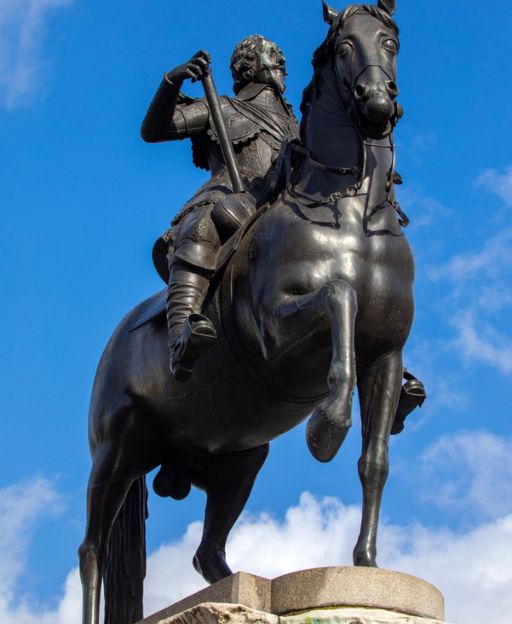
The equestrian statue of King Charles I has stood at Charing Cross since 1675. But it came extraordinarily close to never existing at all.
The statue was cast in 1633 by the French sculptor Hubert Le Sueur, commissioned by Richard Weston, the Earl of Portland. At the time, Charles I was still on the throne, still convinced that kings ruled by divine right, and still heading toward the catastrophic civil war that would split England in two.
When the Parliamentarians won that war, they were in no mood for royal monuments. Parliament ordered the statue to be destroyed. A brazier — a metalworker — named John Rivett was paid to smelt it down. He took the money. He accepted the commission. And then he simply did not do it.
Instead, Rivett buried the statue and kept it hidden throughout the years of the Commonwealth and Protectorate. The statue survived underground while its subject’s cause lay in ruins. When Charles II was restored to the throne in 1660, Rivett produced the statue intact. It had been there all along.
Why This Spot Was Chosen — and What It Means
The statue was not placed in Trafalgar Square by accident. Charles II chose the location with cold precision.
The spot at Charing Cross was where, in 1660, several of the men who had signed his father’s death warrant were themselves executed. They were the Regicides — the men who had put a king on trial and condemned him to death. Charles II made sure the statue of his father would stand on the very ground where their own punishment had been carried out.
And then he pointed the statue south, down Whitehall, directly toward the Banqueting House. That is where Charles I walked out on the morning of 30 January 1649, stepped through a first-floor window, and was beheaded in front of a crowd. Every day, the bronze king faces the place where he died. You can visit the Banqueting House today and stand at that very window — it is one of the most quietly powerful sites in all of London.
The symbolism is layered and deliberate. This is not a statue that simply commemorates a monarch. It is a statement. A reckoning. A piece of stone-cold political theatre cast in bronze.
Enjoying this? 3,000+ London lovers get stories like this every week. Subscribe free →
The Church That Made Him a Saint
The mourning ceremony is organised by the Society of King Charles the Martyr — a body that has kept the memory of the king alive for generations. They gather each 30th of January, the anniversary of his execution, to lay a wreath at the statue’s base and mark the day with prayer.
This is not merely sentimental royalism. The Church of England actually marks January 30th as the Feast of King Charles, Martyr. Charles I is a saint in the Anglican calendar — one of the stranger facts about a church that he himself helped tear apart through his religious policies.
The ceremony is open to anyone who wishes to attend. There is no ticket. No velvet rope. You simply turn up on January 30th and stand with the small group of people who still believe this matters. In a city that is always moving, always building, always forgetting, there is something rather extraordinary about people who refuse to let go.
London’s Oldest Equestrian Statue
Beyond the ceremony and the political drama, the statue itself is worth a long look. It is the oldest equestrian statue in London — older than anything in Trafalgar Square proper, older than Nelson’s Column, older than the lions at its base.
Hubert Le Sueur was one of the finest sculptors working in England in the early seventeenth century. The king sits upright on his horse, commanding even in bronze, wearing armour but no crown. There is something almost elegiac about his posture — a man on horseback who never quite reached where he was going.
The statue sits on a Portland stone plinth. At its base, you will often find fresh flowers or a small wreath, even outside of January — left by people who still feel the pull of this particular story. London is full of monuments. Very few of them still provoke this kind of quiet devotion.
If you are planning your time in London, you can read our complete London planning guide for everything you need to know before you go. And if royal traditions are your thing, do not miss our guide on what nobody tells you before you watch the Changing of the Guard.
Frequently Asked Questions
Where exactly is the King Charles I statue in London?
The statue stands at the top of Whitehall, just south of Trafalgar Square at Charing Cross. It faces directly down Whitehall toward the Banqueting House — the building where Charles I was executed in 1649. The nearest Tube station is Charing Cross or Embankment.
When does the annual mourning ceremony take place at the statue?
Every year on 30 January — the anniversary of King Charles I’s execution in 1649 — members of the Society of King Charles the Martyr gather at the statue to lay a wreath and hold a short ceremony. It is open to the public and free to attend. No booking is required.
Is the King Charles I statue free to visit?
Yes, completely free. The statue stands on the public pavement at Charing Cross and is accessible at any time of day. It is easy to walk past without noticing — look for it just south of the main Trafalgar Square fountains, facing down toward Whitehall.
Why is the King Charles I statue in London so historically significant?
It is the oldest equestrian statue in London, cast in 1633 by sculptor Hubert Le Sueur. It survived the Interregnum only because the metalworker paid to destroy it secretly hid it instead. Charles II then placed it at the exact location where his father’s killers had been executed — pointing toward the site of the execution itself. Few statues in London carry so much deliberate meaning.
Next time you walk through Trafalgar Square, look south. The bronze king is easy to miss in the flow of the city. But he has been there for 350 years, looking toward the place where his story ended, with fresh flowers at his feet and a small ceremony each January to remind London he has not been forgotten.
🇬🇧 25 Hidden Gems of London Most Tourists Never Find
From secret riverside walks to hidden Victorian tunnels, centuries-old pubs to rooftop gardens with skyline views — our free guide reveals the London most visitors never discover. Join 3,000+ London lovers who get it free.
Get Your Free London Hidden Gems Guide →📲 Know someone who’d love this? Share on WhatsApp →
Love more? Join 65,000 Ireland lovers → · Join 43,000 Scotland lovers → · Join 29,000+ Italy lovers →
Free forever · Unsubscribe anytime
Subscribe Free