
Walk down Holland Park Road in Kensington and you might not give the red-brick building a second glance. It looks like a dozen other Victorian townhouses on the street. But step inside, and you will find yourself standing in what may be the most extraordinary interior in London — a private Arab palace, built tile by tile over three decades by one of the most celebrated artists of the Victorian age.
The Man Who Built It All
Lord Frederic Leighton was not a modest man. As President of the Royal Academy and the most decorated British artist of his generation, he moved in circles that included royalty, writers, and the leading thinkers of Victorian England. He was, by any standard, a star.
In 1864, he began building his home on Holland Park Road. Then he kept building. Over the next three decades, he added room after room — a studio wing, a gallery, an extraordinary hall inspired by Islamic architecture — until the house had become something far stranger and more magnificent than a mere Victorian townhouse.
Leighton became the first — and only — artist ever raised to the British peerage. His title, Baron Leighton of Stretton, was granted on 24 January 1896. He died the following day. His peerage lasted less than 24 hours, making it the shortest in British history.
Today, the house he spent a lifetime creating is a museum open to the public — and most London visitors walk past it without ever knowing it exists.
The Arab Hall — London’s Most Surprising Room
The centrepiece of the house is a room that has no business existing in west London. The Arab Hall was inspired by the La Zisa palace in Palermo, Sicily, but its materials came from far further afield.
Over more than twenty years, Leighton collected antique Islamic tiles from Syria, Egypt, Rhodes, and Persia. He had them shipped back to London and set into the walls of a room designed around a central pool, a golden mosaic frieze running just below the ceiling, and stained-glass windows that filter afternoon light into shifting pools of colour.
The overall effect is overwhelming. The tiles range across centuries — some from the 13th, others from the 17th — yet they cohere into something that feels entirely complete. A gilded peacock mosaic rises above the main archway. A small fountain sits at the centre of the space. Intricate carved wooden screens line the upper gallery level.
There is simply nothing else like it in Britain. Visitors who have explored every famous corner of London often say the Arab Hall is the single most jaw-dropping interior they encountered. High praise in a city of extraordinary rooms.
The Studios, the Silk Room, and the Story in Every Corner
The house is not just the Arab Hall. Each room tells a different part of Leighton’s life and obsessions.
The main studio — where Leighton painted the large canvases that made him famous — was designed around a single enormous north-facing window. Natural light was everything to Victorian painters, and this room was engineered to capture it at its best throughout the day.
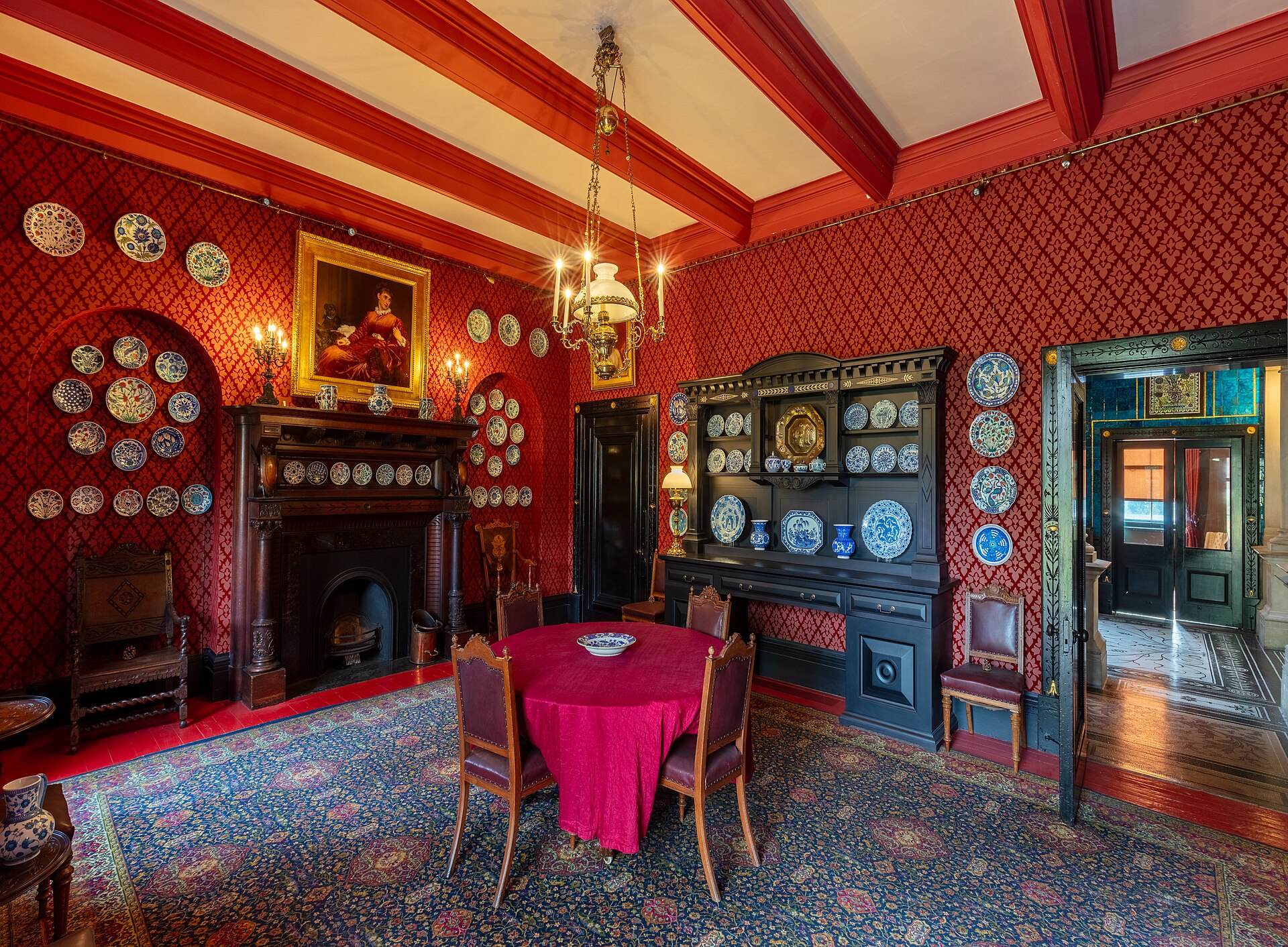
The Silk Room was lined in original Persian silk, its walls a deep jewel-like richness that feels unlike anything in a conventional museum. The staircase hall — known as the Narcissus Hall — takes its name from the mosaic at its base. Small private galleries and connecting rooms hold paintings by Leighton and his contemporaries, many of them rarely seen in public collections.
It feels less like a museum and more like a man’s mind made physical — every detail chosen, every surface considered, every room a small argument about what a beautiful life could look like.
Enjoying this? 3,000+ London lovers get stories like this every week. Subscribe free →
Planning Your Visit
Leighton House is open Wednesday to Monday (closed Tuesday). Admission is around £12.50 for adults, with free entry for under-12s. The easiest approach is from High Street Kensington tube station — the house is a 10-minute walk through quiet residential streets, heading south along Kensington Church Street and then onto Holland Park Road.
You could comfortably spend 90 minutes inside. Guided tours run on selected afternoons and are well worth booking in advance if you want the full story of each room. Photography is generally permitted in most areas of the house.
If you’re putting together your London trip from scratch, the London Planning Hub covers everything you need before you arrive — transport, neighbourhoods, and where to focus your time.
What to See Nearby
This part of London rewards slow exploration. Holland Park is immediately adjacent to the museum — 54 acres of parkland that includes a formal Japanese garden and regular open-air opera performances in summer. It’s one of the least crowded of London’s major parks.
The Design Museum is a 15-minute walk west, and Kensington Palace is walkable to the east. Kensington Church Street, running back toward the tube, has a solid range of cafés and restaurants at every price point.
This corner of London is one of the best half-days the city offers — unhurried, beautiful, and almost completely off the tourist trail. For more ideas on discovering the side of London that most visitors miss, this guide to hidden gardens and secret green spaces is a good place to start.
Is Leighton House Museum worth visiting in London?
Yes — it’s one of the most distinctive interiors in the city. The Arab Hall alone justifies the trip. Admission is around £12.50 and the visit typically takes 60 to 90 minutes. It is rarely crowded and genuinely unlike anything else in London.
How do I get to Leighton House Museum?
Take the Tube to High Street Kensington (District or Circle line), then walk south along Kensington Church Street and turn onto Holland Park Road. The house is at number 12, about a 10-minute walk from the station.
What is the Arab Hall at Leighton House?
The Arab Hall is a room at the heart of Leighton House designed to evoke an Islamic palace interior. It is decorated with antique tiles that Leighton collected from Syria, Egypt, Rhodes, and Persia over more than twenty years. It features a central pool, a gilded mosaic frieze, carved wooden screens, and stained-glass windows.
When is the best time to visit Leighton House?
Weekday mornings tend to be the quietest. The house is open Wednesday to Monday (closed Tuesday). If you’d like a guided tour, book in advance — they run on selected afternoons and provide significantly more context about each room and about Leighton’s remarkable life.
Most people who visit say they wish they had come sooner. It is one of those London places that, once you know about it, you wonder how you missed it for so long.
🇬🇧 25 Hidden Gems of London Most Tourists Never Find
From secret riverside walks to hidden Victorian tunnels, centuries-old pubs to rooftop gardens with skyline views — our free guide reveals the London most visitors never discover. Join 3,000+ London lovers who get it free.
Get Your Free London Hidden Gems Guide →Love more? Join 65,000 Ireland lovers → · Join 43,000 Scotland lovers → · Join 29,000+ Italy lovers →
Free forever · Unsubscribe anytime
Subscribe Free