
Most bookshops are just rooms full of books. Daunt Books in Marylebone is something else entirely.
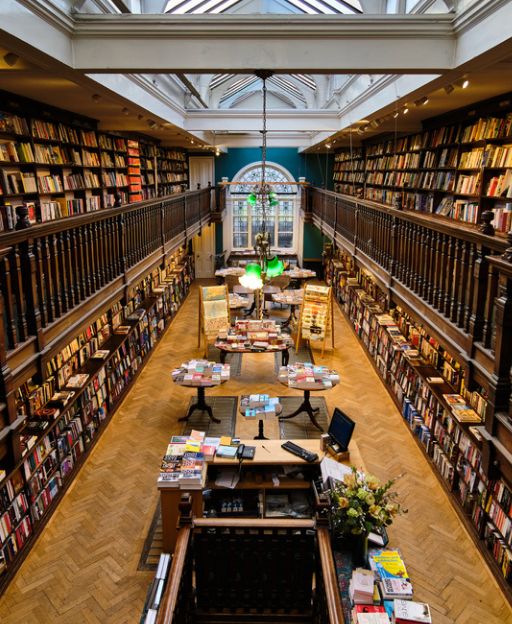
The moment you step through the door at 83 Marylebone High Street, you understand why Londoners travel from across the city just to browse. This is not a quick stop. It is, for many regulars, an event in itself.
There is a reason this bookshop has been talked about for decades. And it is not only the books.
A Building That Was Made to Sell Dreams
The building at 83 Marylebone High Street was commissioned in 1912 as a purpose-built bookshop. That was rare then. It is almost unheard of today.
🏙️ Love London?
3,000 London lovers get hidden history, street-level stories, and local secrets every week. Free, forever — no spam, unsubscribe any time.
Subscribe free — enter your email:
The result is a long, skylighted gallery lined with oak shelves on two levels. Arts and Crafts woodwork frames every alcove. A stained glass window glows at the far end. Green banker’s lamps cast warm pools of light over the reading tables below.
When you look up from a book, the roof is glass. Natural light falls across the spines around you. It feels like somewhere important.
James Daunt opened his travel bookshop here in 1990. He had the good sense not to change very much about the interior. Some things are better left alone.
The result is a space that feels both old and alive — a working bookshop where the architecture does half the selling. First-time visitors often spend twenty minutes simply standing and looking up before they think about browsing.
The System That Sets Daunt Books Apart
Walk into the travel section and you will notice something immediately unusual.
The shelves are not organised by publisher or genre. They are organised by country. That might sound simple, but the logic goes far deeper than it first appears.
If you find the Japan section, you will find the guidebooks, yes. But alongside them, you will also find fiction set in Japan. Poetry written there. History covering feudal lords and modern industry. Memoirs by writers who spent a year in Tokyo.
The idea is that you should not have to shop around to understand a place. Everything about Japan — or Peru, or Norway, or Ghana — lives together on the same shelves.
You pull one book out and another catches your eye. You came in for a Rough Guide. You leave with a novel, a history, and a collection of essays you had never heard of.
This is why people come to Daunt Books without a plan and leave with four books they never expected to buy. The system makes discovery inevitable.
James Daunt later went on to turn around Waterstones, and then Barnes and Noble in America. His reputation was built on one principle: a great bookshop should make you want to read more, not just spend more.
The Street That Became a Literary Village
Daunt Books did not end up on Marylebone High Street by accident. And the street did not become what it is by accident either.
Marylebone High Street runs through one of London’s quieter, more self-contained neighbourhoods. Independent shops line both sides. The streets behind it are Georgian and residential. It has the feel of a village that somehow ended up inside a major city.
The bookshop anchors the whole thing. On Saturday mornings, Londoners walk the length of the street and treat the visit to Daunt Books as the centrepiece of the outing. They pick up coffee, browse the deli, and then spend forty minutes in the galleries.
Bloomsbury, a short journey to the east, has the British Museum and the ghosts of Virginia Woolf and E.M. Forster. If you want to combine bookshops with culture, the free museums of London make the perfect companion to a literary afternoon.
But Marylebone has something the others do not. It has Daunt Books at the heart of it, giving the street a reason to exist beyond the ordinary.
The Branches — and Why the Original Is Still the One
Daunt Books has grown over the years. There are now branches in Belsize Park, Chelsea, Hampstead, Holland Park, Kew, and several other London locations. Each one is a proper independent bookshop — not a franchise satellite.
But regulars will tell you that Marylebone is the only one that truly counts.
This is not snobbery. It is the building. None of the other branches have the 1912 gallery, the skylights, or the oak shelving that runs floor to ceiling. The other branches are good bookshops. Marylebone is a destination.
If you are planning a trip to London and want to understand what this city values about culture and learning, Daunt Books on Marylebone High Street is one of the most honest answers you will find. Not a museum, not a monument. A bookshop, still doing exactly what it was built to do.
How to Visit Daunt Books Like a Regular
The flagship shop opens at 9am on weekdays, 9:30am on Saturdays, and 11am on Sundays.
Saturday morning is the busiest time. If you want the galleries to yourself, go on a weekday morning before 11am. The light is better and the staff will have time to talk to you.
Take a mental list of countries you plan to visit — or places you have always been curious about. Go to the relevant section. Pull out the first book that interests you. Then look at what is shelved alongside it.
You will stay longer than you planned. You will spend more than you intended. And you will almost certainly read better for it.
The nearest Tube stations are Baker Street or Bond Street, both a short walk away. If you are putting together the rest of your trip, the London 3-day itinerary is a good place to start — Marylebone fits naturally into any slow, neighbourly version of the city. And if getting across town feels daunting, the complete guide to getting around London covers everything you need to know.
There are hundreds of bookshops in London. Some are bigger. Some are older. Some are cheaper. None of them feel quite like this one.
Walking out of Daunt Books with a bag of books you had never planned to buy is one of the quiet pleasures this city does better than almost anywhere else in the world.
🇬🇧 25 Hidden Gems of London Most Tourists Never Find
From secret riverside walks to hidden Victorian tunnels, centuries-old pubs to rooftop gardens with skyline views — our free guide reveals the London most visitors never discover. Join 3,000+ London lovers who get it free.
Get Your Free London Hidden Gems Guide →Love more? Join 65,000 Ireland lovers · Join 43,000 Scotland lovers · Join 30,000 Italy lovers
Free forever · Unsubscribe anytime