Most visitors walk through Soho on the way to somewhere else. They pass the restaurants, the neon signs, the narrow streets packed after dark — and they do not realise they are standing in one of the most quietly subversive places in British history.
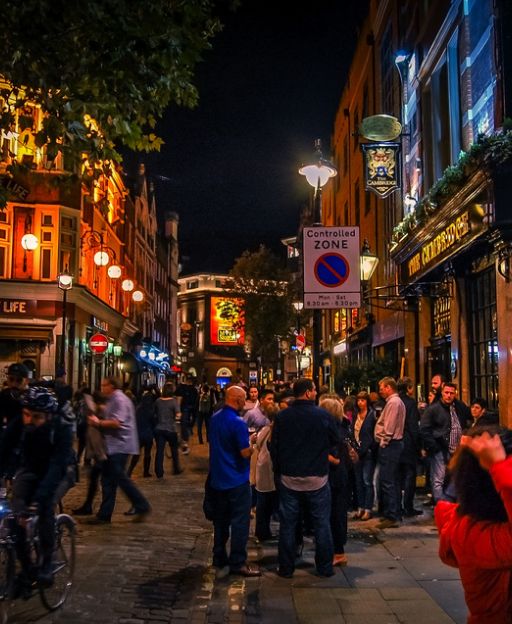
Soho covers less than a square mile. It sits between Oxford Street to the north and Leicester Square to the south, Charing Cross Road to the east and Regent Street to the west. On a map, it barely registers. On the ground, it feels like its own city.
This is the neighbourhood that has sheltered refugees, harboured artists, launched music movements, and quietly ignored the rules that the rest of London preferred to keep. For 400 years, Soho has been the square mile where outsiders go when they have nowhere else to go — and where they have always, eventually, changed something.
A Hunting Ground That Became a Neighbourhood
The name Soho is believed to come from a hunting cry. “So-Ho!” was the call riders used in the fields north of London when they spotted a hare or deer in open country.
🏙️ Love London?
3,000 London lovers get hidden history, street-level stories, and local secrets every week. Free, forever — no spam, unsubscribe any time.
Subscribe free — enter your email:
In the early 17th century, that is all this area was: pasture and woodland on the edge of a city that was still growing outward from the Thames. The fields were used for grazing, for hunting, for the kind of open space that every expanding city eventually swallows.
By 1650, London had arrived. Streets were laid out. Houses went up. The first residents were wealthy — noblemen, merchants, and gentlemen who built handsome townhouses along the new roads and considered Soho one of the finer addresses in the city.
Then, as happened so often in London’s history, the rich moved west to find something newer and quieter. They went to Mayfair, to Marylebone, to streets that had not yet been built. What they left behind became something far more interesting than it had ever been while they were there.
The Refugees Who Remade It
In 1685, King Louis XIV of France revoked the Edict of Nantes. Overnight, French Protestants — the Huguenots — lost their legal protections. Tens of thousands fled across the Channel to England.
Many of them came to Soho. They brought silk weaving, fine watchmaking, and their own traditions of cooking — traditions that would eventually shape the way London thought about food entirely. They also brought a talent for quiet, determined survival in a country that was not quite sure what to do with them.
Greek Street filled with Greek settlers. Dean Street attracted Italian immigrants. A French Protestant church opened on Soho Square. Within a generation, Soho had become London’s first genuinely cosmopolitan quarter — a place where the usual hierarchies of English society were scrambled by the simple fact that so many different people had arrived at once.
Over the next two centuries, every new wave of refugees and immigrants found their way here. Irish workers. Eastern European Jews. Chinese sailors who had come to work in the docks and stayed. Each group remade a corner of the neighbourhood in their own image. Each group was absorbed by a place that had long since learned not to ask too many questions.
Artists, Drinkers, and the Colony Room
By the 1940s, Soho had become the part of London where artists went when they could not afford anywhere else — and when they did not want to follow the rules of anywhere else.
The painter Francis Bacon could be found most afternoons at Wheeler’s seafood restaurant on Old Compton Street, working through a bottle of Chablis and arguing loudly about painting. Dylan Thomas, the Welsh poet, drifted through Soho’s pubs during his London years, perpetually broke and perpetually working on something nobody had seen yet.
The Colony Room Club on Dean Street became their home. Opened in 1948 by Muriel Belcher, it was a private drinking club with a membership fee of one pound and an entry policy that was entirely personal. If Muriel found you interesting, you were in. If she didn’t, no amount of money would change her mind.
Artists, writers, minor criminals, gamblers, and the occasional aristocrat drank together in a single smoke-filled room above a shop. The Colony Room closed in 2008 when the rent finally became impossible. But the idea it represented — that certain places should exist outside the usual sorting mechanisms of class and reputation — lived on in the neighbourhood it left behind.
The Jazz Clubs That Changed London
Through the 1950s and into the 1960s, Soho’s cramped basement clubs became the underground heart of London’s music scene. The Flamingo Club on Wardour Street played American jazz and then rhythm and blues to mixed-race audiences at a time when that was still considered genuinely remarkable in much of Britain.
American musicians who could not get bookings in more formal venues found their way to Soho instead. They played to audiences who had sought out their records and knew their work. The exchange between American jazz and the young British musicians who came to listen in those basements shaped the sound that would eventually come out of Britain in the 1960s.
The story of Ronnie Scott’s Jazz Club says more about what Soho’s music scene meant than almost anything else. Scott opened his club on Frith Street in 1959 with almost no money and an extraordinary amount of nerve. It is still there today, still playing, still drawing audiences from across the world to a narrow street in the heart of Soho.
Jazz, then R&B, then rock and roll, then punk — Soho was where new sounds arrived first, and where they found the audiences willing to hear them before the rest of the city caught up.
Old Compton Street and the Community That Claimed It
In the 1980s and 1990s, Old Compton Street became the visible centre of London’s LGBTQ+ community. Bars and cafés opened along its length. The street became a place where people could be openly themselves in public — something that was still not safe in many parts of the city.
The community that gathered here had the same quality that Soho had always attracted: people who did not fit the expected pattern, and who had found, in this particular square mile, a place that made room for them without making them explain themselves.
Old Compton Street today still carries that meaning. Some of the original bars are gone. The street has changed, as everything in Soho changes eventually. But ask anyone who walked along it for the first time, years ago, and felt something shift — they will tell you exactly what it meant.
What Soho Still Is
Soho today is more expensive than it has ever been. Rising rents have replaced workshops with offices and old pubs with coffee shops. The Colony Room is gone. The Marquee Club, where the Rolling Stones and Jimi Hendrix played, is gone. Some of the neighbourhood’s most storied corners have been smoothed into something easier to manage.
And yet Berwick Street Market still trades on Fridays and Saturdays, as it has since the 18th century. The jazz clubs still play. The restaurants on Frith Street and Dean Street still fill every night of the week. The narrow streets after dark still hold the sense that something might happen here that would not happen anywhere else in London.
A short walk west, Carnaby Street is still there — the narrow road that once dressed an entire generation and helped turn Soho into a global idea. And if you want to make the most of your time in this part of London, the complete guide to getting around London is the best place to start planning.
Soho has never been just one thing. It has always been the sum of everyone who ended up here — the refugees and the rebels, the artists and the musicians, the people who came because they had no other choice and the people who came because they knew exactly what they were choosing.
For 400 years, it has been the part of London that does not quite behave. It seems unlikely to change now.
🇬🇧 25 Hidden Gems of London Most Tourists Never Find
From secret riverside walks to hidden Victorian tunnels, centuries-old pubs to rooftop gardens with skyline views — our free guide reveals the London most visitors never discover. Join 3,000+ London lovers who get it free.
Get Your Free London Hidden Gems Guide →Love more? Join 65,000 Ireland lovers → · Join 43,000 Scotland lovers → · Join 30,000 Italy lovers →
Free forever · Unsubscribe anytime