
Most London pubs look the same from the outside. A painted sign. A chalked menu by the door. Maybe a window box with struggling geraniums.
But some pubs in this city have always had bigger ideas.
Walk into The Rabbit Hole in Streatham, and you will see exactly what we mean. It is not like any other pub in the neighbourhood. It is not like any other pub in London.
A Room That Makes No Sense — in the Best Way
The Rabbit Hole takes its name completely seriously.
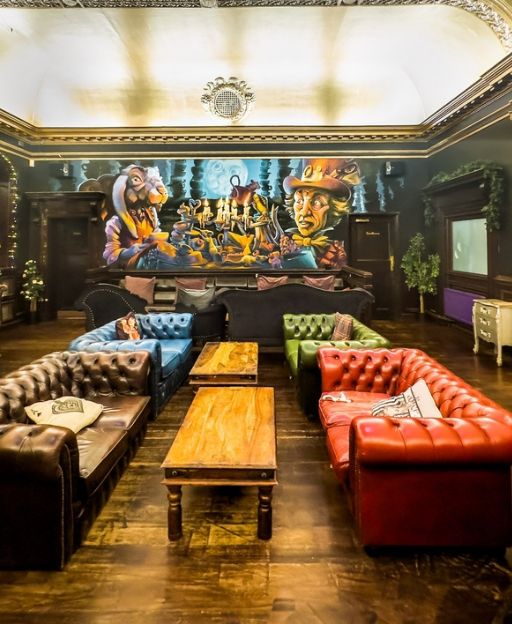
Step through the door and the ordinary world disappears behind you. Chesterfield sofas in deep red, forest green, and vivid blue fill the room in every direction. Above them, covering the entire back wall, a vast mural brings the Mad Hatter’s tea party to life — characters frozen mid-chaos in a scene that feels both familiar and faintly unhinged.
The ceiling is ornate plaster. The lighting is warm and low. Every detail is considered. The effect is less “local pub on a Tuesday night” and more “Lewis Carroll’s sitting room, if Lewis Carroll had excellent taste in furniture.”
It is, to use a completely accurate phrase, a rabbit hole.
The contrast with the street outside makes the moment of arrival all the more striking. London does this better than anywhere — ordinary doors that open onto extraordinary spaces. You pass dozens of them every day without knowing what is on the other side. This particular door leads somewhere worth remembering.
Why London Has Always Built Theatrical Pubs
The Rabbit Hole is unusual. But the instinct behind it is centuries old.
Victorian London invented what historians now call the gin palace — enormous, deliberately spectacular drinking establishments designed to stun the senses and pull people off the street. Etched glass panels. Mirrored walls that doubled the light. Gas lighting so bright the city outside seemed dim by comparison.
These spaces were theatrical by design. The people who built them understood that atmosphere was as much a part of the product as the drink itself. A plain room with cheap beer had competition. A glittering palace — even a modestly priced one — had something to offer that nowhere else could match.
That tradition never fully disappeared. Walk into almost any Victorian pub in London that has not been stripped back and modernised, and you will find carved mahogany, painted tiles, decorative ironwork, and ornamental plasterwork that craftsmen spent months completing. The Victorian pub was a piece of public architecture as much as it was a business.
The Rabbit Hole continues this tradition — with a twist borrowed from Lewis Carroll.
The English World That Carroll Created
Lewis Carroll published Alice’s Adventures in Wonderland in 1865. The book has never been out of print. Its characters — the Mad Hatter, the Queen of Hearts, the Cheshire Cat, the White Rabbit — have been part of English cultural life for more than 150 years.
Carroll wrote the book in Oxford. But the world he created has always felt specifically, unmistakably English in its sensibility. The relentless politeness masking complete chaos. The rules that make no sense but must nonetheless be obeyed. The tea parties that spiral inexorably in the wrong direction. The creatures who are simultaneously terrifying and absurd.
For all its strangeness, Wonderland reflects something real about English life — a quality that visitors often notice before locals do.
There is a reason a South London pub chose to honour this world. It fits. London is full of things that operate according to logic that no outsider can quite decode. A pub that leans into that quality is not just themed — it is making a point.
South London’s Hidden Cultural Life
Streatham does not appear in most visitor guides. It sits in the borough of Lambeth, well south of the tourist belt, far enough from Zone 1 to feel like a different city.
That is precisely its appeal.
South London has long been home to some of the most interesting, independent, and genuinely creative businesses in the capital. Brixton has its Village Market and its deep music heritage. Dulwich has its picture gallery, one of the oldest public art collections in Britain. Peckham has an emerging art scene that would make many central postcodes quietly jealous.
Streatham has Streatham Common — one of London’s more generous open spaces — and The Rabbit Hole.
For anyone who wants to understand what London feels like when it is not performing for visitors, venturing south is always worthwhile. The city changes character. The pace shifts. The streets feel less curated, more lived-in. London’s greatest pubs are rarely in its most visible places — they tend to be tucked away in corners that most people pass through without stopping.
The Rabbit Hole is a good destination after a walk on the Common, or as a reason to make the journey south in its own right. Either way, it rewards the effort.
Planning Your Visit
The Rabbit Hole is on Streatham High Road, one of the longest high streets in London. It is easily reachable by overground rail from Victoria or London Bridge, or by bus from Brixton Underground station.
The interior is photogenic enough that a quieter weekday afternoon gives you the room to take it in properly. Weekend evenings fill quickly, particularly when events are running.
It works best when you settle into it slowly. Choose a sofa. Let the murals do their work. The characters on the wall do not demand anything from you — they are just there, presiding over an ongoing tea party that has been running, on these walls, for years.
If you are building a broader London trip, our 25 Hidden Gems guide covers more of the city’s less obvious discoveries. For getting across London to reach South Streatham without guesswork, the complete London transport guide covers every option clearly.
London has more than 3,500 pubs. The extraordinary ones are there if you are willing to look past the sign and step inside.
Sometimes the door itself is the beginning of the story.
Join 3,000+ London Lovers
Every weekday morning, get London’s hidden gems, culture, and travel inspiration — straight to your inbox.
Subscribe free — enter your email:
Love more? Join 65,000 Ireland lovers → · Join 43,000 Scotland lovers → · Join 30,000 Italy lovers →
Free forever · Unsubscribe anytime