
Walk the grand streets of Kensington or Chelsea and you will notice it everywhere: a narrow gap between two stately terraces, often cobbled, often unmarked, leading away from the noise of the main road.
Step through it. What you find on the other side is one of London’s best-kept secrets — a mews street.
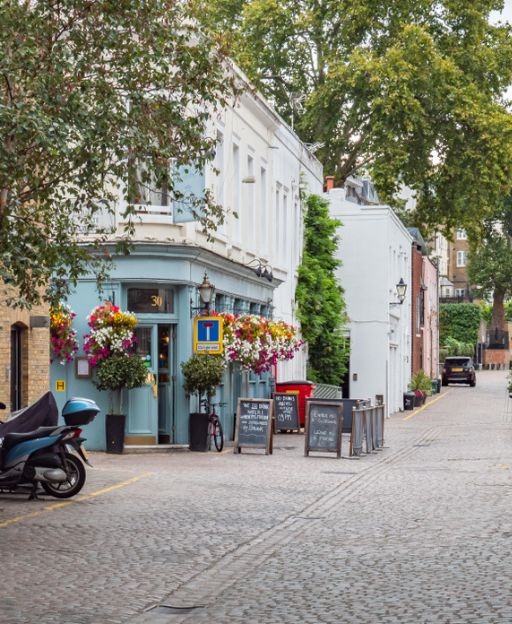
Most visitors never make the turn. They follow the maps to the broad boulevards and the familiar landmarks. But behind some of the most famous addresses in the world, London keeps a quieter version of itself — and the mews is how you find it.
What Is a Mews, and Why Does London Have So Many?
The word “mews” has an unusual origin. It comes from the Royal Mews near Charing Cross, where the king’s falcons were once kept. A “mewing” was a cage for moulting hawks — a place of enclosed, quiet purpose.
As horses replaced falcons as the city’s primary concern, the name transferred to the stable blocks. By the time London’s great Georgian and Victorian terraces were built — the cream crescents of Bayswater, the stuccoed mansions of Belgravia — every row of wealthy townhouses needed a service lane behind it.
That lane held the stables, the carriages, the coal stores, and the small apartments above where grooms and coachmen slept. It was functional, working-class, and entirely invisible from the front of the house.
By the late 19th century, as carriages gave way to motorcars, the stables became garages. By the mid-20th century, as garages gave way to home conversions, the mews became some of London’s most sought-after addresses. Today, a two-bedroom house on a Kensington mews regularly sells for over £2 million. The grooms would not recognise the place.
Those Victorian and Georgian terraces that line the grand streets are, in many ways, the front of a story — and the mews is the back of it.
What You Find When You Turn Off the Main Road
Step into a London mews today and the noise of the city softens almost immediately. The cobblestones muffle footsteps. The white-painted walls reflect light even on grey days, giving the lane an almost Mediterranean quality that feels entirely out of place in Zone 1.
Unlike the anonymous terraces facing the main streets, each mews house announces itself. A window box overflowing with geraniums. A front door painted pillar-box red. A vintage bicycle propped against a Georgian fanlight. These are homes that people have chosen to make personal, precisely because the lane gives them the privacy to do it.
Many mews streets are technically private roads — shared access for residents — but almost none are actually closed to visitors. You will rarely find a gate or a guard. London has never quite committed to the idea of “private” in an excluding sense. Walk in, walk slowly, and nobody will say a word.
The Most Beautiful Mews Streets in London
London has hundreds of mews streets, scattered across every borough. But a handful have become known even to those who seek them out.
Kynance Mews
One of the most visited mews in London, Kynance sits in the Royal Borough of Kensington and Chelsea, a short walk from the Natural History Museum. The white-painted houses, the climbing roses, and the curve of the cobblestone lane make it feel like a film set — which, in a sense, it often is. You will recognise it from dozens of London dramas. Go early on a weekday morning to have it almost to yourself.
St Luke’s Mews
Just off Westbourne Park Road in Notting Hill, St Luke’s Mews became famous as the location of the blue front door in the film Love Actually. The door has long since changed colour, but the mews retains its quiet charm. It is the kind of London that exists just behind the tourist maps — easy to find once you know where to look, invisible otherwise.
Bathurst Mews
Near Hyde Park, Bathurst Mews is one of the few in London that still functions as a working stable. The Hyde Park Stables have operated here for over 150 years, offering horses for hire into the park. You can walk the cobblestones and hear real horses — something almost impossible to experience anywhere else in Zone 1.
Leinster Mews
Near Queensway in Bayswater, Leinster Mews is quieter and less photographed than Kynance, but arguably more authentic. Many houses here still show their stable origins in the wide ground-floor doors — now converted to garages or open entrance halls, but unmistakably horse-scale in their proportions.
Enjoying this? 3,000+ London lovers get stories like this every week. Subscribe free →
The Mews Pub: A London Tradition Worth Finding
One detail that many visitors miss: London’s mews streets often contain their own pubs.
These are not grand Victorian gin palaces or polished craft beer bars. They are small, quiet, and almost entirely populated by people who live within walking distance. The Queen’s Arms on Queen’s Gate Mews in South Kensington is a perfect example. Tucked at the end of a cobblestone lane, with flower baskets spilling down its blue facade, it feels nothing like the hotel bars on Cromwell Road fifty metres away. The ceiling is low, the beer is cold, and the conversation is local.
Finding a mews pub is, in its way, the best thing you can do in London. For more of the city’s remarkable drinking history, the guide to London’s oldest pubs goes several centuries further back.
How to Find London’s Hidden Mews Streets
The trick to finding mews streets is not a map — it is attention. On any major residential street in Kensington, Chelsea, Marylebone, or Belgravia, look for the gaps between the grand terraces. Look for cobblestones beginning where the pavement ends. Look for a slight narrowing of the sky above.
The best areas to explore on foot include the streets behind Gloucester Road, the lanes off Pembridge Road in Notting Hill, and the quiet blocks between Knightsbridge and Chelsea. A morning walk through any of these areas will turn up half a dozen mews without trying.
If you are planning your first visit to London and want to build in time for the city’s quieter corners, our 3-day London itinerary for first-time visitors gives you a framework that leaves room for exactly this kind of discovery.
Frequently Asked Questions
What is a mews in London?
A mews is a row of small houses converted from former stables or coach houses. They sit behind the grand Georgian and Victorian terraces that line London’s residential streets, accessed via a narrow lane off the main road. Most were built in the 18th and 19th centuries to house horses, carriages, and the staff who managed them.
Where are the most beautiful mews streets in London?
Kynance Mews in South Kensington, St Luke’s Mews in Notting Hill, Bathurst Mews near Hyde Park, and Leinster Mews in Bayswater are among the most visited. For a less-photographed alternative, explore the mews behind Marylebone High Street or the lanes off Pembridge Road in Notting Hill.
Can visitors walk through London mews streets?
Yes. Most London mews are open to pedestrians during the day, even those designated as private roads. There are rarely gates or security. Simply walk in quietly — the cobblestones are part of the city’s informal public realm and most residents are used to visitors passing through.
Why are London mews houses so expensive?
Mews houses offer a combination of qualities that are rare in any city: a private lane, a small garden or garage, low-rise surroundings, and a village atmosphere within Zone 1 or 2 of the Underground. The contrast with the noise and scale of the surrounding streets makes them exceptionally desirable. A mews house in Kensington or Chelsea can sell for over £2 million for a two-bedroom property.
London keeps its secrets well. The mews lanes are proof of it — a whole world of quiet cobblestone streets, flower-hung doorways, and local pubs that exist just one turn off the main road, waiting for the visitors who think to look.
🇬🇧 25 London Places Most Visitors Miss
From secret riverside walks to hidden Victorian tunnels, centuries-old pubs to rooftop gardens with skyline views — our free guide reveals the London most visitors never discover. Join 3,000+ London lovers who get it free.
Get Your Free 25-Places Guide →📲 Know someone who’d love this? Share on WhatsApp →
Love more? Join 65,000 Ireland lovers → · Join 43,000 Scotland lovers → · Join 29,000+ Italy lovers →
Free forever · Unsubscribe anytime
Subscribe Free