
There is a pub in Hampstead that was already 70 years old when Shakespeare was writing his first plays. You can still sit in it. You can still order a pint. The low beams have been there for four centuries, and the garden looks out over the same heath where Dick Turpin once kept his horse.
London has a pub for what feels like every 100 metres of street. But a handful of them are different. They are not just old buildings that happen to sell beer. They are places where centuries of history have settled so deep that the walls seem to remember.
The Spaniards Inn: Four Centuries on Hampstead Heath
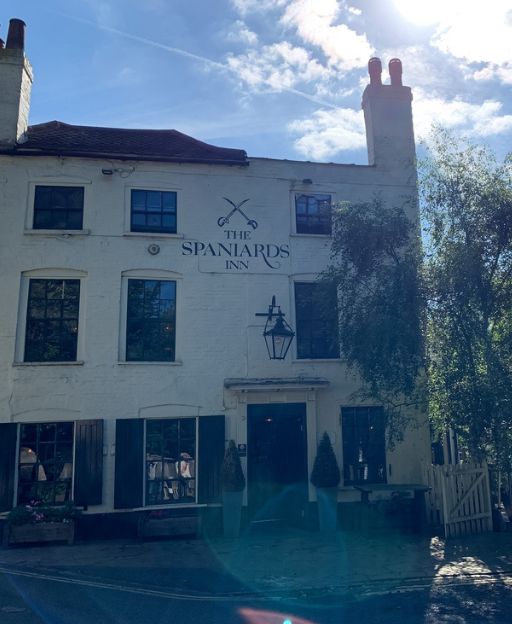
The Spaniards Inn opened in 1585, during the reign of Elizabeth I. At that point, Shakespeare had not yet written Romeo and Juliet. The Spanish Armada had not yet sailed. The inn has been serving drinks, quietly, ever since.
The building sits on Spaniards Road, between Hampstead and Highgate, at the edge of the Heath. It is low, whitewashed, and unassuming from the outside — the kind of place you might drive past without a second glance. Inside, it has all the things an old English pub should have: low ceilings, open fires, and a sense that time moves differently here.
The highwayman Dick Turpin’s father is said to have run the inn in the early 1700s. The young Dick Turpin grew up in these rooms and used the Heath as his working ground. Whether the stories are strictly true is almost beside the point — this is the kind of place where history naturally clings.
John Keats drank here. Lord Byron visited. Bram Stoker used the inn as a setting in Dracula. Charles Dickens mentioned it in The Pickwick Papers. The pub does not trade heavily on any of this. There are no laminated cards explaining the famous guests. There is the beer, the garden, and four hundred years of continued opening.
Ye Olde Cheshire Cheese: The Fleet Street Regular
Wine Office Court is a narrow alley just off Fleet Street, a few steps from where London’s newspaper industry once ran. Most people walk straight past the entrance to Ye Olde Cheshire Cheese without noticing it. That is probably how its regulars like it.
The current building was rebuilt in 1667, the year after the Great Fire swept through this part of the City. But there was a pub on this site before the fire, and probably for centuries before that. The Cheshire Cheese is the kind of place that outlasts disasters and simply carries on.
The ceilings are low. The floors are uneven. It has several bars on different levels, a labyrinthine layout that takes more than one visit to understand. There is a cellar bar that feels carved from the city itself.
Dr Samuel Johnson — the man who wrote the first great English dictionary — had a regular seat here. His house is a museum just around the corner on Gough Square. Charles Dickens wrote the place into A Tale of Two Cities. Mark Twain visited during his time in London. The Cheshire Cheese does not rush to point any of this out.
The George Inn: London’s Last Galleried Coaching Inn
On Borough High Street in Southwark, a covered gateway leads into a courtyard that has barely changed since 1677. The George Inn is the last surviving galleried coaching inn in London — a form of building that once lined this entire road.
Coaching inns were working places. Travellers heading south would stop here to change horses or spend the night before continuing their journey. The external galleries — the wooden balconies running around the upper floors of the courtyard — allowed guests to reach their rooms directly from outside, without going through the building.
The National Trust owns the George now, which is partly why it has survived while every other galleried inn on this road was demolished. When you sit in the courtyard, you are looking at carpentry from the 1670s.
Shakespeare was performing nearby, at theatres a short walk away across Bankside. Whether he ever drank at the George is unknown, but the connection feels plausible. Dickens mentioned it in Little Dorrit. The pub is still open and still serving.
Enjoying this? 3,000+ London lovers get stories like this every week. Subscribe free →
Ye Olde Mitre: The Pub Hidden in Plain Sight
Most people who walk along Hatton Garden — London’s jewellery quarter — never notice the small alley on the left called Ely Court. Those who do find Ye Olde Mitre, a pub that was founded in 1546 for the servants of the Bishop of Ely.
The bishop owned a large estate here — Ely Place — and the pub was built to serve the household staff. When the estate eventually fell away and the streets were built over, the alley and the pub simply remained. For years, Ye Olde Mitre technically fell under the jurisdiction of Cambridgeshire rather than London, an anomaly that persisted well into the modern era.
In one corner of the bar, there is a preserved cherry tree trunk. Elizabeth I is said to have danced around this tree at a summer party on the bishop’s estate, back when the area was open garden. The pub was later built around the stump.
The entrance is unmarked from the main road. There is no street frontage, no sign visible from Hatton Garden. You reach it through a passage barely wide enough for two people. On summer evenings, the bar spills into the alley and the whole space feels like it belongs to a different era entirely.
What These Pubs Have in Common
They are not museums. That is the point. You cannot visit the Spaniards Inn and simply look at it — you have to order a drink and sit down. The George Inn’s courtyard only makes sense when someone is sitting in it. The Mitre’s tiny bar is alive with conversation.
These pubs have survived because people kept using them. The Great Fire came and the Cheshire Cheese was rebuilt. The pub trade shifted away from coaching inns and the George became a curiosity. Hampstead changed from a village to a suburb and the Spaniards kept on regardless.
None of them particularly advertise their age. They leave that to visitors to discover. If you are planning a trip and want to see London’s layers rather than just its surface, our London trip planning guide covers where to stay, how to get around, and how to make the most of a few days in the city.
You might also want to read about the remarkable pub that served free beer to a mob — and saved a priceless art collection, or discover what a proper Sunday roast in London is actually supposed to look like.
What is the oldest pub in London still open today?
Ye Olde Mitre in Holborn, founded in 1546, is one of the oldest continually licensed pubs in London. The Spaniards Inn, dating from 1585, is another strong contender. Both are still open and serving regular customers.
When is the best time to visit historic London pubs?
Weekday lunchtimes are quietest. Evenings and weekends, particularly at well-known spots like the George Inn, can be very busy. If you want atmosphere without the crowds, a Tuesday or Wednesday afternoon is ideal.
Are historic London pubs worth visiting as a tourist?
Yes, genuinely. These are not tourist traps with inflated prices and staged atmosphere. The Spaniards Inn, the Cheshire Cheese, and the Mitre are all neighbourhood pubs first. The beer is ordinary. The experience is not.
How do I find Ye Olde Mitre?
Walk along Hatton Garden in the Holborn area and look for a small passageway called Ely Court on the left-hand side, just before Ely Place. The entrance is easy to miss. Once you are through the passage, the pub is immediately in front of you.
London keeps adding layers. Glass towers go up, new areas become fashionable, old industries disappear. But underneath it all, the Spaniards Inn still has its low beams. The George still has its courtyard. The Mitre still has its alley. Go looking for them. Most of the city walks past without ever knowing they are there.
🇬🇧 25 Hidden Gems of London Most Tourists Never Find
From secret riverside walks to hidden Victorian tunnels, centuries-old pubs to rooftop gardens with skyline views — our free guide reveals the London most visitors never discover. Join 3,000+ London lovers who get it free.
Get Your Free London Hidden Gems Guide →📲 Know someone who’d love this? Share on WhatsApp →
Love more? Join 65,000 Ireland lovers → · Join 43,000 Scotland lovers → · Join 29,000+ Italy lovers →
Free forever · Unsubscribe anytime
Subscribe Free