
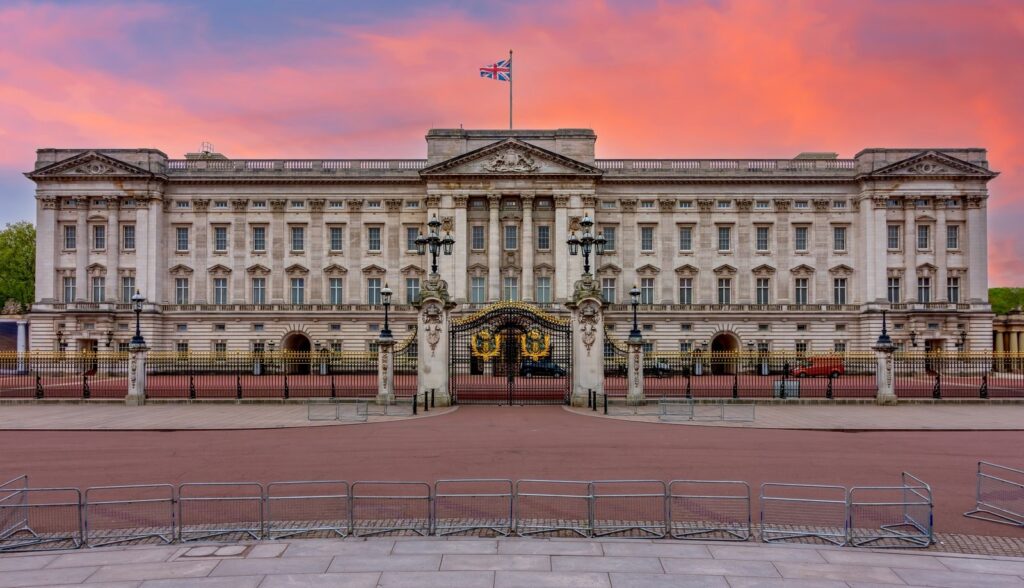
Buckingham Palace stands at the end of The Mall like it has always been there. Most visitors assume it has anchored British royal life for centuries — a permanent fixture, as inevitable as the Union Jack above its roof.
The truth is stranger, more complicated, and far more interesting.
The palace was built for a duke. Rejected by two kings. Offered to Parliament as a makeshift replacement building after a fire. And finally moved into — reluctantly — only when an 18-year-old queen ran out of patience with her childhood home.
Built for a Duke, Not a King
The story begins in 1703, when John Sheffield, Duke of Buckingham and Normanby, built a grand townhouse at the far end of St James’s Park. He called it Buckingham House.
It wasn’t a royal commission. It was a private residence. But it was imposing enough to catch royal eyes almost immediately.
Queen Anne reportedly admired the view of the house from across the park. It occupied a prime position — private enough for a family, grand enough to impress foreign dignitaries. Sheffield had accidentally created something that would define London’s skyline for three centuries.
When Sheffield died, his estate sold the property. In 1761, George III snapped it up — but not, as you might expect, to house the monarchy’s official state functions.
The King Who Bought It as a Family Home
George III purchased Buckingham House as a private family retreat for his wife, Queen Charlotte. They renamed it “The Queen’s House.” It was domestic, comfortable, and entirely separate from the formal ceremonies at St James’s Palace across the park.
Fourteen of their fifteen children were born here. The family spent happy years in its relatively modest rooms — by royal standards, at least.
George had no intention of making it the nation’s official royal residence. The same king spent years retreating to Kew Palace when London felt too much — a habit that tells you everything about how he thought of the city’s grand buildings.
The idea of Buckingham Palace as a formal seat of royal power wouldn’t surface for another sixty years.
The Redesign That Spiralled Out of Control
When George IV came to the throne, he wanted something grander. In 1821, he commissioned the architect John Nash — fresh from redesigning Regent Street — to transform the modest Queen’s House into a proper royal palace.
What followed was one of the biggest cost overruns in British architectural history.
The original estimate was £200,000. By the time the scaffolding came down, the bill had exceeded £700,000 — the equivalent of tens of millions in today’s money. Parliament was furious. A Select Committee investigation found the spending had been wildly mismanaged.
Nash was dismissed for “gross neglect and irregularity.” He never worked for the Crown again.
George IV died in 1830 before the renovations were complete. He never spent a single night in the finished palace.
Enjoying this? 3,000+ London lovers get stories like this every week. Subscribe free →
The King Who Refused to Move In
George’s brother, William IV, inherited the throne in 1830 — and the unfinished palace along with it. He wanted nothing to do with either.
When the Houses of Parliament burned down in 1834, William offered Buckingham Palace to Parliament as a replacement building. Publicly. Twice.
Parliament declined. They commissioned a new building on the same riverside site — what became the Houses of Parliament that still stand today.
Buckingham Palace sat largely empty, barely furnished, with the east wing still missing and no famous balcony in sight. For a building that would become the defining symbol of the British monarchy, it had a remarkably undignified start.
The Teenager Who Finally Moved In
Victoria became queen on 20 June 1837 at the age of eighteen. Three weeks later, she moved into Buckingham Palace.
She did it partly to escape Kensington Palace, where her claustrophobic childhood under her mother’s strict regime had left her desperate for independence. Partly because a queen ought to live in a palace. And partly, perhaps, because she was finally free to make her own decisions.
Victoria was the first monarch to officially use Buckingham Palace as the sovereign’s primary London residence. She redefined it entirely — filling its rooms, hosting state banquets, and giving it a purpose it had never really had before.
In 1851, the east wing was added, enclosing the central courtyard and creating the famous façade that faces The Mall. With it came the balcony — the one that has since hosted every royal wave, every VE Day celebration, every championship homecoming and royal wedding in modern British memory.
None of that balcony existed before Victoria. She made it all happen — a teenager who inherited a half-finished building that two kings had rejected, and turned it into the heart of the nation.
What You Can Actually See Today
Buckingham Palace opens its State Rooms to visitors every summer, usually from late July through September. The 19 State Rooms include the Throne Room, the White Drawing Room, and the Grand Staircase — the same spaces used for state occasions and royal receptions throughout the year.
The Royal Mews is open year-round and houses the royal horses, historic carriages, and the cars used for state occasions. It is one of the most underrated visits in central London.
The King’s Gallery (formerly the Queen’s Gallery) displays rotating exhibitions from the Royal Collection — one of the largest and most valuable art collections in the world.
And the Changing of the Guard is free — no ticket, no booking. It takes place on the palace forecourt and is one of those London traditions that never loses its pull, however many times you’ve seen it.
If you’re planning a full day around royal London, a visit to Hampton Court Palace makes a superb follow-up — another royal residence with a story that stretches back to Henry VIII, and with far fewer crowds than the palace on The Mall.
For help building your London itinerary around visits like this, the 3-day London itinerary has all the planning guidance you need.
Frequently Asked Questions
When can you visit inside Buckingham Palace?
The State Rooms open to the public each summer, typically from late July through late September. Tickets must be booked in advance and sell out quickly. The Royal Mews and King’s Gallery are open year-round with more flexibility on tickets.
How many rooms does Buckingham Palace have?
Buckingham Palace has 775 rooms in total, including 19 State Rooms, 52 royal and guest bedrooms, 188 staff bedrooms, 92 offices, and 78 bathrooms. It also has its own post office, swimming pool, doctor’s surgery, and staff bar.
Is the Changing of the Guard worth seeing?
Yes — and it is entirely free. The ceremony typically takes place at 11am at the palace forecourt, though the schedule varies by season and is sometimes cancelled at short notice. Arrive 30 minutes early for a good view. Check the official schedule online before you go.
How long should you spend at Buckingham Palace?
If you’re viewing the exterior and watching the Changing of the Guard, allow around two hours. If you’re visiting the State Rooms, plan for two to three hours inside. Add another hour each for the Royal Mews and King’s Gallery if you’re visiting those separately.
🇬🇧 25 London Places Most Visitors Miss
From secret riverside walks to hidden Victorian tunnels, centuries-old pubs to rooftop gardens with skyline views — our free guide reveals the London most visitors never discover. Join 3,000+ London lovers who get it free.
Get Your Free 25-Places Guide →📲 Know someone who’d love this? Share on WhatsApp →
Free forever · Unsubscribe anytime
Subscribe Free