
In the early hours of Sunday, 2 September 1666, a fire broke out at a bakery on Pudding Lane in the City of London. By the time the flames finally died out four days later, more than 13,000 houses had been destroyed, 87 churches had burned to their foundations, and the medieval city that had stood for centuries was gone.
What those four days produced was something unexpected: a new London, shaped by a visionary architect named Christopher Wren, and defined by buildings that still stand today.
If you want to understand London at its most dramatic, the story of the Great Fire is essential. And you can still walk the ground where it happened, and stand inside buildings Wren designed to replace what was lost.
How a Bakery on Pudding Lane Burned Down a City
The fire began in the small hours of Sunday morning at the bakery of Thomas Farynor, the King’s baker, on Pudding Lane near London Bridge. The exact cause has never been firmly established, but the most likely explanation is that the baking ovens were not properly extinguished the night before.
Farynor, his family, and a maid escaped through an upstairs window. A servant who refused to leave became one of the fire’s first victims.
Within hours, the flames had spread to a nearby inn, then to Thames Street, where warehouses were packed with flammable goods: tallow, oil, coal, and rope. The summer of 1666 had been exceptionally dry, and a strong east wind was blowing. The fire moved faster than any firefighting effort could contain it.
Samuel Pepys, the civil servant and diarist who would become the most celebrated eyewitness to the disaster, climbed onto the roof of his house and saw “a lamentable fire.” He walked through the city, recording what he observed with the kind of detail that makes his diary one of the most vivid primary sources in English history.
A City Built to Burn
To understand how the fire could consume so much so quickly, you need to understand what medieval London looked like.
The city was packed with timber-framed houses — some five or six stories tall — leaning out over narrow lanes so that upper floors almost touched the buildings opposite. In summer, the wood was bone dry. The lanes between them were barely wide enough for a cart.
Water was scarce. Leather buckets, fire hooks, and hand pumps were the main tools available. Fire breaks — created by pulling down buildings in the path of the flames — required a royal order to implement. By the time King Charles II authorised the use of gunpowder to blast firebreaks, the wind had done most of the damage.
The fire burned for four days. By 6 September, it was effectively out, helped at last by a change in the wind and the efforts of firefighters working through the night.
🏙️ Enjoying this? 3,000 London lovers get stories like this every week. Subscribe free →
What Was Lost — and What Survived
The numbers are staggering. The fire destroyed approximately 13,200 houses across 373 acres of the City of London. Eighty-seven churches burned. The old St Paul’s Cathedral, a medieval structure dating to the 11th century, collapsed entirely. The Royal Exchange, the hub of London’s commercial life, was gone.
Despite the scale of the destruction, the death toll was surprisingly low. Only six deaths were officially recorded. Historians believe the true figure was likely higher — not all deaths would have been documented — but the population had time to flee, and most escaped with their lives if not their homes.
For those tracing London family history, the fire is a significant event to understand. It destroyed a great deal, but many parish records survived either because their churches escaped or because registers had been taken elsewhere for safekeeping. The London Metropolitan Archives holds a remarkable collection of pre-fire records, and many are now available online through genealogy platforms.
Christopher Wren and the New London
Within days of the fire being extinguished, Christopher Wren had already submitted a plan for rebuilding the city. So had John Evelyn, another diarist and contemporary. Neither plan was adopted in full — the pressure to rebuild quickly, and the complexity of establishing land ownership, made wholesale redesign impractical.
But the results were remarkable. New building regulations banned timber-framed overhanging construction. Streets were widened. Buildings had to be of stone or brick. And Wren was given the task of rebuilding 51 London churches — a commission that would occupy the rest of his professional life.
His masterpiece was the new St Paul’s Cathedral, whose dome has defined the London skyline for more than 300 years. He also rebuilt a series of smaller churches throughout the City, each with its own distinctive character. Several survive today and are well worth visiting.
Walking the Great Fire Heritage Trail Today
You can trace the fire’s path through the modern City of London in a single afternoon. Here are the key sites, each within easy walking distance of the others.
The Monument
The Monument to the Great Fire of London stands 202 feet tall — exactly the distance from its base to the site of Farynor’s bakery on Pudding Lane where the fire began. Designed by Wren and Robert Hooke, it was completed in 1677. You can climb the 311 steps to the top for views across the City of London. It remains one of the tallest isolated stone columns in the world.
The Monument is at Monument Street, EC3R 8AH. Admission is £6 for adults. Monument Underground station is a short walk away.
St Paul’s Cathedral
The cathedral you see today is entirely Wren’s creation, completed in 1710. The old St Paul’s burned to a shell in the fire — the lead on its roof melted and ran in streams down the surrounding streets. Wren’s replacement took 35 years to build and stands as one of the finest examples of English Baroque architecture anywhere in the world.
American visitors often appreciate that St Paul’s has strong connections to the United States. The American Memorial Chapel inside commemorates the 28,000 Americans who died in the Second World War while stationed in Britain. It is one of the most moving spaces in London.
St Dunstan-in-the-East
This is the hidden gem of the Great Fire heritage trail — and one of the most photographed locations in London that most visitors never hear about.
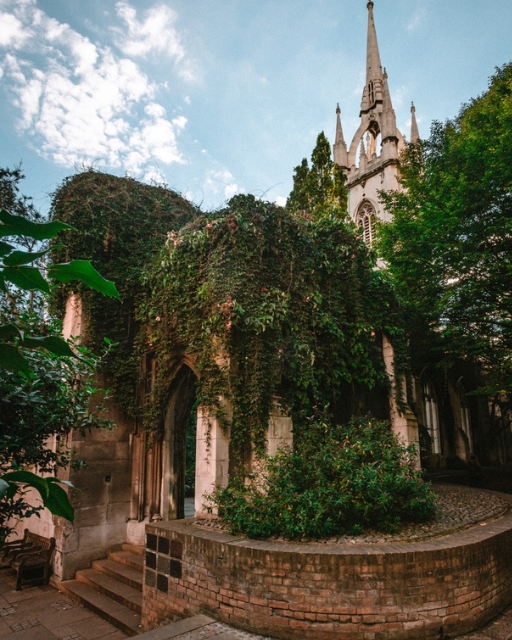
St Dunstan-in-the-East is a medieval church that was partially damaged in the Great Fire and then partially rebuilt by Wren. It was badly damaged again during the Blitz in 1941 and was never fully restored. Instead, the City of London transformed it into a public garden in 1967.
Today, the stone ruins are draped in ivy and climbing plants. A Gothic tower — the Wren-designed steeple — rises above the greenery. In summer, it is a quiet refuge in the middle of one of the world’s busiest financial districts, popular with office workers eating lunch and tourists who stumble across it by accident.
There is no admission charge and it is open daily. Find it at St Dunstan’s Hill, EC3R 5DD, a short walk from Monument station.
Pudding Lane
Pudding Lane today is a short, unremarkable City lane with little to see beyond modern office buildings. But a plaque marks the approximate site of Farynor’s bakery, and it is worth the brief detour to stand where the whole thing began. The lane runs between Monument Street and Eastcheap, a few minutes’ walk from the Monument itself.
The Guildhall
The Guildhall, on Gresham Street in the City of London, dates to the early 15th century and is one of the few buildings to have survived the Great Fire largely intact. Its great hall was damaged but not destroyed. The site has served as the civic centre of the City for more than 800 years. The Guildhall is open to visitors free of charge when not in use for official events.
Planning Your Great Fire Heritage Walk
The walk from Pudding Lane to the Monument to St Dunstan-in-the-East takes about 25 minutes at a gentle pace. Add St Paul’s Cathedral and the Guildhall and you have a full half-day of history in a compact area that is entirely walkable.
All the sites are in the Square Mile, the historic core of the City of London. Monument is the nearest Underground station for the starting point. St Paul’s station is closest to the cathedral. The best time to visit is during the working week when the buildings are more likely to be open, though St Dunstan-in-the-East and the Monument are accessible at weekends too.
The City is noticeably quieter at weekends, which makes the heritage walk more peaceful — a rare chance to have the financial heart of London almost to yourself.
Frequently Asked Questions About the Great Fire of London
When did the Great Fire of London happen?
The Great Fire of London began on 2 September 1666 and burned for four days, finally coming under control on 6 September 1666. It started in the early hours of Sunday morning at a bakery on Pudding Lane in the City of London.
How many houses did the Great Fire of London destroy?
The Great Fire destroyed approximately 13,200 houses and 87 churches across 373 acres of the City of London. The old St Paul’s Cathedral, the Royal Exchange, and most of the medieval city were also destroyed. The fire left an estimated 70,000 people homeless in a city of around 80,000.
What caused the Great Fire of London?
The fire started at the bakery of Thomas Farynor on Pudding Lane. The most likely cause is that ovens were not properly extinguished the night before. The fire spread rapidly because of exceptionally dry conditions after a long summer drought, a strong east wind, and the tightly packed timber buildings of medieval London.
How many people died in the Great Fire of London?
Only six deaths were officially recorded during the Great Fire of London. Historians believe the true number was likely higher, as deaths among the poorest Londoners would not always have been documented. Despite the enormous scale of the destruction, most people had time to flee, and the majority escaped with their lives.
Join 3,000+ London Lovers
Every week, get London’s hidden history, heritage walks, and stories from the city’s remarkable past — straight to your inbox.
Subscribe free — enter your email:
Already subscribed? Download your free London guide (PDF)
Love more? Join 64,000 Ireland lovers → · Join 43,000 Scotland lovers → · Join 30,000 Italy lovers →
Free forever · One email per week · Unsubscribe anytime
