
Most people visit Tower Bridge once, take a photograph from the South Bank, and move on. They see the towers, admire the view, and never wonder what is inside. But suspended 42 metres above the Thames, there is a glass floor that most visitors have no idea exists. And that is just the beginning.
When the Bridge Was Built, London Held Its Breath
Construction of Tower Bridge began in 1886 and took eight years to complete. Over 400 workers built it. Five died during the process. When it finally opened in June 1894, crowds lined both banks of the Thames to watch the bascules rise for the first time. The Prince and Princess of Wales were among those present.
🏙️ Love London?
3,000 London lovers get hidden history, street-level stories, and local secrets every week. Free, forever — no spam, unsubscribe any time.
Subscribe free — enter your email:
The brief from the City of London was complex. The bridge had to open regularly for tall ships sailing upriver to the Pool of London. It also had to look like it belonged alongside the medieval Tower of London, which stood just a stone’s throw away. What emerged was something unique — a working bascule bridge dressed up as a Gothic castle.
The towers were steel-framed, not stone. The Gothic stonework was added purely for appearance. Inside those decorative walls was an entirely different world — one that most of the 40 million people who cross Tower Bridge every year never think to explore.
The High-Level Walkways Nobody Used
When Tower Bridge opened, two high-level walkways were built to connect the tops of the towers at a height of 42 metres. The idea was straightforward. When the bascules were raised to let ships through, pedestrians would be able to cross using the walkways above, rather than waiting on the bank for the bridge to close again.
In practice, almost nobody used them. The staircases were steep and the climb was tiring. Most Londoners preferred to wait the few minutes until the bridge closed, rather than make the effort. The walkways gradually developed a reputation as a haunt for pickpockets. By 1910, just sixteen years after the bridge opened, they were closed to the public altogether.
They remained unused for most of the twentieth century — two glass-enclosed corridors sitting empty above one of the world’s most famous rivers, unseen by almost everyone who crossed below them.
The Glass Floor That Stops People in Their Tracks
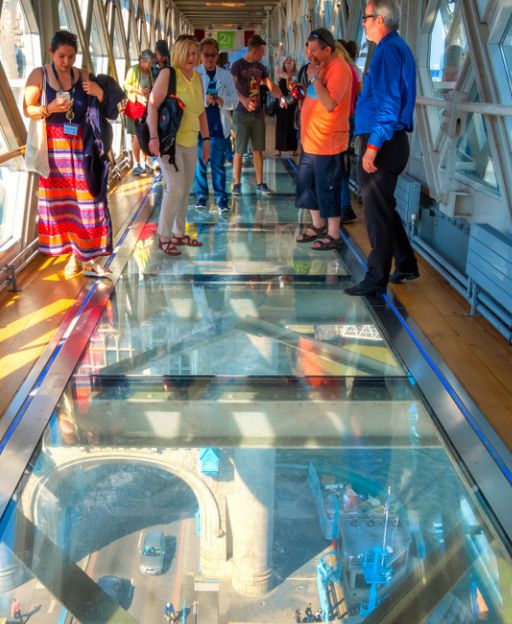
The walkways reopened as part of the Tower Bridge Exhibition in 1982. But the real transformation came in 2014, when a major upgrade introduced something that has been stopping visitors in their tracks ever since — a glass floor running along the full length of both walkways.
The panels are 11 millimetres thick and completely transparent. Stand on them, and you are looking straight down through 42 metres of open air at the road below. On days when the bascules are raised to let a tall ship through, you are looking down at the river itself, with boats moving beneath your feet.
People react very differently. Some stride straight across without hesitation. Others inch forward, gripping the handrail until their knuckles go white. A few people look down once, take a sharp breath, and decide the regular floor beside the glass is perfectly adequate. Almost everyone remembers the experience for years. If you are planning a trip to London, this is one of those things worth building your day around — you can find everything you need at our London planning guide.
The Victorian Engine Rooms Below
Most visitors spend all their time on the walkways and overlook the Victorian Engine Rooms, which sit on the south side of the bridge at river level. This is a significant oversight.
The original steam-powered hydraulic engines that operated the bascules are still here. They were replaced by oil and electric motors in 1976, but the Victorian machinery was kept in working order and is now on permanent display. Two enormous accumulator towers. Large coal-fired boilers. Intricate pipework running in all directions. The whole thing looks like something from a Jules Verne novel — which is not far off, given the era it was built.
The engineering story is just as compelling as the architectural one. At peak operation, the bridge could raise its bascules in under two minutes. The hydraulic system was considered one of the finest in the world. The men who designed it are largely forgotten today, but the machines they built are still standing. The Thames has a long history of remarkable engineering — if you enjoy that side of London, the story of London’s frost fairs reveals another side of the river’s past.
What to Expect When You Visit
The Tower Bridge Exhibition covers both the high-level walkways and the Victorian Engine Rooms. There is an admission charge, and tickets can be booked online in advance — worth doing in summer, when queues at the entrance can be long. The walkways are enclosed and glazed, so the experience works well in any weather.
Tower Bridge still opens for river traffic around 1,000 times a year. The opening schedule is published on the Tower Bridge website, and if you time your visit to coincide with a lifting, you can watch the bascules rise from directly above. It is a different experience altogether from watching it from the riverbank.
A visit takes roughly 90 minutes if you include the engine rooms. The views from the walkways — upstream towards the City and Canary Wharf, downstream towards Greenwich — are among the finest in London. At dusk, the light on the river is extraordinary. On a clear winter morning, mist lifting off the Thames can make the whole thing feel genuinely cinematic.
The Bridge That Keeps Surprising People
Tower Bridge is one of the most photographed structures in Britain. Millions of people see it every year. But almost all of them see only the outside — the towers, the bascules, the flags. The glass floor above the river, the Victorian engines below, the history written into every piece of metalwork — that belongs to the people who decide to go inside.
London rewards curiosity. Tower Bridge is one of the clearest examples of that. The outside is famous. The inside is something else entirely.
🇬🇧 25 Hidden Gems of London Most Tourists Never Find
From secret riverside walks to hidden Victorian tunnels, centuries-old pubs to rooftop gardens with skyline views — our free guide reveals the London most visitors never discover. Join 3,000+ London lovers who get it free.
Get Your Free London Hidden Gems Guide →Love more? Join 65,000 Ireland lovers → · Join 43,000 Scotland lovers → · Join 30,000 Italy lovers →
Free forever · Unsubscribe anytime
